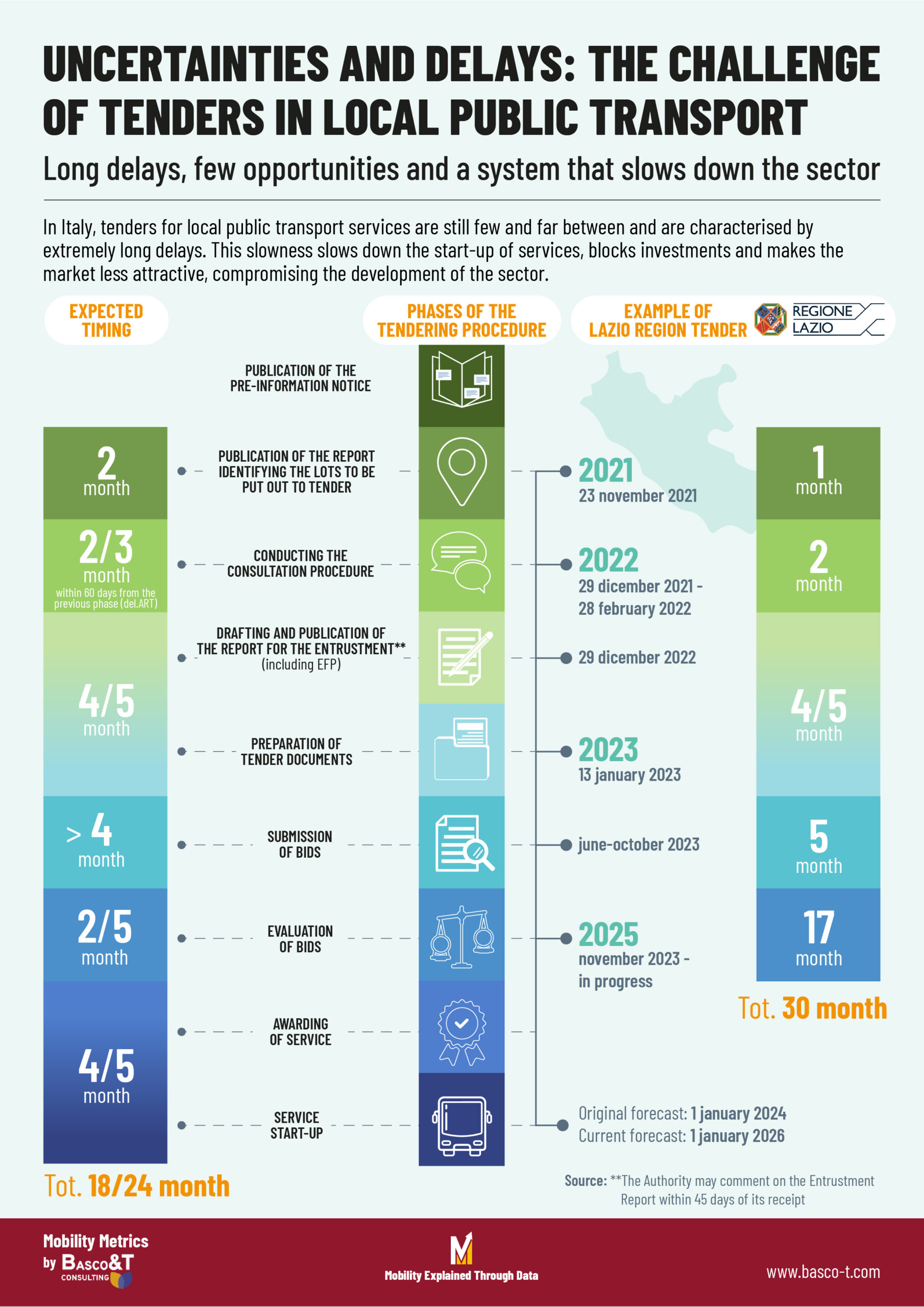
In Italy, tenders for local public transport services are still few and far between and are characterised by extremely long delays. This slowness slows down the start-up of services, blocks investments and makes the market less attractive, compromising the development of the sector.
Share on:
Public tenders for the award of local public transport services are, according to European Regulation 1370/2007, the ordinary instrument for regulating the sector. However, in Italy this model is struggling to be consolidated.
The picture that emerges is that of a fragmented system, where realities coexist that have decisively set out on the path of tenders and others that remain tied to extensions, direct assignments, or situations of blockage.
In the last few years, the races have actually completed and operational, are very few. It is also confirmed by the last Report on the Mobility of the Italianspublished by ISFORT in December 2023according to many regions have preferred to maintain the existing structures. The basis of this choice, there are often a lack of technical facilities adequate and the fear of litigation.
The phases of the tendering process in public transport
A tendering procedure for the award of LPT services by road is generally developed through the following phases:
- Publication of the pre-information notice
- Publication of the report identifying the lots to be put out to tender
- Conducting the consultation procedure
- Drafting and publication of the Report for the Assignment (including EFP)
- Preparation of tender documents
- Submission of bids
- Evaluation of bids
- Awarding of service
- Service start-up
The resolution of the Authority of Regulation of Transportation (ART) no. 154/2019in continuity with the no. 48/2017, defines some of the essential elements of the process: the consultation should be initiated within 60 days from the publication of the lots; the Authority may express comments on Report for the award within 45 days of its receipt. the minimum time limit for the presentation of offers must be at least 110 days from the publication of the notice.
For the other phases, however, no specific deadlines are set, leaving ample room for defining the actual timeframe.In general, the process should last approximately 14-16 months and in any case not more than two years.
It should also be borne in mind that once the service has been awarded, participating companies have approximately 30 days to lodge any appeals with the TAR. The outcome of these proceedings can take up to over a year, further affecting the start-up time.
The case of the Region of Lazio: the procedure is still in progress since 2023
An emblematic example of the length of the timeframe is represented by the tender launched by the Lazio Region for the procedure of entrusting the LPT road service of 11 lots (excluding the interurban service of the city of Rome). Below are the main time steps:
- November 2021: with Regional Decree no. 801/2021, the Lazio Region formally initiates the tender process, entrusting ASTRAL S.p.A. with the management of the procedure.
- December 29, 2021 – February 28, 2022takes place on the public consultation period relating to the proposed joint in 11 lots, corresponding to the Network Drive (UdR) identified.
- December 29, 2022is approved the Report for the award with the decision of the regional Council no. 1253.
- 13 January 2023: the call for tenders is published.
- June - October 2023: the deadline for submitting bids, initially scheduled for June, is first slipped to July, then finally set for 16 October.
- September – November 2023September is established, the commission, with work expected to start from the 18th of October, then returned to the beginning of November.
- 31 January 2025: According to the latest available update, the evaluation of bids is still ongoing.
The announcement included the launch of the new service January 1, 2024but in the four years since the start of the path (2021), and two years after the publication of it (2023), the procedure is still in the stage of preliminary assessment. Currently, the forecast for the start of the service, subject to further slippages, are scheduled for 1 January 2026.
The case of Lazio clearly highlights two central critical issues: the scarcity of tenders and the excessive duration of the processes. Such long delays, particularly between the award and the actual start of the service, risk rendering obsolete the economic, technical and operational assumptions on which the tender was built.
Effects of delays in tendering procedures
Long waits in the tendering process prevent indispensable investments in rolling stock, thus holding back the development and quality of the service. In addition, the uncertainty and slowness of the process reduce the attractiveness of the market, making it less competitive and less attractive to operators and investors, discouraging their participation.
For more on the topic of bidding in LPT, read also: Frameworking the LPT sector in Italy: the key role of M&A ahead of the 2026 tenders and How much is a public transport company really worth?