The analysis, based on data collected by Holacheck in 2025 during on-the-ground inspection and verification activities, provides a detailed picture of fare evasion, highlighting that the phenomenon cannot be attributed to a single profile but exhibits different characteristics depending on age, gender and nationality. The evidence gathered suggests that more targeted strategies to combat fare evasion should be adopted, through prevention campaigns, checks tailored to different contexts and more effective recovery procedures. Understanding the profile of passengers who have been fined is a useful tool for comprehending the phenomenon and supporting transport companies in improving the effectiveness of their prevention, enforcement and collection activities.
Share on:
The analysis provides an accurate picture of the demographic and behavioural profile of passengers fined on local public transport (LPT). A sample of operators was selected, drawn from a variety of contexts (high-density urban areas, suburban networks, metropolitan services, tramways and funiculars) across the whole of the country. The sample relates to the year 2025. The data used in the analysis are based on on-site inspections and audits carried out by Holacheck. The uniform distribution of the companies in the sample allows the observed behaviours to be considered as predictive clusters for statistical purposes, enabling projections to be made on a national scale.
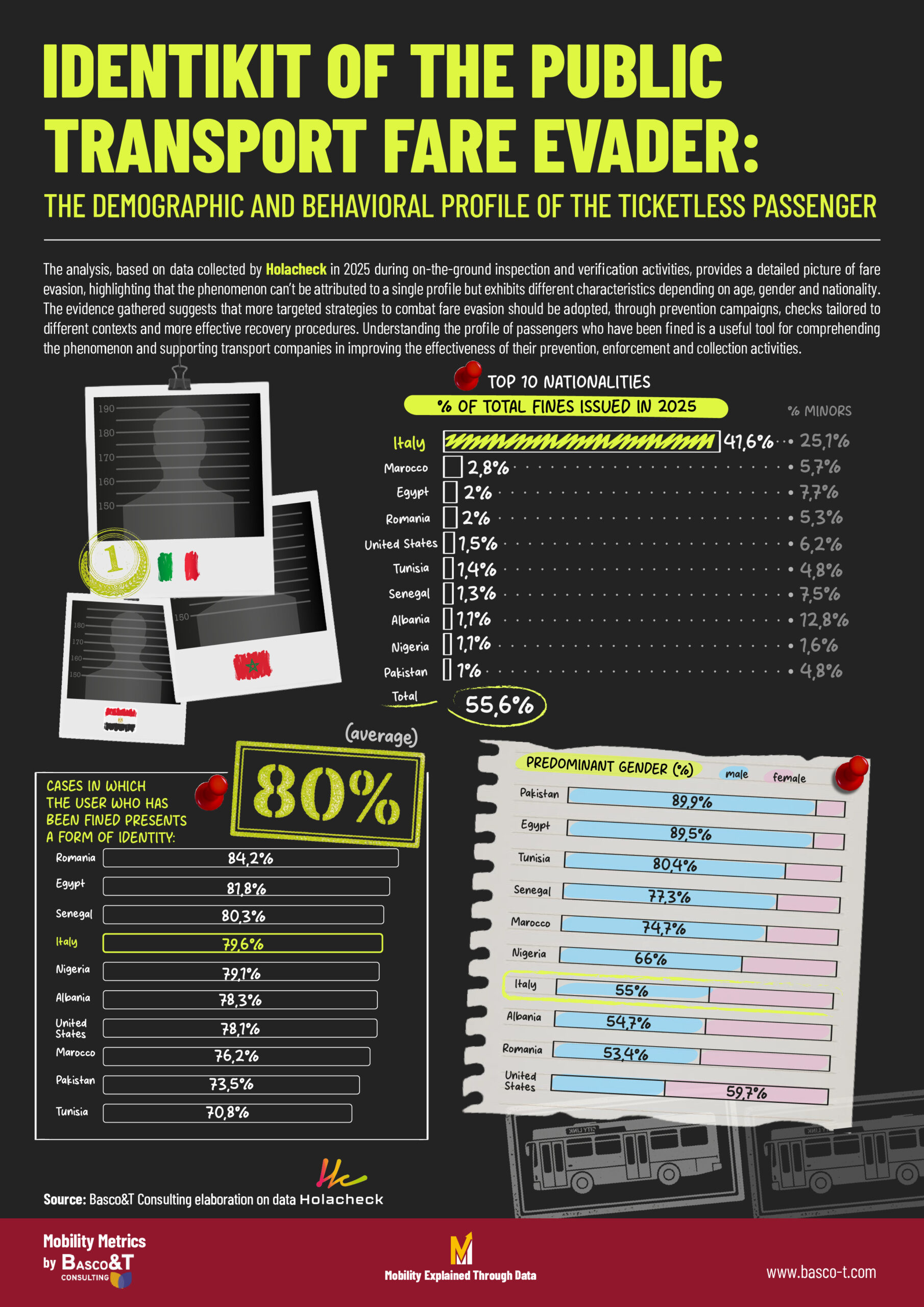
Based on a representative sample of 822,000 reports, the top 10 nationalities alone account for 55.6 per cent of the total, with Italian nationals representing the largest single group (42.97 per cent of the total). Analysis by gender reveals a clear male predominance in almost all clusters, with peaks of nearly 90 per cent men among citizens originally from Pakistan and Egypt.
Minors Fined
| Nazionalità | % minorenni |
| EGITTO | 7.7 |
| SENEGAL | 7.5 |
| STATI UNITI | 6.2 |
| MAROCCO | 5.7 |
| ROMANIA | 5.3 |
| TUNISIA | 4.8 |
| PAKISTAN | 4.8 |
| ITALIA | 25.0 |
| ALBANIA | 12.8 |
| NIGERIA | 1.6 |
The analysis reveals a finding of great sociological significance: the proportion of minors fined is particularly high amongst Italian citizens, affecting one in four passengers (25 per cent). This figure falls significantly below 10 per cent for almost all other nationalities, with the exception of the Albanian community, which records 12.5 per cent of fines issued to minors.
Predominant Gender
| Nazionalità | Sesso | % prevalenza | % con documento |
| PAKISTAN | M | 89.9% | 73.5 |
| EGITTO | M | 89.5% | 81.8 |
| TUNISIA | M | 80.4% | 70.8 |
| SENEGAL | M | 77.3% | 80.3 |
| MAROCCO | M | 74.7% | 76.2 |
| NIGERIA | M | 66.0% | 79.1 |
| STATI UNITI | F | 59.7% | 78.1 |
| ITALIA | M | 55.0% | 79.6 |
| ALBANIA | M | 54.7% | 78.3 |
| ROMANIA | M | 53.4% | 84.2 |
The gender profile reveals a systematic imbalance. With the exception of the cluster comprising US citizens, where women are in the majority (F 60.1%), sanctioned tariff evasion is a phenomenon predominantly involving men.
At the same time, Holacheck’s fieldwork disproves the myth of the anonymous ‘ghost’ evader: in around 80 per cent of cases, the person fined presents a valid identity document to the inspectors, enabling their details to be recorded correctly..
The highest proportions of men are found in the Pakistani (89.9 per cent) and Egyptian (89.5 per cent) communities. By contrast, communities of European origin (Italian, Romanian and Albanian) show a much more balanced gender distribution, close to 50 per cent. The rate of document possession at the time of the penalty fluctuates steadily between 70.8 per cent (Tunisia) and 84.2 per cent (Romania), providing an excellent demographic basis for subsequent recovery measures.
Conclusion
The analysis reveals a much more nuanced profile of fare evaders than is commonly assumed. The phenomenon cannot be attributed to a single demographic group, but exhibits different characteristics depending on nationality, age and gender. Italian nationals make up the largest proportion of passengers fined, and there is a particularly high proportion of minors among them.
Equally significant is the data relating to identification: around four out of five users fined present a valid document at the time of the check. Offenders whose identity cannot be established therefore represent a minority compared to a predominantly identifiable group which, at least in theory, can be reached by subsequent collection procedures.
The evidence gathered points to the need to move beyond a one-size-fits-all approach to enforcement. Prevention campaigns targeting young people, checks tailored to different local contexts, and more effective recovery procedures can help make enforcement efforts more targeted. Understanding the profile of passengers who have been fined does not mean attributing behaviour to entire communities, but rather providing transport operators with more precise tools to understand the phenomenon, prevent fare evasion and improve their ability to collect fares.
The analysis therefore provides key strategic guidance for planning measures to combat tax evasion at national level.