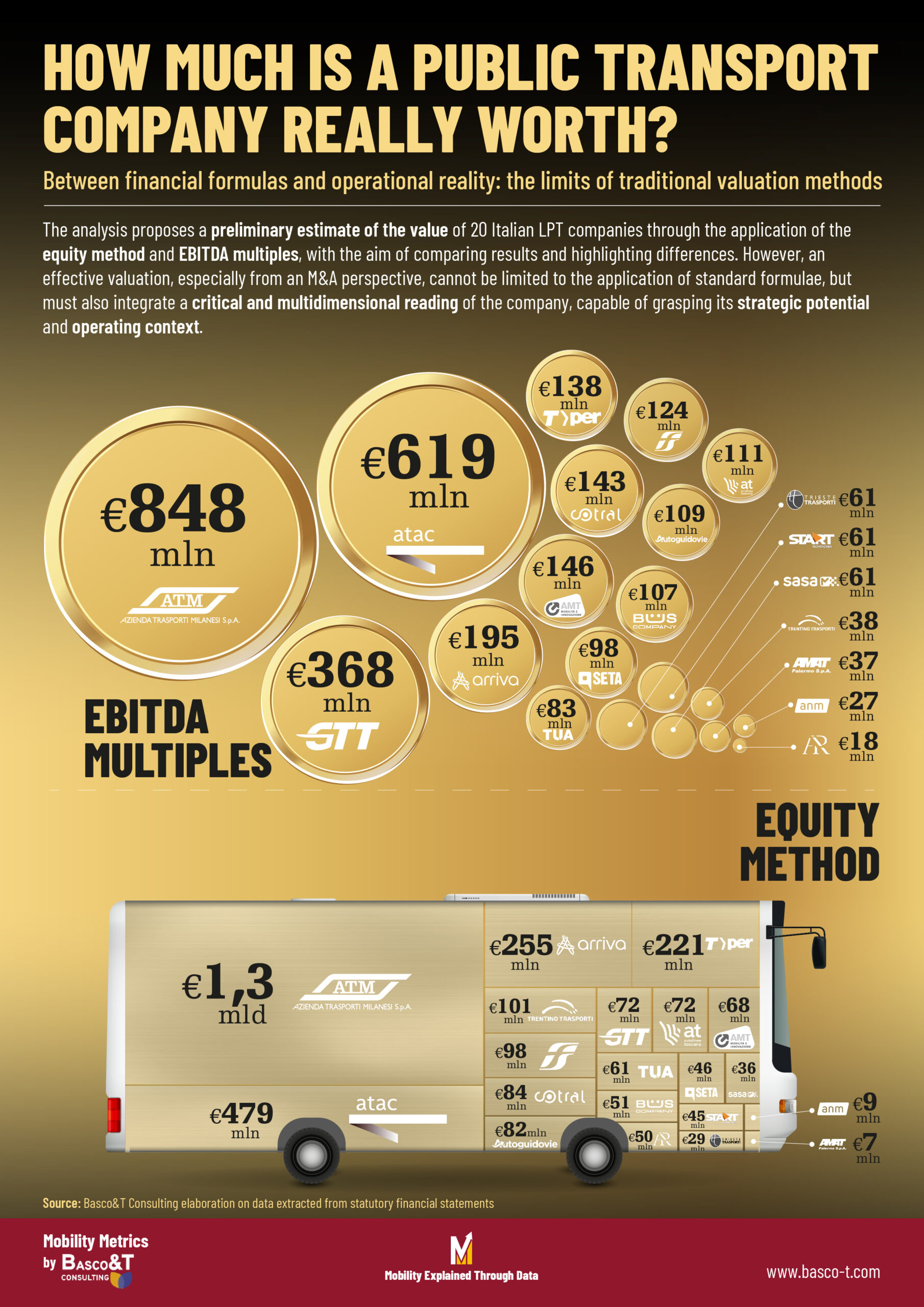
The analysis proposes a preliminary estimate of the value of 20 Italian LPT companies through the application of the equity method and EBITDA multiples, with the aim of comparing results and highlighting differences. However, an effective valuation, especially from an M&A perspective, cannot be limited to the application of standard formulae, but must also integrate a critical and multidimensional reading of the company, capable of grasping its strategic potential and operating context.
Share on:
In the field of Local Public Transport (LPT) in Italy, the Mergers & Acquisitions (M&A) are of a strategic importance in view of the increasing pressure to improve the efficiency and aggregation. The Italian marketfeaturing a high degree of fragmentation with a plurality of operators of small and mid-size, are approaching a crucial stage: from 2026, with the the end of the schemes of extensionmany service contracts will be put to race. In this scenario, business combinations and acquisition can represent levers decisive in order to strengthen its competitive position, reduce operational costs, and access to skills, technologies, and areas otherwise not covered.
In the context of the operations of merger and acquisition (M&A)the valuation of a company is a crucial step, aimed to determine the economic value in a way that is coherent and justifiable. To this end, we generally refer to a series of methods conventionally used, which are divided into four main categories: asset, income, financial, and comparative.
The equity method is mainly based on the net value of the assets, i.e. the difference between assets and liabilities, with any adjustments. The method incomeinstead, enhances the value of the undertaking on the basis of its ability to generate profits in the future using models of discounting of income. The the financial method takes as a reference, the future cash flows (DCF), discounted at a rate of risk is appropriate for you. Finally, the comparative method is based on a comparison with similar companies, using market multiples observed in similar operations.
In the field of local public transport, the companies are committed to working with models of custody is different (in house races, sub-custody), in different territorial contexts and require an interpretation that takes into account the specific context. Is need to consider a series of qualitative variables and contextual that is not apparent from the sun of mathematical formulas. Among these elements are covered aspects related to the positioning competitive and the territorial dynamicsas the composition ofuser or the presence of the operators aggregated or fragmented. From the operational point of view, are important indicators such as:
- traffic revenues
- evasion rate
- average age of the fleet
- efficiency of maintenance processes
- investment planning and the framework of planned public contributions
These aspects have to be translated into KPI management and compared with benchmark sectoral to get a reading comparative effective. Another key element is represented by the contractual conditions in: the type of custody, the duration the residual, the ability to predict tariff increasesthe mechanisms of the indexing the fees and the distribution of risks within the matrix of the contract. Only by integrating these dimensions into a structural analysis it is possible to return to a realistic assessment, and useful for strategic purposes of the operation.
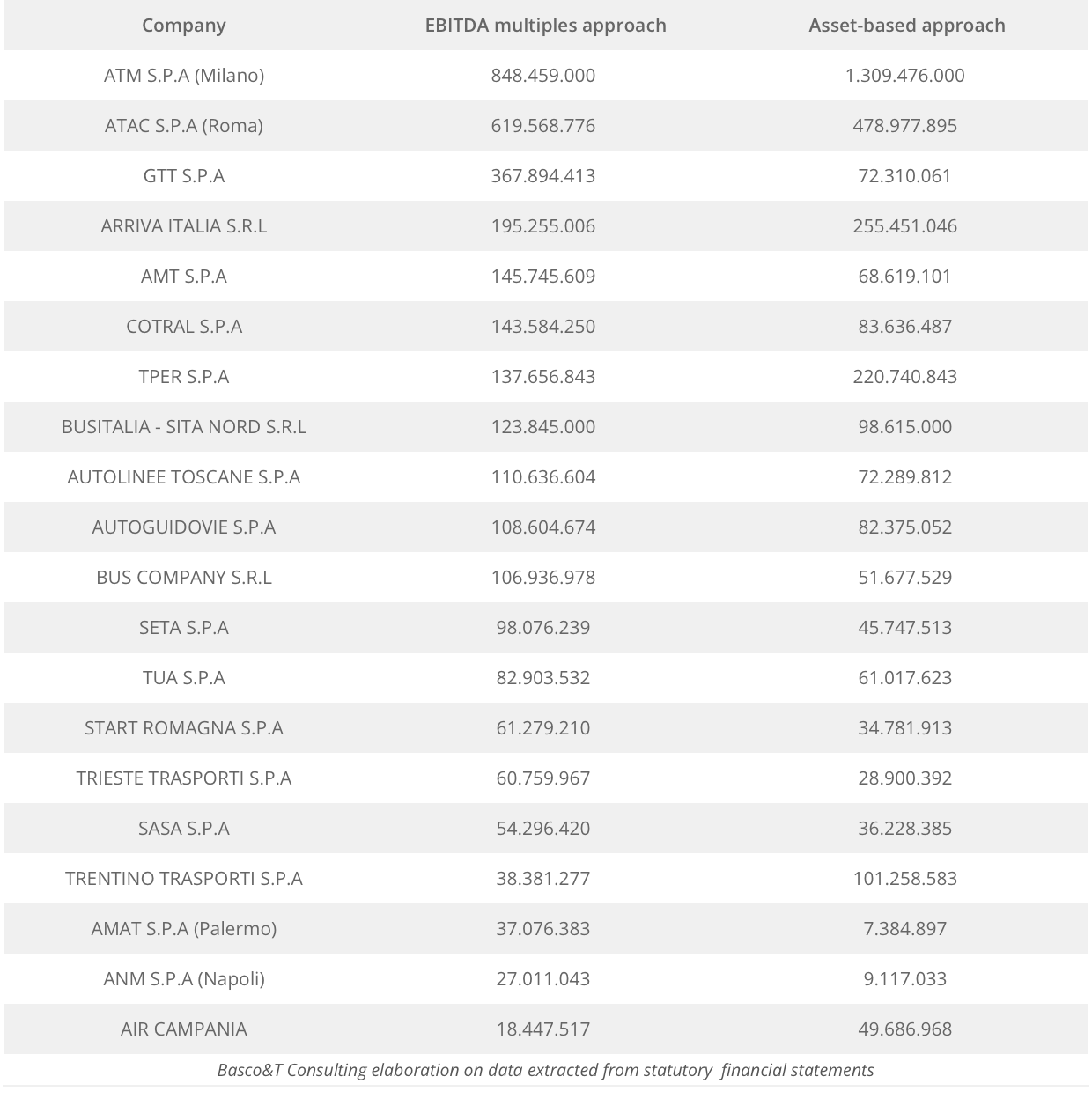
The table below provides a rough estimate of the value of the top twenty LPT companies in Italy, using a simplification of the EBITDA multiples method and the equity method. In the first case, the EBITDA 2023 was normalised by excluding extraordinary items (total extraordinary income and expenses), then multiplied by a multiple of 6 - selected within a reference range (practice) of the sector (5-7), taking into account the size of the company and the characteristics of the sector - and finally adjusted with the net financial position.
For the equity method, on the other hand, reference was made to the equity shown in the balance sheet, also adjusted by taking into account the net financial position, in order to obtain an estimate of the overall value of the company consistent with the actual financial structure.
Notes:
*ANM S.p.A. values refer to 2022
**The values shown represent a simplified estimate based solely on data extracted from the statutory financial statements and do not take into account all the elements that would be subject to in-depth analysis in a full evaluation
It is evident that the application of one method over another leads to substantially different results, as each approach returns a different representation of corporate value. The asset method tends to reward companies with significant assets (e.g. real estate, owned fleet), while the income method reflects the company's operational and earnings capacity. In particular, we can observe:
- ATM S.p.A. asset value is significantly higher than its income value, which is a sign of a very solid asset structure (probably rich in real estate assets and owned vehicles). The capitalised earnings value is still very high, confirming a good operating performance.
- GTT S.p.A. shows an opposite imbalance: the capitalised earnings value is more than five times higher than the asset value. This suggests a company that, despite a relatively low net worth (probably due to past liabilities or write-downs), has a strong operating capacity and a significant revenue/EBITDA structure. This is a typical case where the earnings method better captures the company's potential than the balance sheet.
Ultimately, an effective valuation in M&A transactions is not limited to the application of formulas, but requires a critical and multi-dimensional reading of the company, capable of grasping both its economic and strategic dimensions.
For more on the market context, also read the analysis on the fragmentation of LPT in Italy and the growing role of M&A ahead of the 2026 tenders.