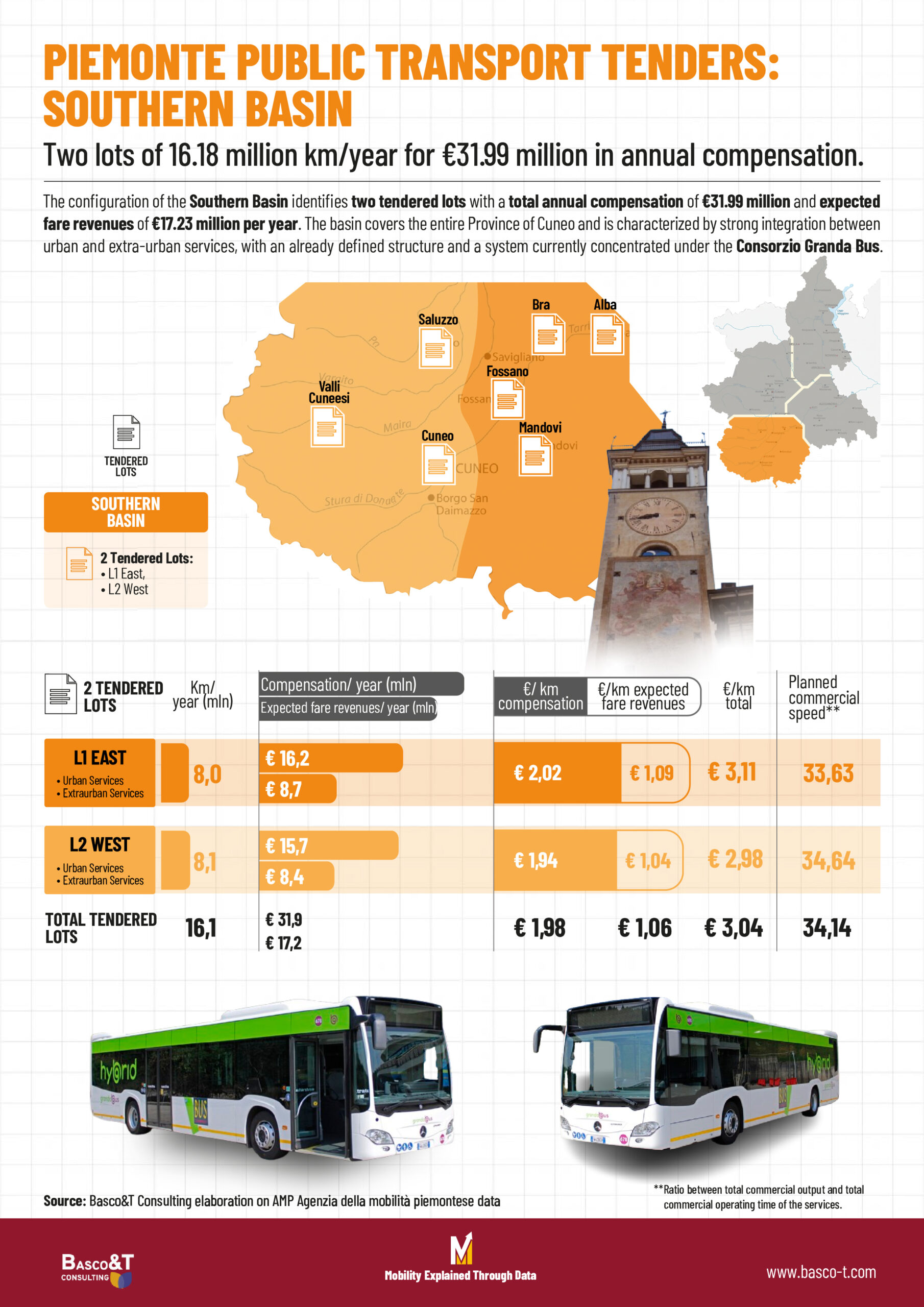
The configuration of the Southern Basin identifies two tendered lots with a total annual compensation of €31.99 million and expected fare revenues of €17.23 million per year. The basin covers the entire Province of Cuneo and is characterized by strong integration between urban and extra-urban services, with an already defined structure and a system currently concentrated under the Consorzio Granda Bus.
Share on:
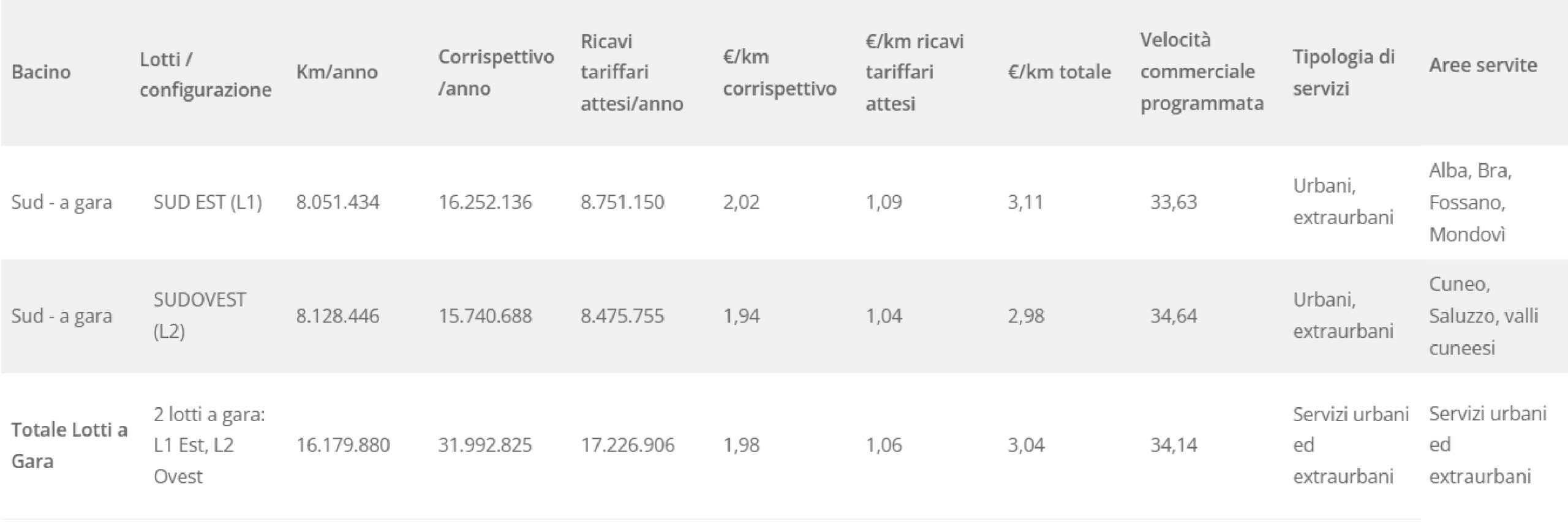
In the Southern Basin, the service configuration outlines a clear tender perimeter, divided into two distinct but balanced territorial lots, with the structure of the South-East Basin already clearly defined in the AMP report. Total service production amounts to 16,179,880 km/year, with annual compensation of €31,992,825 and expected fare revenues of €17,226,906. The average overall value stands at €3.04/km, while the planned commercial speed is 34.14 km/h.
The two lots are built along clearly identifiable territorial corridors, reflecting the geography of the province and its main urban centers.
Lot South-East (L1) covers Alba, Bra, Fossano, Mondovì, and the south-eastern area of the basin. It accounts for 8,051,434 km/year, with annual compensation of €16,252,136 and expected fare revenues of €8,751,150. The overall economic value reaches €3.11/km, with a commercial speed of 33.63 km/h.
Lot South-West (L2) , on the other hand, includes Cuneo, Saluzzo, the Cuneo valleys, and the western area. It totals 8,128,446 km/year, with annual compensation of €15,740,688 and expected fare revenues of €8,475,755. The overall value stands at €2.98/km, with a slightly higher commercial speed of 34.64 km/h.
These are therefore two lots that are not only similar in size, but also coherent from both a territorial and operational perspective, designed to ensure economic balance and industrial clarity within the basin.
Unlike other regional basins, the Southern Basin does not show significant separate components (such as in-house lots or sub-lots for weak demand areas), but rather a strong management concentration. The current structure is dominated by the Consorzio Granda Bus, which brings together 13 operators and effectively represents the main industrial player in the territory.
The framework is completed by a fleet of 308 buses and 370 PAO (other operational assets), confirming the significant size of the basin and its importance within the regional public transport system.
Overall, the Southern Basin presents a mature structure: the lots are clearly defined, the economic parameters are established, and the territory has been divided according to mobility demand logic. The tender therefore takes place in an already consolidated context, where the main challenge will be introducing competitive dynamics into a system that is currently highly concentrated.