An analytical comparison of fares, mileage and investment reveals a marked imbalance between funding in the North and that in the Centre and South for local public road transport.
The analysis of the structural and economic state of Local Public Transport (LPT) in Italy compares two of the most significant tendering procedures of recent years: the tender issued by the Milan, Monza and Brianza, Lodi and Pavia basin, and the Lazio Region’s combined urban and extra-urban tender managed by Astral S.p.A. The data analysed reveal a clear and unequivocal divide in terms of the public resources allocated.
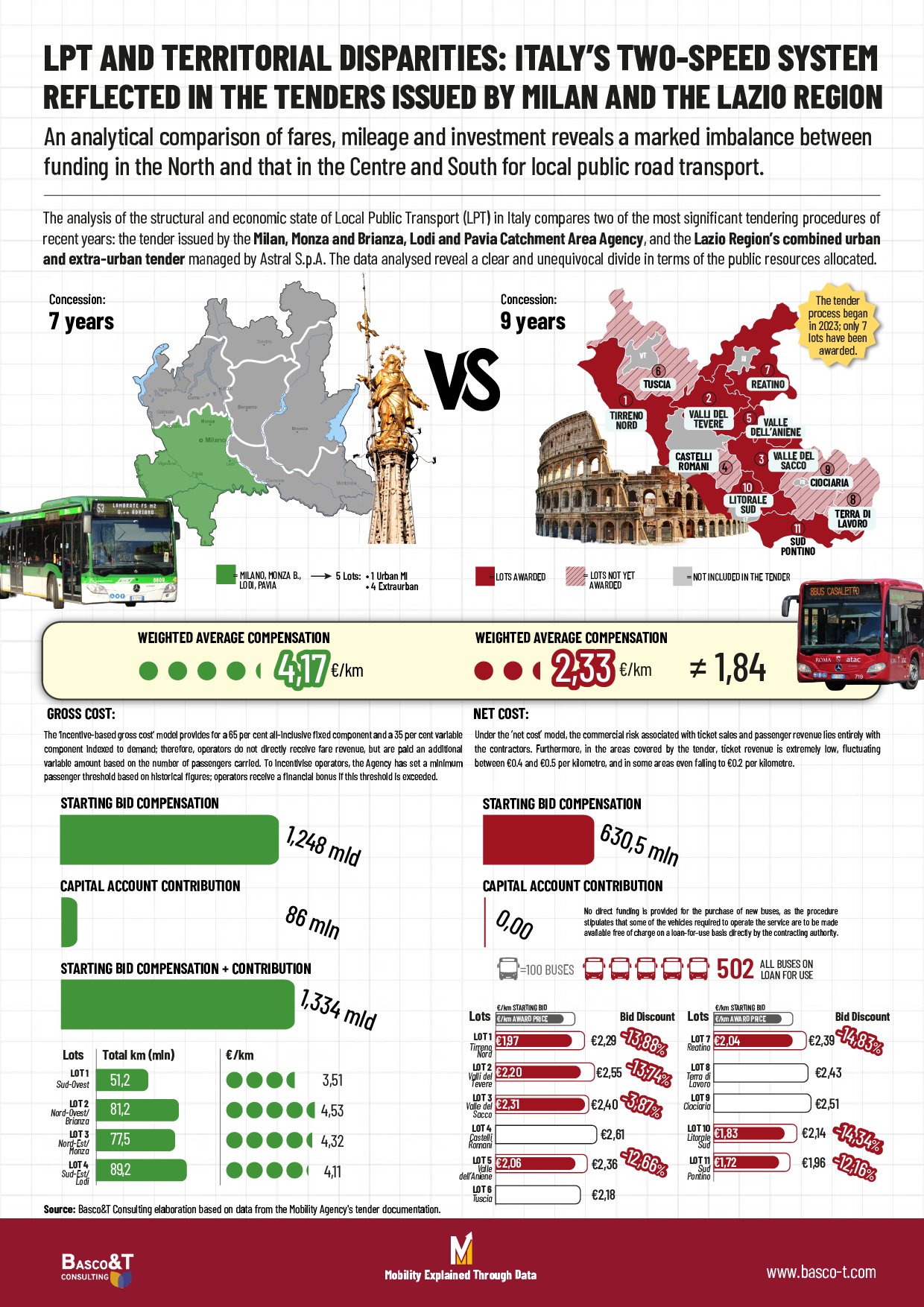
The data examined show a clear and unequivocal divide in terms of public resources allocated. While the Milan basinallocates €1.248 billion for a 7-year contract, ensuring a weighted average compensation of €4.17 per km (rising to €4.46 per km when including over €86 million in capital contributions exclusively intended for fleet renewal), the Lazio Region has tendered a total value of €630.5 million spread over 9 years, corresponding to a weighted average compensation of just €2.33 per km, with no structural funding flows for vehicle fleets integrated into the base contract. Beyond the purely financial gap, a deep difference also emerges in the efficiency and administrative fluidity of the two procedures (in Lazio, the tender published in 2023 has yet to complete its awarding process), confirming the existence of territorial asymmetries that disadvantage Central and Southern Italy.
Share on:
The Structural Divide in Local Mobility
Local public transport represents the main driver of connectivity, environmental sustainability, and citizens’ right to mobility. However, the industrial and financial architecture of intercity and suburban procurement tenders in Italy is revealing a deep and concerning asymmetry between high-investment models in the North and economically underfunded procedures in Central and Southern regions. A direct comparison between the new open procedure for the Milan metropolitan basin and the regional tender in Lazio provides a clear quantitative illustration of this imbalance.
The Milan Model: Industrial Remuneration and Financial Endowment for Fleet Renewal
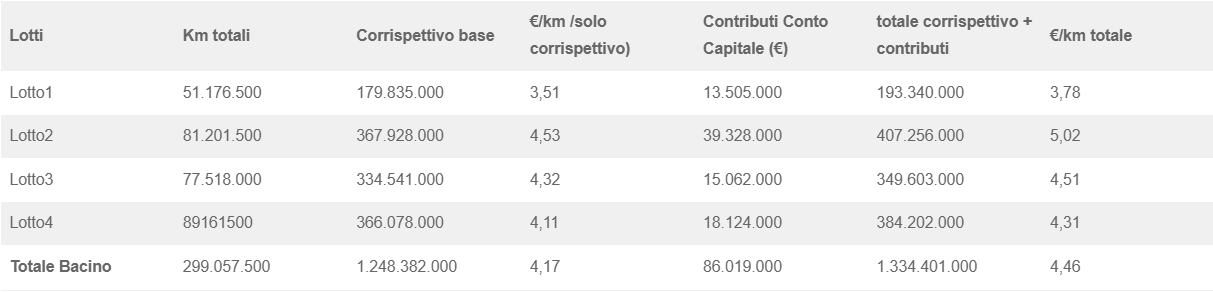
The Public Transport Agency for the metropolitan area of Milan, Monza and Brianza, Lodi, and Pavia has structured its tender around four self-sufficient territorial lots, with a total tender value of €1,248,382,000 and a contract duration of seven years.
The Lombardy transport plan is based on a progressive increase in service mileage, (implemented through three successive phases). Operations are expected to grow from approximately 36.5 million bus-kilometres in the first year of service to a consolidated annual level of more than 54.4 million bus-kilometres from the third through the seventh year. Remuneration follows an incentive-based gross-cost model, consisting of a 65% fixed all-inclusive component and a 35% variable component indexed to passenger demand.
The cornerstone of the Milan tender is the direct allocation of financial resources to support the ecological and technological transition of the fleet. The contracting authority provides €86,019,000 in capital grants (funded through the National Strategic Plan for Sustainable Mobility and regional resources), earmarked exclusively for fleet renewal.This investment enables the authority to impose contractual obligations requiring that 100% of the fleet, once fully deployed, be equipped with Advanced Driver Assistance Systems (ADAS), Blind Spot Detection systems, automatic passenger-counting equipment, and integrated video surveillance systems.
The table below presents the economic and operational indicators, expressed on a per-kilometre basis, calculated for each lot within the Milan transport basin over the entire seven-year concession period.
Tabella 1: Analisi Economica e Chilometrica Gara TPL Milano (Totale su 7 Anni)
The Lazio Region Procedure: Tariff Fragmentation and a “Net Cost” Concession
On the opposite end of the spectrum, the Lazio Region and the contracting authority Astral S.p.A. have launched a tender for the concession of minimum provincial transport services, divided into 11 Network Units (lots). The procedure presents structural characteristics that contrast sharply with the Lombardy model: the total estimated tender value amounts to €630,503,635, covering a contract duration of nine years(2024–2032) .
The total planned service volume over the nine-year period is 270,368,274.98 vehicle-kilometres. The chosen award model is a “net cost” scheme, meaning that the commercial risk associated with ticket sales and fare revenue performance lies entirely with the awarded operators.
Furthermore, the approach to fleet renewal is the reverse of the Milan case. Capital grants included in the base tender are set to zero (€0.00). The Lazio Region does not provide direct monetary contributions within the contract for vehicle amortisation. Instead, it commits to transferring to the winning operators, under a free usufruct arrangement, a share of vehicles centrally purchased through the FSC and regional funds. Operators are required to finance the remaining fleet requirements at their own expense.
Table 2: Economic and Operational Analysis of the Lazio Region TPL Tender – Astral (Total over 9 Years)
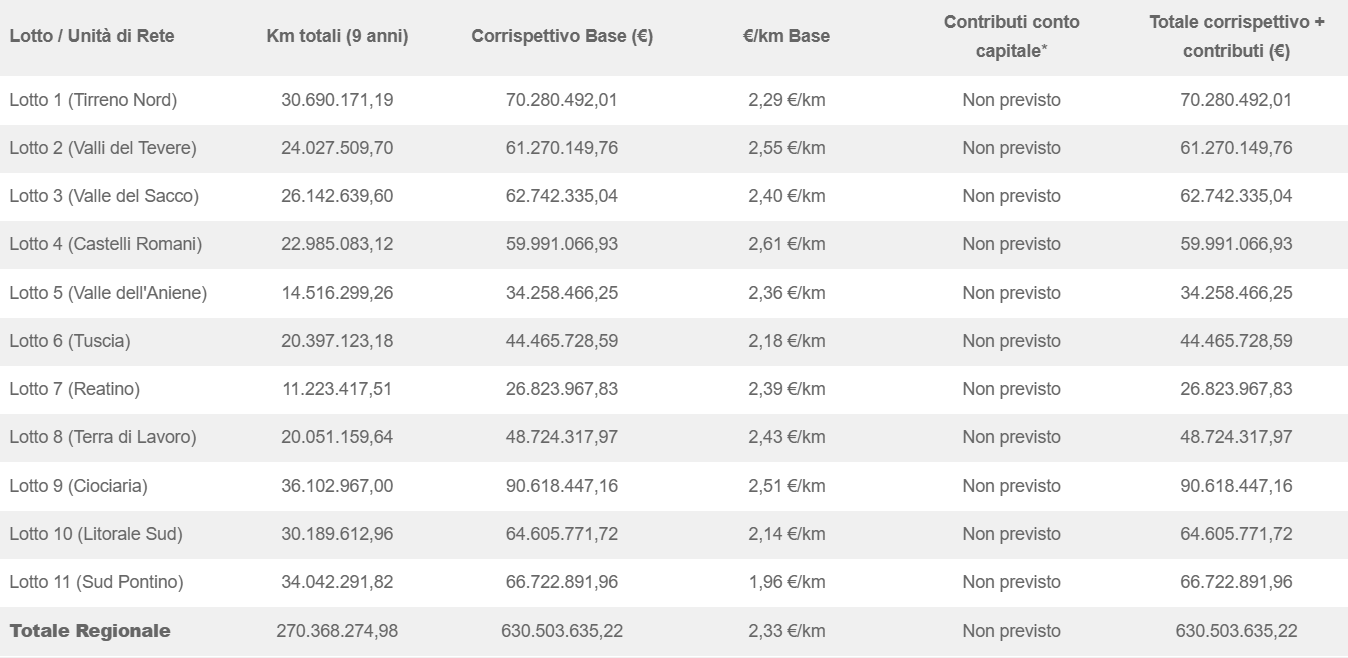
*Note: The Lazio Region (ASTRAL) does not provide monetary contributions included in the service remuneration for the depreciation of privately owned vehicles; instead, it transfers to the successful operators, under a free usufruct arrangement, a share of vehicles centrally purchased through FSC and regional funds.
Comparative Analysis of Unit Value: The Gap in Per-Kilometre Funding
The mathematical evidence of a two-speed Italian public transport system becomes clear when comparing the weighted average overall economic value recognised per contract lot (€/vehicle-kilometre):
- The Milan tender guarantees awarded operators a weighted average compensation of €4.17 per kilometre. When the impact of fleet investment funding included in the tender is factored in, the total mobilised investment rises to €4.46 per kilometre.
- The Lazio tender stands at a significantly lower weighted average of €2.33 per kilometre, reaching a minimum of €1.96/km in Lot 11 (South Pontine extra-urban area).
This results in a structural gap of €1.84 less per kilometre in the Lazio region compared to Milan. This asymmetry has a direct impact on service robustness: a lower per-kilometre compensation sharply reduces industrial margins needed to absorb fixed driver labour costs (governed by social safeguard clauses), limits resources allocated to preventive maintenance of depots and vehicles, and weakens the commercial attractiveness of tenders for large private operators or established transport companies.
The consequences of this underfunding are also evident at the administrative level. While the Milan tender is moving towards operational implementation, the Lazio extra-urban procedure (originally published in early 2023) remains partially stalled or incomplete due to a high number of administrative appeals and the lack of financial sustainability in the Economic and Financial Plans (EFPs) across several territorial lots, forcing many municipalities to remain tied to costly extensions and temporary renewals of incumbent operators.
Notes:
The Incentive Gross Cost Model (Milan Tender): All revenue generated from the sale of travel tickets is collected directly by the Contracting Authority. The operator is remunerated through an all-inclusive per-kilometer fee which, in the case of Milan, is structured into two components: a fixed portion equal to 65% (covering basic operating costs) and a variable portion equal to 35%, directly indexed to and linked with the number of fare-paying passengers actually transported.
The Net Cost Model (Lazio Region Tender): All ticketing revenues are retained directly by the operator. The public payment does not cover the full value of the service but serves solely as an operating compensation, calculated as the difference between standard operating costs and the forecast fare revenues. Consequently, the operational and commercial demand risk remains entirely with the private operator.