In the debate on sustainable mobility, there is often talk of investment, quality of service, technological innovation. But too little is said about profitability: the ability of LPT companies to generate profits. Without adequate economic margins, in fact, it is difficult to plan investments, improve performance, attract capital.
An analysis of profitability margins of the main Italian public transport companies highlights the sector's difficulty in generating profits, with a market dominated by public companies, low growth margins, and a few exceptions among privately or mixed-capital companies.
Share on:
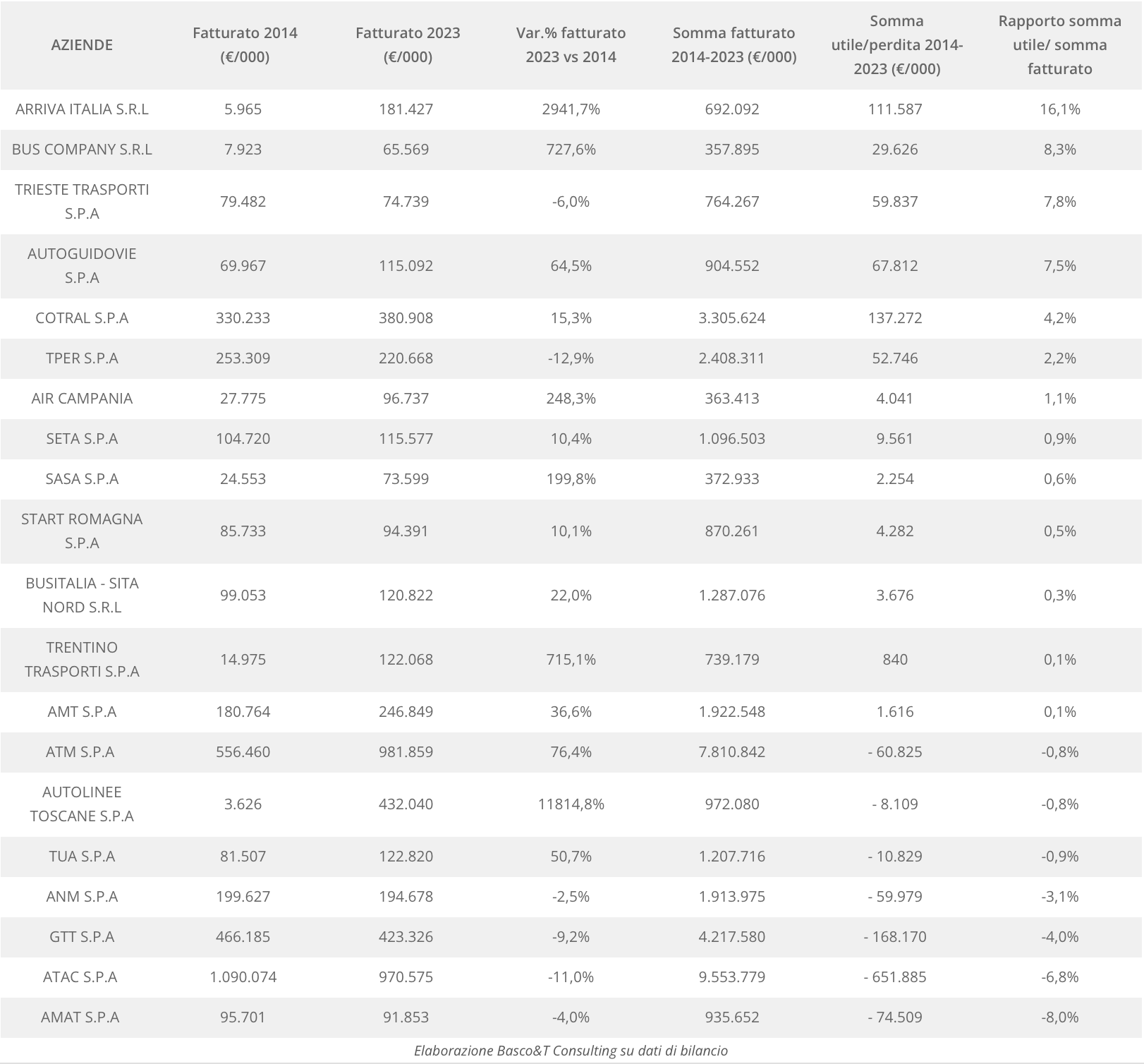
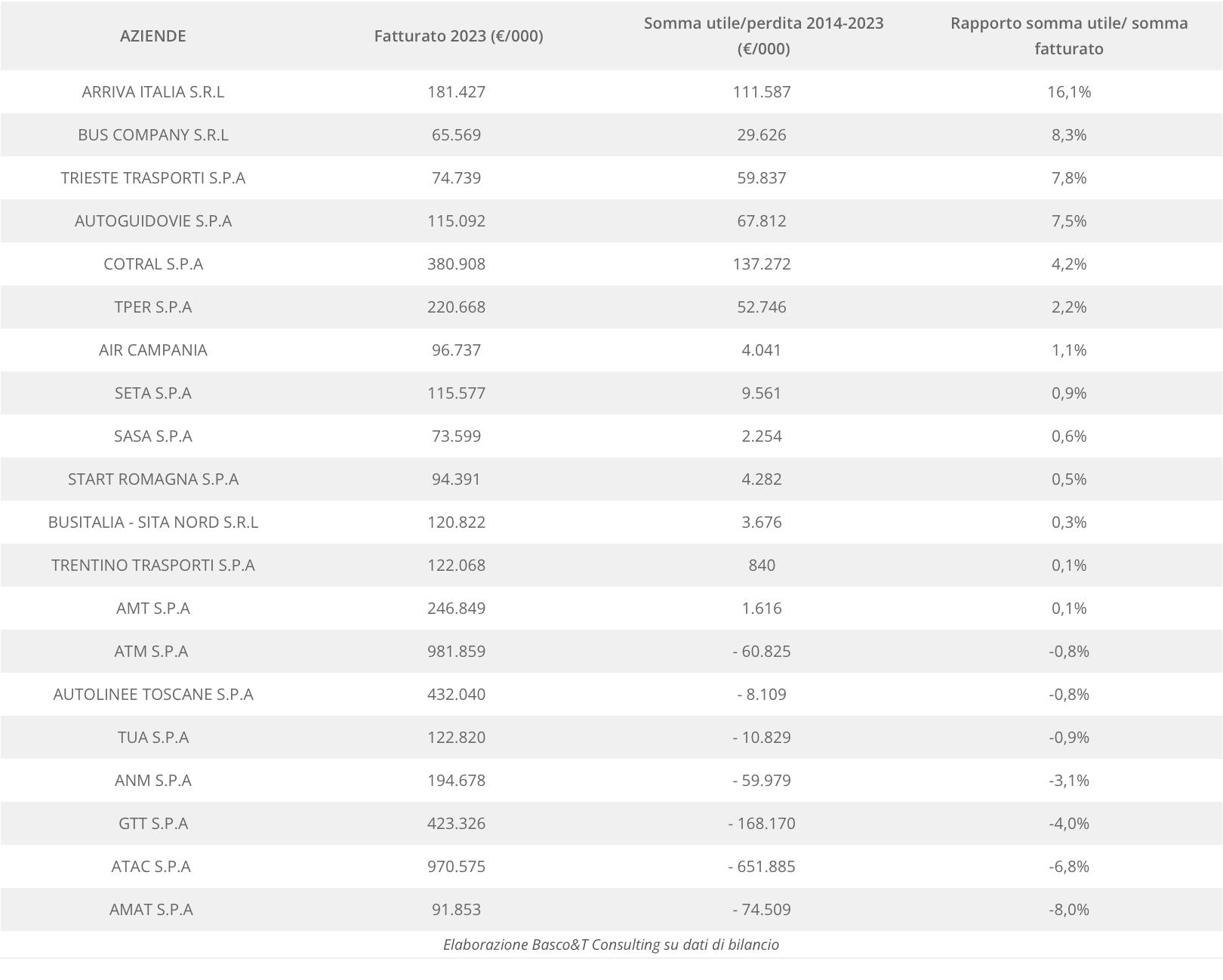
The analysis examined the profitability margin (profit/turnover) of the top 20 local public transport companies in Italy over the last ten years, using data extracted from public balance sheets. The companies were selected on the basis of their turnover in 2023. Subsequently, the sum of turnover and operating profit from 2014 to 2023 was calculated in order to determine the average profitability margin over the period considered.
The profit/revenue ratio, an indicator of company profitability, varies significantly between different companies, with values reflecting both their ownership structures and the conditions in which they operate.
Notes:
*The most recent data for ANM S.p.A. is from 2022
**The least recent data for Air Campania S.p.A. is from 2018
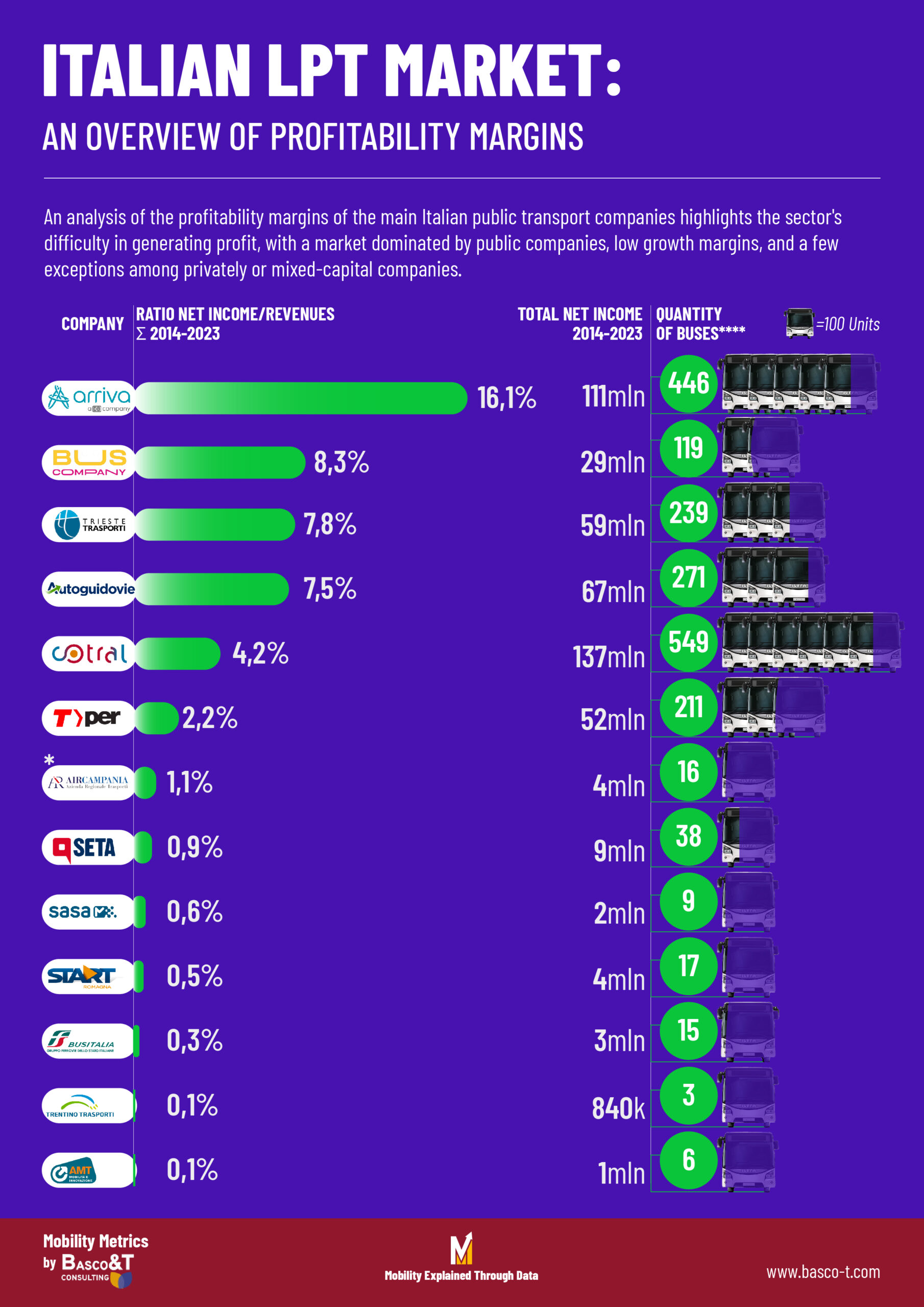
The analysis shows that, on average, private or mixed-capital companies have a higher profit/revenue ratio than public companies. Arriva Italia records the best ratio at 16,1%The company is part of the Arriva PLC (from 2010 to 2023, a subsidiary of Deutsche Bahn (DB)that in 2024 has been acquired by The Squared Capital, american society of private equity firm specializing in investments in the energy sector, public services, transport and telecommunications at the global level.
It is significant that the position of Bus Company Ltd.with a margin of8,3%, followed by Trieste Trasporti S.p.A. (mixed company, with the participation of Comes with 7,8% and Autoguidovie with 7,50%. These values are in relatively good compared with the industry average TPL Italian, characterized by low profit margins.
Publicly controlled companies such as Cotral S.p.A. (Lazio) and TPER S.p.A. (Emilia Romagna) show lower ratios, 4.2% and 2.2%, respectively, reflecting lower profitability.
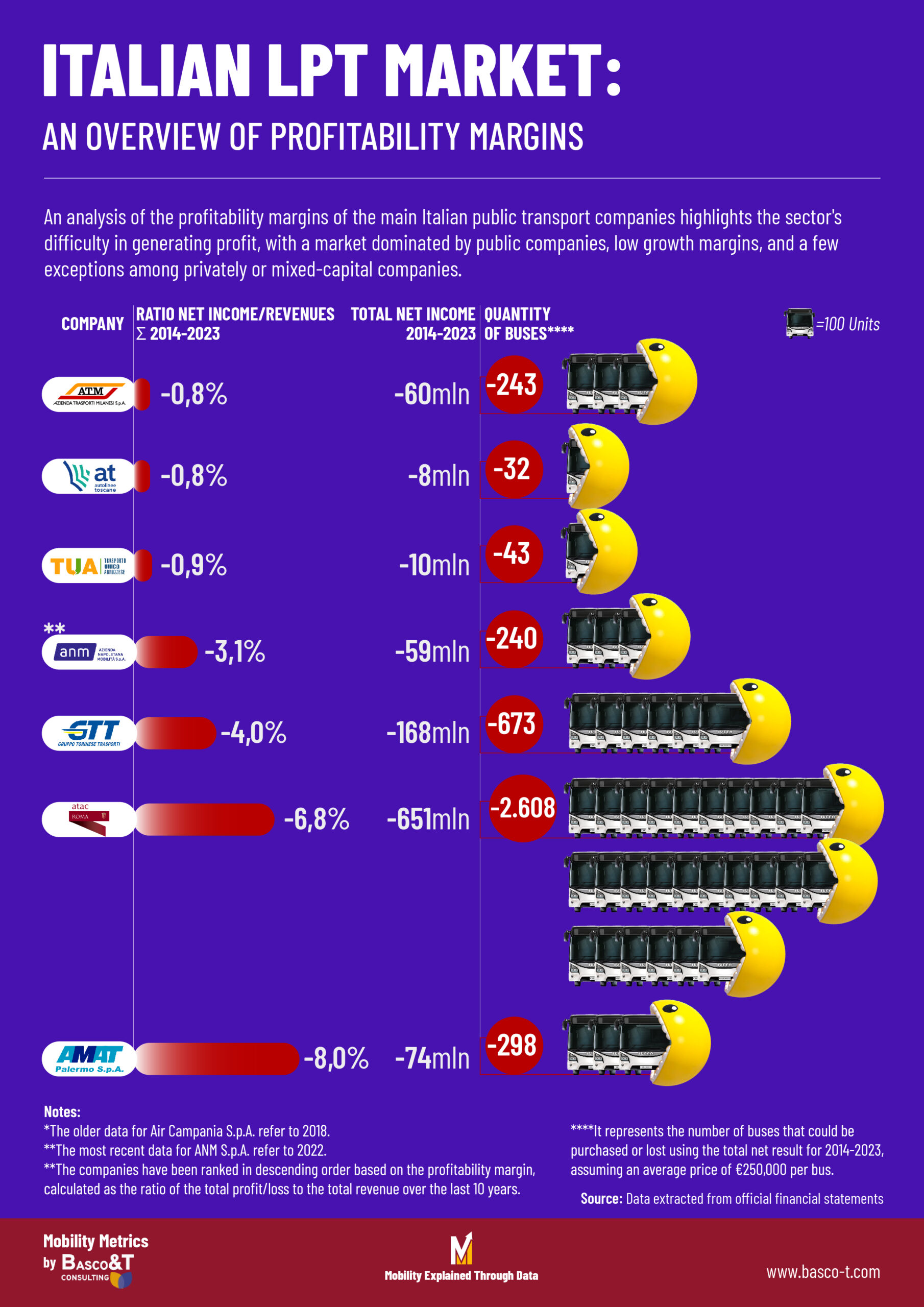
Among the companies analyzed, ATAC S.p.A. from Rome recorded the highest loss, with €651.9 million, and a margin (revenue/profit ratio) of -6.8%. It is followed by GTT S.p.A. from Turin, which accumulated €168.1 million in losses, with a margin of -4.0%.
AMAT S.p.A. from Palermo is the company with the worst ratio between profit and revenue, marking -8.0% and a total loss of €74.5 million. ANM S.p.A. from Naples closed the period with a negative balance of €62.3 million, with a profit/revenue ratio of -3.1%.
Below €20 million in losses is TUA S.p.A., which closed with a deficit of €10.8 million (-0.90%). Autolinee Toscane S.p.A. reported a loss of €8.1 million (-0.83%).
Finally, ATM S.p.A. Milan recorded an overall loss of 60,8 million €, equal to -0,80% compared to the overall turnover for the period 2014-2023.
The analysis clearly shows a structural limitation: between 2014 and 2023, most companies operated with minimal margins, or even at a loss. Companies with private or mixed capital stand out with better results (Arriva Italia at 16.1%, Bus Company 8.3%, Trieste Trasporti 7.8%, Autoguidovie 7.5%), while many public companies struggle to break even.
At the bottom of the ranking are operators of large cities such as ATAC, AMAT Palermo or GTT Torino with cumulative losses exceeding €100 million in some cases over the decade. A situation that raises strategic questions about the resilience of the current model.
In this context, the latest ART (Transport Regulation Authority) resolution - which introduces new criteria for determining the reasonable profit margin in service contracts - could represent a step change: establishing a minimum recognised margin means starting to treat LPT also as an industrial sector, not only as a public service.
Notes:
****In the infographic, the loss derived from the sum of operating results for the 2014-2023 period has been visually represented in terms of the number of buses that could have been purchased or lost, assuming an average price of €250,000 per bus.
For a comparison of the leading Italian public transport companies by revenue, you can read our updated ranking.
Data used