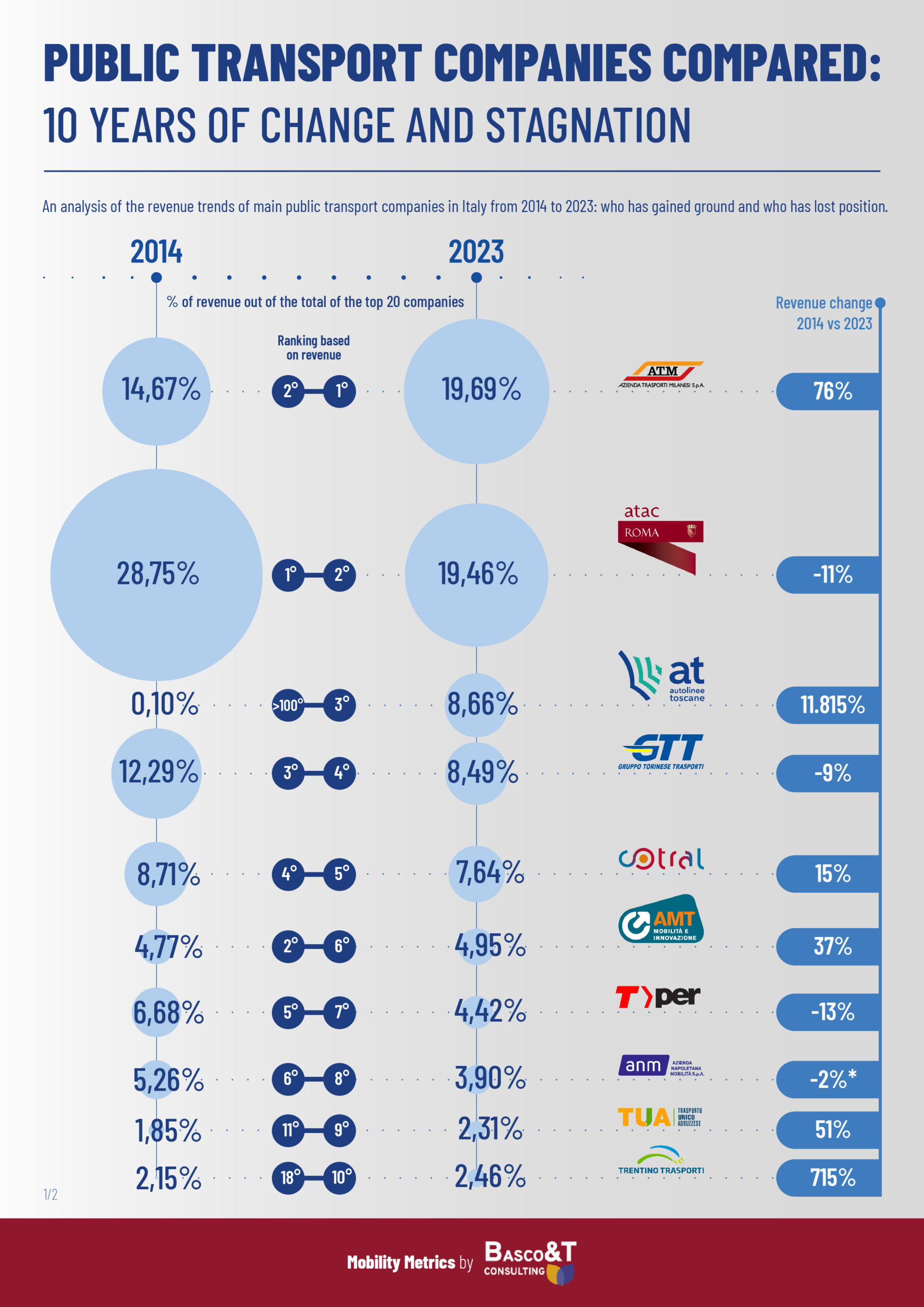
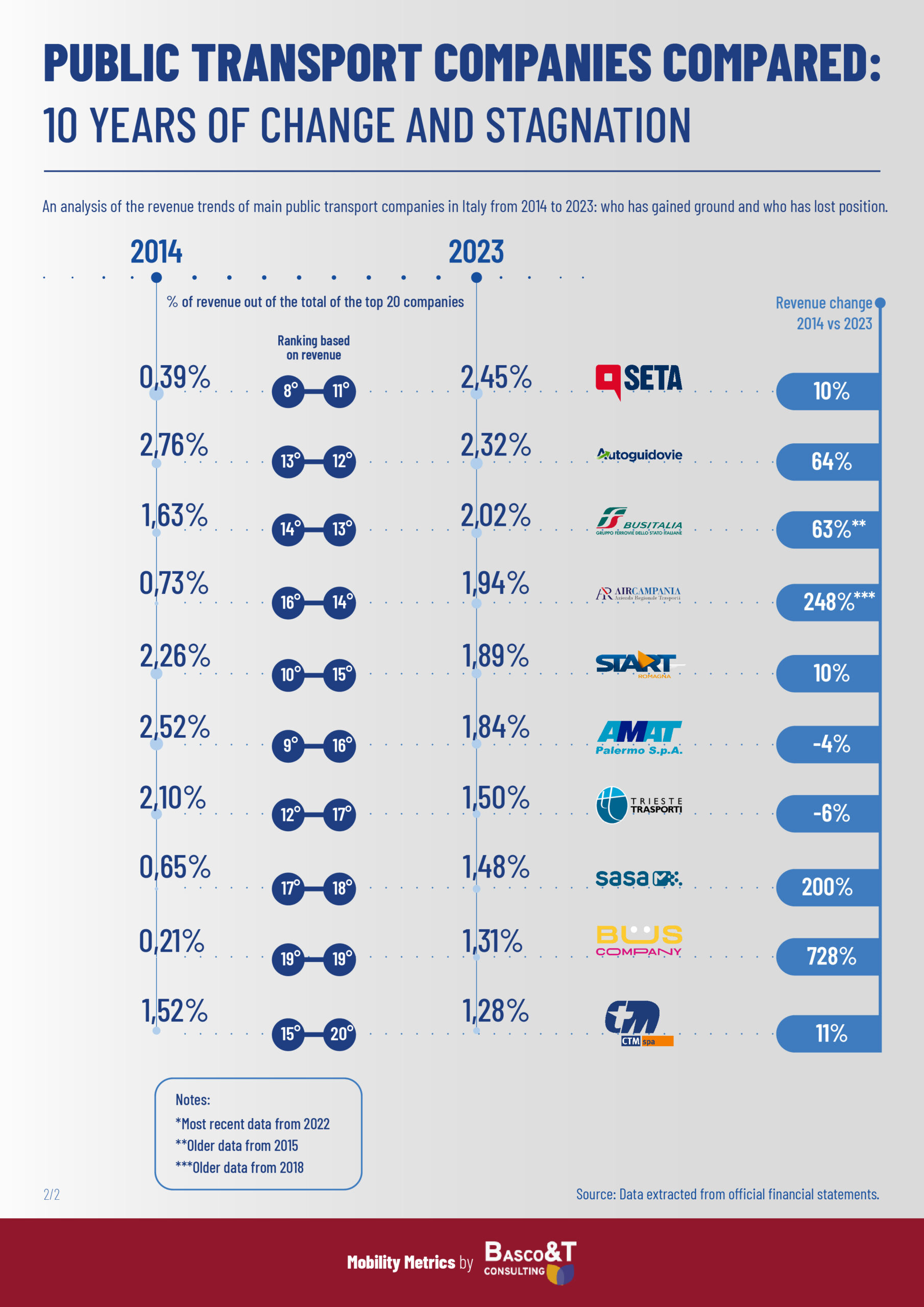
An analysis of the revenue trends of main public trasporti companies in Italy from 2014 to 2023: who has gained ground and who has lost position.
Share on:
The data analyzed are from the official financial statements of the companies considered, extracted through data banks. The companies have been classified on the basis of the turnover recorded in 2023, and then compared with that of 2014. Subsequently, it was calculated the ratio between the turnover of the individual companies and the total revenue for the sector, emphasizing the weight that each company has of the total sales of the major Italian companies, is for the 2014 to 2023. Have not been taken into consideration, the agencies of the mobility and consortia.
Analysis of the Turnover of the Companies of the TPL in Italy (2014-2023)
The analysis of data relating to the revenues of leading companies of local public transport (LPT) in Italy between 2014 and 2023 highlights an industry characterized by substantial stability, with limited changes in the positions of the vertex. Despite some variations in the sales, as of today, the market still appears to be dominated by the same public actors of the last decade. However, the reality has shown growth dynamics relevant, often linked to the allocation of new tenders for the award of the service.
The main changes in the ranking of companies TPL
- ATM SPA – 1st position in 2023 (2nd in 2014)
Thanks to a significant increase in turnover, ATM SPA is able to win the leadership of the market. In 2014, its turnover amounted to approximately 556 million euroswhile in 2023 has reached the 981 millionby registering a growth of +76%. This increase has allowed the company to overcome ATAC SPAalways been the main operator of the field. - ATAC SPA – 2nd position in 2023 (1st in 2014)
ATAC SPA, which in 2014 had a turnover of 1.09 billion, has suffered a decline in the -10,9%usd 970 million in 2023. The loss of the first position that reflects the structural difficulties and the financial of the company, which has faced years of economic crisis and internal reorganization. - Autolinee Toscane Spa – 3rd place in 2023
The company has seen an increase in extraordinary +118%, going from a turnover of 3.6 million in 2014 432 million euros in 2023. This result is directly linked to the award of the tender to the single lot invitation by the Region of Tuscany, which has enabled it to operate on a catchment area much wider than in the past. - GTT SPA – 4th position in 2023 (3rd in 2014)
Despite a slight decline -9%, GTT SPA has maintained a prominent position, passing by 466 million in 2014 423 million in 2023. - COTRAL S.p.A. – 5th place in 2023 (4th in 2014)
With an increase in the +15%, COTRAL has seen its turnover rise to 380 million in 2023, despite losing a position with respect to the ranking of 2014.
The group Arrives in Italy, not included in the cluster analysis, has completed the process of incorporation to 31 December 2020 of some of the companies of the TPL subsidiaries. In 2023 has achieved a turnover of €181mln, that the posizionerebbe on the 9th place in the ranking.
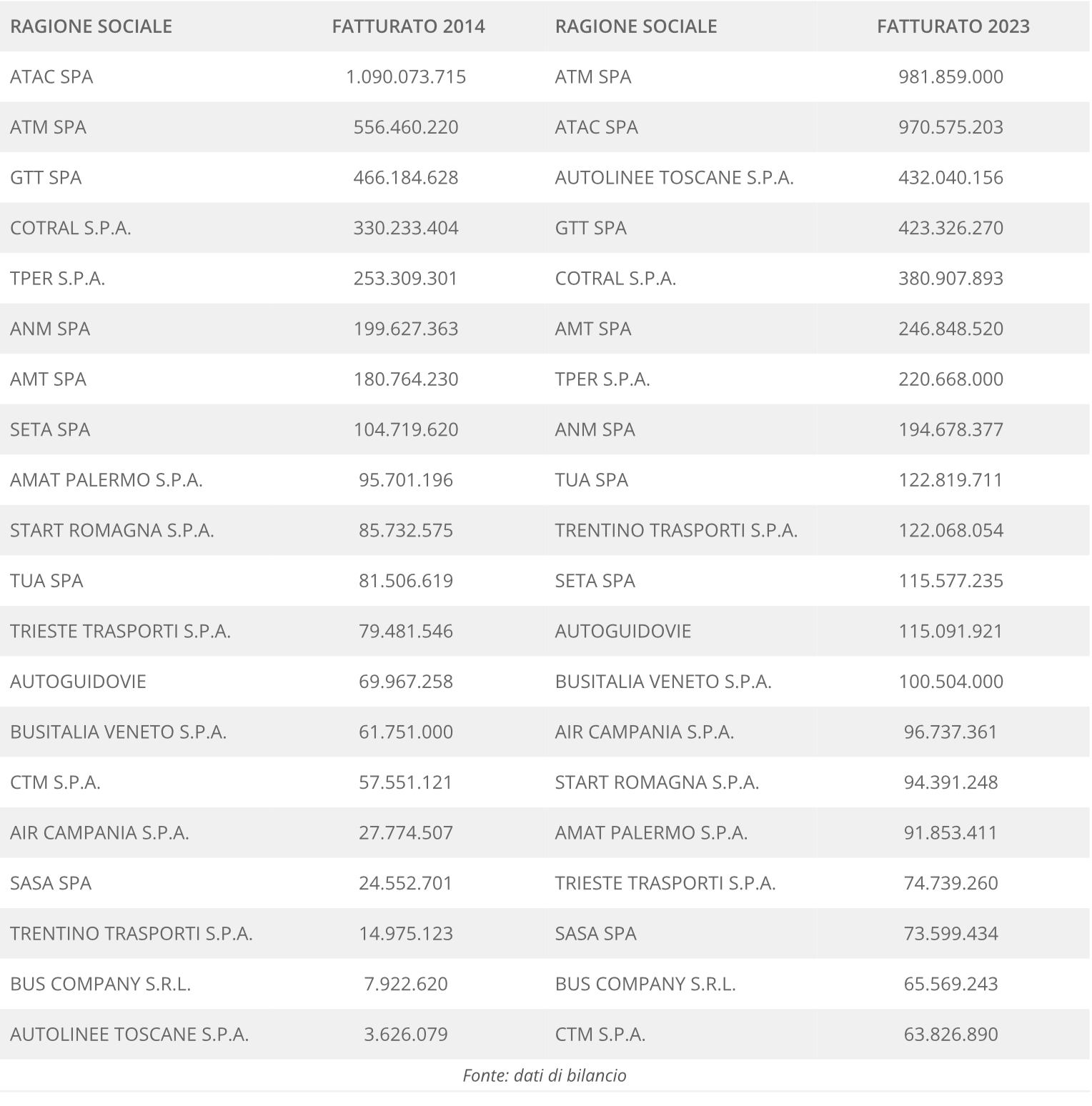
*In the column of 2014, it has been reported revenue of Busitalia of 2015 being given less recent available. Similarly, since the Air Campania founded in 2018, it was reported in 2018.
The impact of the race and the acquisitions of turnover
In addition to the case Autolinee Toscane**in view of the TPL Italian emerge some companies that have registered a significant growth thanks to some well-targeted acquisitions and the awarding of public tenders at the local level. Among these, Bus Company that operates primarily in the Piedmont, and Autoguidovie with a strong presence in Lombardy and Emilia-Romagna, stand for a major expansion of its turnover.
**in the ranking of LPT companies by revenue in 2014, there were more than the 100th position.
The immobility of the market TPL
In spite of the changes in the turnover and the consolidation of a number of operators, in the field of local public transport in Italy is characterized by a low mobility competitive. The presence of historical companies, are strongly rooted in the territory and, often, public participation, restricts the entry of new actors and the dynamism of the market. The competitions at regional and provincial level have allowed some change, but the overall picture still appears to be dominated by a small number of actors involved.