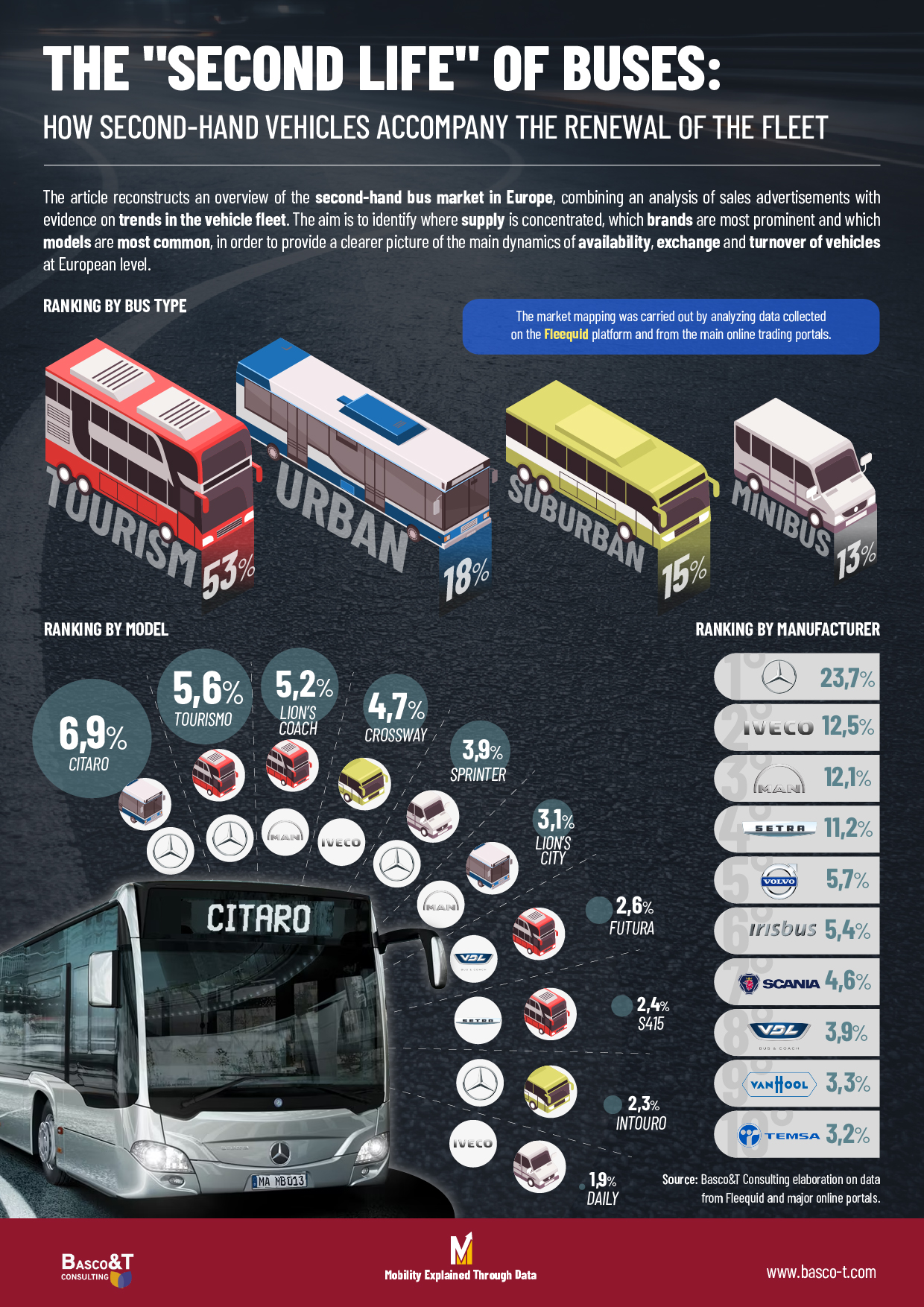
The article reconstructs an overview of the second-hand bus market in Europe, combining an analysis of sales advertisements with evidence on trends in the vehicle fleet. The aim is to identify where supply is concentrated, which brands are most prominent and which models are most common, in order to provide a clearer picture of the main dynamics of availability, exchange and turnover of vehicles at European level.
Share on:
The second-hand market is not just a sales channel, but a real operational indicator. Analysis of ACEA data and a sample of advertisements on the Fleequid platform and major online sales portals reveals a sector where second-hand goods act as a buffer for technological replacement and the reallocation of assets between different national markets.
Source: Basco&T Consulting elaboration on data ACEA and ACI
The scenario: A broad European fleet, stable over time
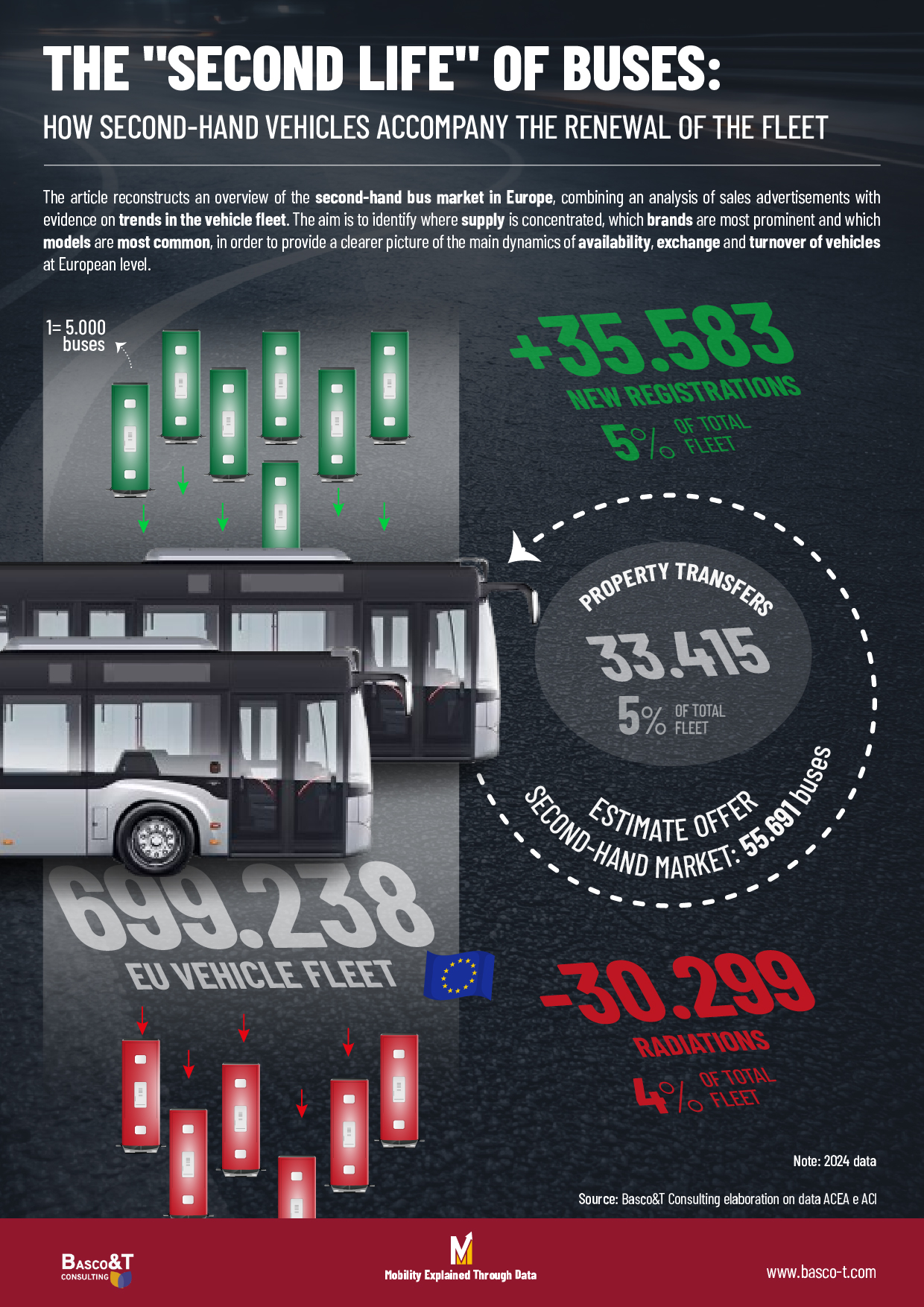
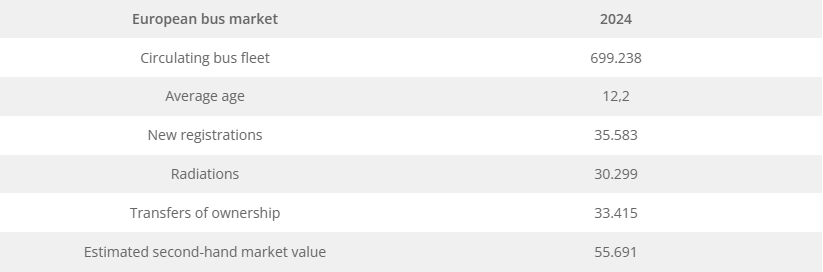
The table provides an overview of the size of the European bus market. Analysis of European fleets in the period 2018–2024 shows structural stability: the number of buses in circulation varies only slightly, with an average annual growth rate of around +0.2%. The only significant discontinuity is observed in 2020, when the fleet recorded a -8% decrease compared to 2019, a figure attributable to exceptional factors linked to the pandemic and not representative of the ordinary dynamics of the market. Adjusting the series for this anomaly, the average annual growth for the period is +1.4%.
In 2024, with nearly 700,000 buses in circulation in Europe and an average age of 12.2 years, the main challenge is not so much the expansion of the fleet as its renewal. In this scenario, the used vehicle market plays a vital role in the system: it allows vehicles that are still fully operational to be reallocated and continue their life cycle in different contexts and service missions.
Alongside the stock, the table also frames the “dynamic” dimension of the market, distinguishing three fundamental flows:
- New registrations: the number of buses registered during the year and constituting new additions to the fleet.
- Radiations: refer to the removal of vehicles from the register or the rolling stock, i.e. vehicles that are permanently removed from a country's fleet because they have been scrapped, exported outside the market/register, or decommissioned in accordance with the administrative procedures in place. This is a crucial indicator because it measures the “exit point” of the system: more de-registrations mean greater potential replacement and pressure to renew.
- Property transfers: property transfers measure the change of ownership of vehicles already in circulation. This is the heart of the second-hand market, because it describes how much of the stock is reallocated between operators, territories or uses without necessarily leaving the fleet.
The estimate of the number of deregistrations and transfers of ownership at European level was developed based on Italian data provided by ACI. For each country, annual deregistrations were reconstructed as the difference between registrations for the year and the observed (or structural) change in the vehicle fleet, the latter defined on the basis of historical trends in stock.
Property transfers were estimated by applying a conversion coefficient to deregistrations, calibrated on the ratio observed in Italy between transfers and deregistrations, appropriately adjusted for the different average age of national fleets, in order to take into account structural differences in fleet maturity and propensity to resell. The approach adopted allows for an estimate that is consistent with the demographic dynamics of the European bus fleet and comparable between countries in the absence of homogeneous data on transfers.
The data on actual property transfers (estimated at around 33,415 units per year) is accompanied by an assessment of the market's overall supply capacity. This rough estimate is not limited to completed transactions, but quantifies the critical mass of assets made visible by sales channels. Transfers measure the actual flow of exchange, while potential supply expresses its overall liquidity.
Mapping the European second-hand market
Through the analysis of a sample of bus sales advertisements published online on the Fleequid platform and on the main buying and selling portals, a mapping of the characteristics of the European second-hand market was carried out.
- Geographical concentration of supply: reading compared to the vehicle fleet and average age
Source: Basco&T Consulting analysis based on ACEA data, Fleequid and leading online portals
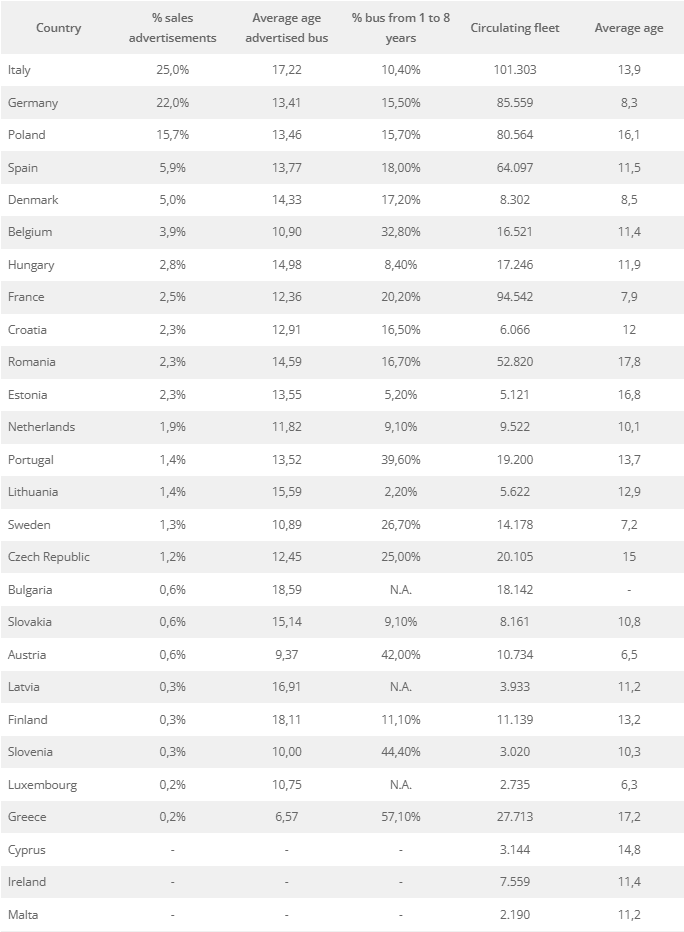
The sample of advertisements shows a high geographical concentration, with a few countries generating a significant share of the visible supply. This result is partly consistent with the structure of the European market, where countries with larger fleets and/or more mature fleets tend to feed the second-hand market more consistently, but the distribution of sales advertisements does not always follow the size of the fleet in circulation, revealing curious dynamics.
The intersection of these variables allows European markets to be segmented according to different asset rotation dynamics and related disposal strategies. In 2024, the EU fleet will consist of 699,238 buses, with an average age of 12.2 years. Within this scope, three distinct market models can be identified:
- Secondary market supply basins (Outflow): in contexts characterized by constant fleet renewal and high ecological transition standards, such as Denmark, Germany, and Austria, there is a positive differential: the average age of advertisements is significantly higher than that of the circulating fleet. In Denmark in particular, with an average age of vehicles on the road of 8.5 years and advertisements at 14.3 years, the used car market acts exclusively as a disposal channel for vehicles at the end of their primary operating cycle, with the digital showcase intercepting the portion of the fleet destined for international reallocation to markets with less stringent age requirements.
- Destination and absorption markets (Inflow): countries such as Greece and Poland show a reversal of the trend, with the average age of listings lower than that of the overall national fleet. In Greece, with a fleet age of 17.2 years, listings show an average age of 6.57 years. This phenomenon indicates a qualitative segmentation of the market: the digital sample focuses on assets with greater marketability and excludes obsolete vehicles with no residual commercial value. In these markets, digital second-hand represents the high-end segment of the local supply.
- Markets with converging parameters: countries such as Italy show more aligned values between the age of the fleet (14 years) and the average age of listings (17 years). This convergence indicates a slower turnover rate compared to Northern European markets. In Italy, the disposal of assets does not coincide with the end of the primary operating cycle, but continues in parallel with the aging of the fleet. The used market therefore serves not only as an exit channel, but also as an internal operating segment necessary for maintaining transport capacity.
Source: Basco&T Consulting analysis based on data from the Fleequid platform and leading online portals
- Segmentation by intended use
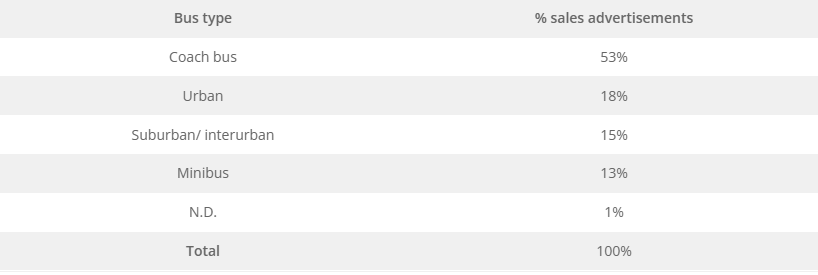
The segmentation of the sample based on intended use reveals a marked prevalence of the tourism sector (coaches), which accounts for 53% of the total supply. This finding is related to the need for accelerated asset rotation in order to maintain high standards of comfort and commercial competitiveness. The remaining segments show an almost uniform distribution, with the urban sector (18%) slightly above the suburban/interurban (15%) and minibus/light (13%) categories.
- Concentration by manufacturer and model
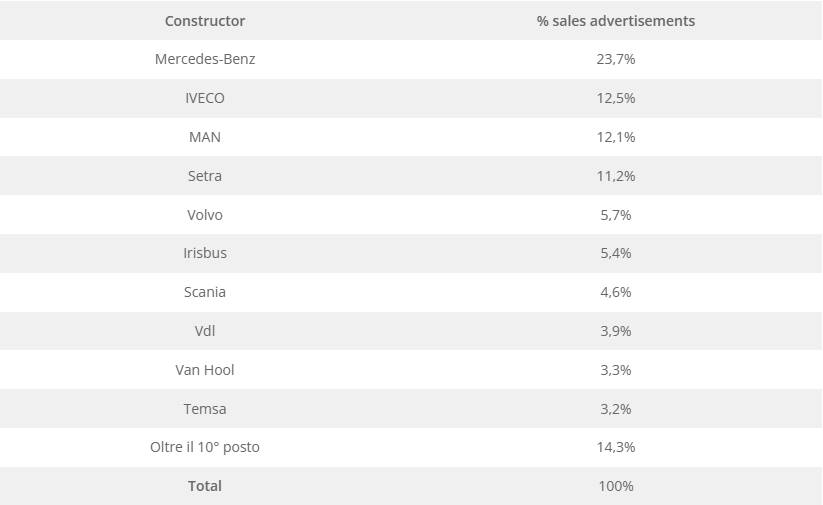
An analysis of supply volumes shows a clear concentration on a small number of manufacturers, with the top four players covering 60% of the market.
- Mercedes-Benz leads with 23.7% of advertisements.
- IVECO (12.5%), MAN (12.1%) and Setra (11.2%) follow with similar volumes.
- Volvo (5.7%), Irisbus (5.4%) and Scania (4.6%) are further behind, while VDL (3.9%), Van Hool (3.3%) and Temsa (3.2%) complete the core group of the most frequently occurring brands.
This polarisation is not random but responds to different motivations: the widespread service network guarantees minimal machine downtime, while the standardisation of components facilitates maintenance even in secondary markets. Furthermore, brands such as Mercedes and Setra ensure high residual value retention.
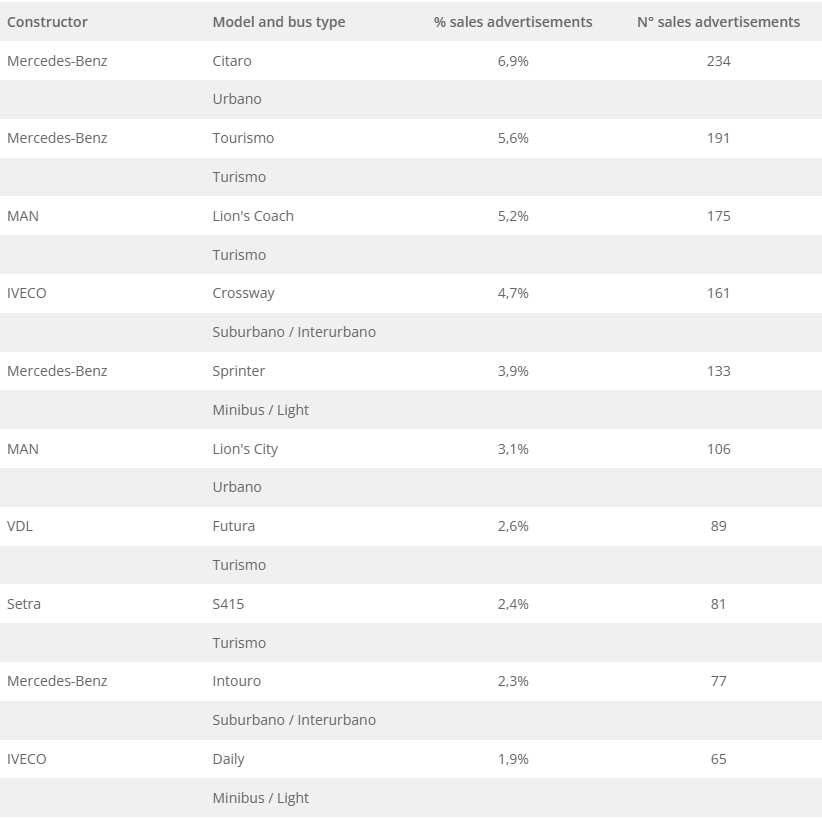
An analysis of the advertisements by model reveals a clearly ‘multi-segment’ mix (urban, interurban, coach and light) covering different operational needs. Among the most common are:
- Mercedes Citaro (6,9%) e Mercedes Tourismo (5,6%), seguiti da IVECO Crossway (4,7%), MAN Lion’s Coach (4,1%) e Mercedes Sprinter (3,9%).
- Rounding out the high end are MAN Lion's City (3.1%), VDL Futura (2.6%), Setra S415 (2.4%), Mercedes Intouro (2.3%) and IVECO Daily (1.9%).
Conclusion
Ultimately, the second-hand market represents an essential cog in the resilience of European public transport. Far from being merely a disposal channel, it constitutes a reserve of operational flexibility that allows operators to manage fleet renewal in line with their actual investment capacity.
Although international political agendas are pushing decisively towards decarbonisation, the used car market acts as a natural stabiliser: it ensures that the existing fleet continues to meet mobility needs even where charging infrastructure or budgets for new cars are not yet fully mature. The challenge in the coming years will therefore not be an abrupt disruption, but rather a gradual integration. As zero-emission technologies become the standard in the new car market, they will also begin to filter into the used car market – currently still dominated by diesel engines – marking the transition to sustainable mobility that is truly accessible to all regions.
In this context, a careful analysis of current sector dynamics shows that the used market is not merely a fallback option, but a genuine strategic lever—provided it is managed wisely. Looking at the second-hand market, the overall supply currently shows a relatively high average age. This is the natural outcome of a pool that includes many vehicles at the end of their lifecycle, with registrations exceeding 20 years. However, stopping at this broad figure would be misleading. Within this supply there is an extremely interesting segment: on average, 30% consists of buses less than eight years old. These vehicles represent the real opportunity in today’s market. They enable transport companies to intervene in a targeted and economically sustainable way to renew their fleets, immediately lowering the average fleet age and achieving a step forward in terms of reliability and emissions performance.
In short, the real challenge for operators is not simply to find a low-cost vehicle, but to identify that valuable segment of “young” used vehicles capable of balancing economic, operational, and environmental sustainability.