The field of local public transport in Italy is a fund large and complex, characterized by a large number of companies, albeit in a gradual reduction. Between 2019 and 2021, the number of operators is down from 931 838 (-9,9%) anche per effetto delle gare degli ultimi anni, che hanno favorito processi di aggregazione. Nonostante questa contrazione, il settore ha maintained operational capacity constantwith over 49.000 means in service, mileage during the year equal to 1.8 billion vehicle-km and more than 225 million train-km. The the number of passengers transported he has recorded a bending, going from 5.5 billion to 5 billion, while the revenue remained stable at around € 12 billion.
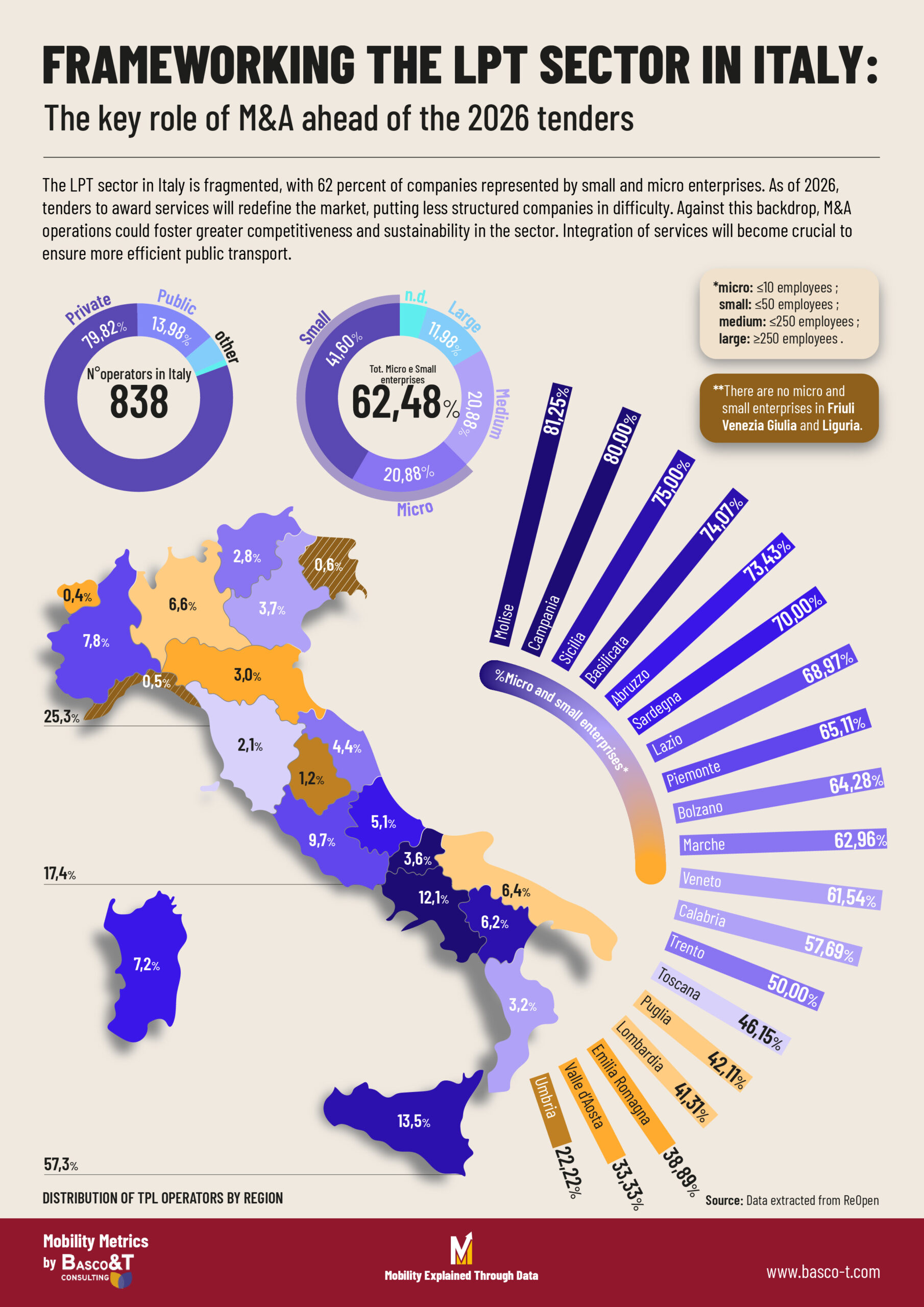
Read full article about frameworking the LPT sector in Italy
The sector is highly fragmented, with 62% of companies classified as small or micro enterprises. This structure poses a number of significant challenges for the future. Chief among them is the urgent need for substantial investment to renew the bus fleet, which is often outdated. Added to this is increasing managerial complexity, driven by the introduction of ever more stringent regulatory requirements that operators must comply with. In such a context, achieving economies of scale becomes essential—not only to improve operational efficiency but also to ensure the economic sustainability of the businesses involved. Starting in 2026, tenders for the award of public transport services will gradually be launched across all Italian regions, helping to reshape the market and alter the current competitive dynamics.
The state of Public Transport Tenders in Italy and how the Regions have acted over the last 10 years
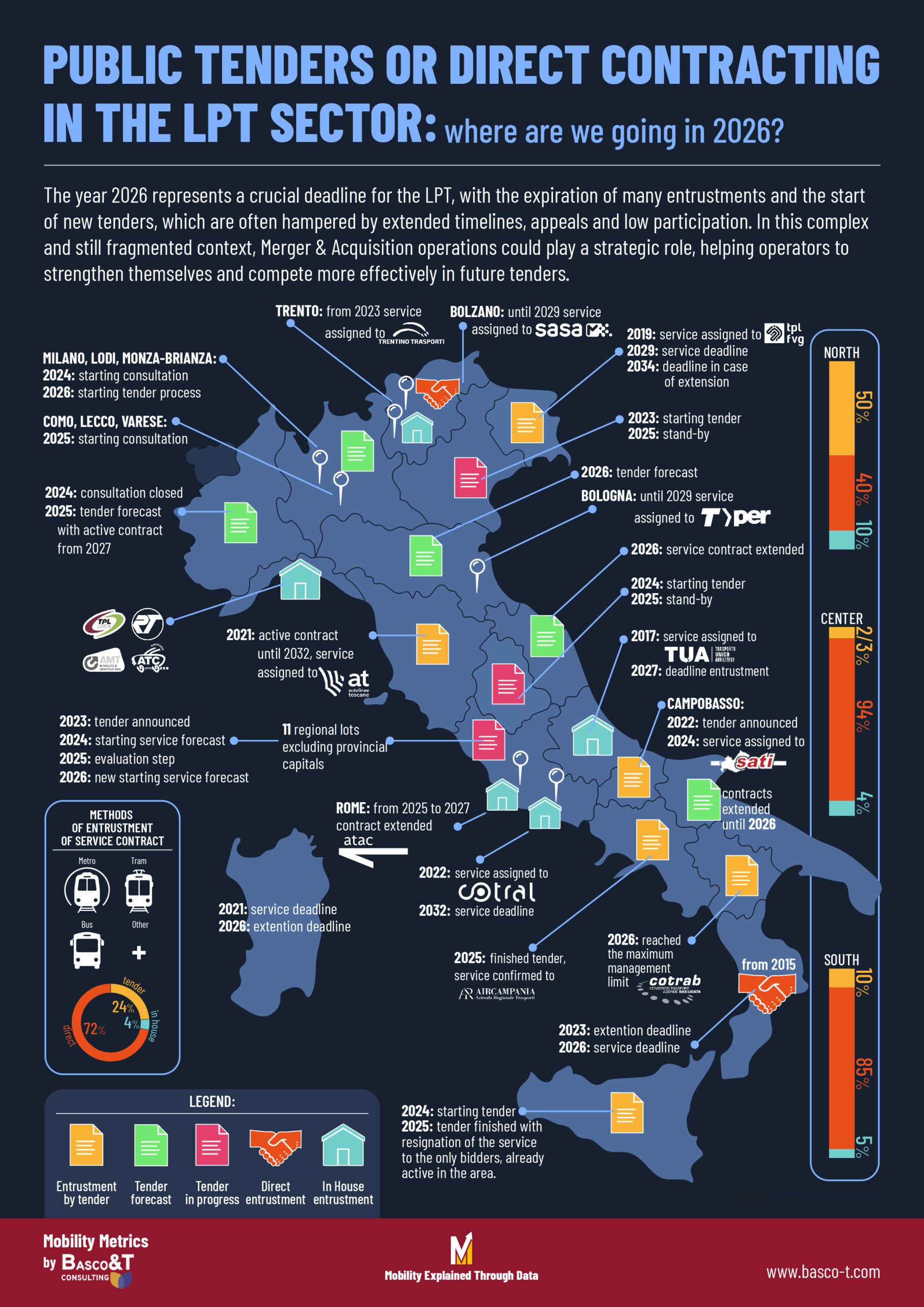
According to the latest data from the National Observatory on Local Public Transport, the awarding of public transport services in Italy reveals significant territorial disparities.
- In the North, the situation is relatively balanced: approximately half of the contracts have been awarded through public tenders, around 40% through direct awards, and the remaining 10% via in-house arrangements.
- In Centerinstead, domina nettamente l’affidamento diretto, che riguarda circa nove contratti su dieci. Le gare sono una rarità – appena il 2-3% del totale – e anche il ricorso alla modalità in-house è piuttosto limitato, attorno al 4%.
- In the South, 85% of contracts have been awarded without any form of competitive tendering. Only a small portion, about 10%, has been assigned through a tendering process, while in-house awards account for less than 5%, confirming that in the vast majority of cases, there has been no competition among operators.
Over the past ten years, the Local Public Transport (LPT) sector in Italy has undergone a period of intense reorganisation, marked by rationalisation processes, the consolidation of service contracts, company mergers, and public consultations in preparation for new tenders.
Scopri l’approfondimento completo sullo situation of tenders in Italy
In Trentino-Alto Adige, the province of Trento initiated in 2023 the procedure for awarding the local public transport (LPT) service through an in-house arrangement, confirming the current operator, Trentino Trasporti. Similarly, in the Autonomous Province of Bolzano, SASA S.p.A. has been confirmed as the operator through a direct award, with the contract extended until 2029.
In Piemonte, a public consultation concluded in December 2024, involving over 460 stakeholders. The tender, with an estimated total value of around €3 billion, was expected to be launched in spring 2025, with contracts coming into effect in 2027.
In Lombardia, the LPT Agency launched a public consultation in 2024 for organizing tenders in the Milan, Lodi, and Monza-Brianza areas, with procedures scheduled to take place by 2026. For the Como, Lecco, and Varese area, a public consultation has been convened for May 2025, aimed at identifying essential assets necessary for the provision of local bus services.
In Veneto, the Province of Rovigo launched its tender in 2023. Meanwhile, Liguria is moving toward in-house awards.
In Friuli Venezia Giulia, the service was awarded in 2019 to the consortium FVG SCARL through a ten-year contract with an optional five-year extension, meaning the contract is set to expire in 2029—or in 2034 if extended.
In Emilia-Romagna, the regional tender is expected in 2026. Specifically in Bologna, the current contract with TPER S.p.A. has been extended until 2029.
In Toscana, since 2021, the entire regional service has been awarded to Autolinee Toscane via a public tender, with the contract running until 2032.
In Lazio, the tender published in January 2023 is still in the bid evaluation phase. The service start, initially planned for 2024, has been postponed to 2026 (subject to further delays). In Rome, a Service Contract has been signed between the Municipality and ATAC S.p.A. for the 2025–2027 period. The contract for Cotral, awarded in-house in 2022, will expire in 2032.
In Umbria, the tender process for four service lots, launched in spring 2024, is currently on hold.
In Marche, all service contracts have been extended by regional decree until September 2026.
In Abruzzo, in 2015, ARPA, GTM, and Sangritana merged to form TUA S.p.A. Since 2017, TUA has held an in-house service contract with the Region, expiring in December 2027.
In Campania, MetroCampania NordEst, SEPSA, and Circumvesuviana were merged into Ente Autonomo Volturno in 2012. In 2013, Metronapoli and Napolipark were incorporated into ANM. More recently, in February 2025, the management of services in Avellino, Caserta, and Benevento was confirmed for Air Campania.
In Molise, a tender was launched in 2022 for the city of Campobasso, and the service was awarded to SATI S.p.A. in 2024.
In Basilicata, a pre-information notice for the tender was issued in 2022, but service provision has been extended to COTRAB until 2026, exceeding the 15-year maximum limit set by EU regulations.
In Puglia, as in Marche, most contracts have been extended until 2026.
In Calabria, direct awards have been repeatedly extended since 2015. The most recent extension, issued in 2023, prolonged service provision until 2026.
In Sicilia, the tender for the awarding of extra-urban LPT services, launched in 2024 and concluded in February 2025, saw participation exclusively from incumbent operators, who were subsequently reawarded the service.
In Sardegna, in 2023, the Regional Government extended service contracts, which had expired in December 2021, until December 2026.
To support local public transport operators and mitigate the effects of the COVID-19 pandemic, most service contracts were extended under the provisions of a Decree-Law issued in March 2022. This legislation allows for contract extensions if operators make investments whose depreciation periods exceed the remaining contract duration, provided the extension does not go beyond 31 December 2026.
As previously noted, 2026 will be a pivotal year for LPT in Italy, with many contracts set to expire and new tenders expected to launch. In this evolving scenario, merger and acquisition (M&A) operations may play a strategic role, helping operators consolidate and better position themselves to compete in upcoming tenders.
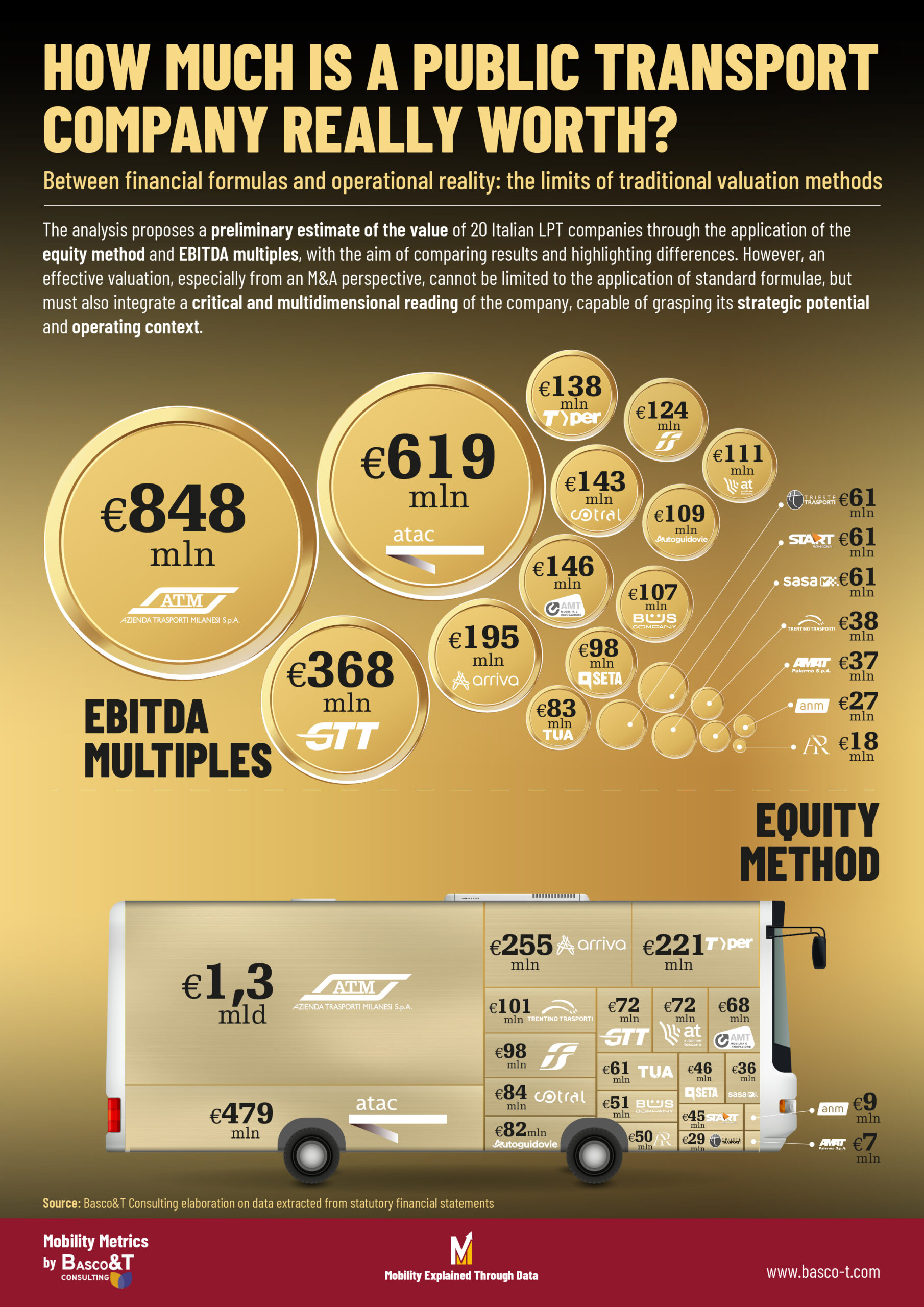
But How Much Is a Public Transport Company Really Worth?
In the context of mergers and acquisitions (M&A), the valuation of a company represents a critical step aimed at determining its economic value in a consistent and justifiable manner. To this end, reference is generally made to a set of widely accepted methodologies, which can be grouped into four main categories:
- The asset-based method, which is grounded in the net value of the company’s assets;
- The income-based method, which focuses on the company’s ability to generate future profits;
- The discounted cash flow (DCF) method, which values the company by discounting expected future cash flows;
- The market-based or comparative method, which evaluates the company by comparing it to similar businesses using market multiples.
Approfondisci i methods of valuing a LPT companies
Tuttavia per una valutazione ottimale, è need to consider a series of qualitative variables and contextual che non emergono dalle sole formule matematiche. Questi aspetti vanno tradotti in KPI management and compared with benchmark sectoral to get a reading comparative effective. Another key element is represented by the contractual conditions in: the type of custody, the duration the residual, the ability to predict tariff increasesthe mechanisms of the indexing the fees and the distribution of risks within the matrix of the contract. Only by integrating these dimensions into a structural analysis it is possible to return to a realistic assessment, and useful for strategic purposes of the operation.
The year 2026 marks a pivotal turning point for local public transport (LPT) in Italy. The launch of new tenders and the expiration of existing contracts will shape a future in which competition, mergers, and acquisitions will play a decisive role. M&A operations may enable operators to meet sector challenges with greater strength, optimising both resources and operational capabilities. However, the current fragmentation of the market and the predominance of small enterprises make the transition toward a more efficient model particularly complex. In the long term, the centrality of competitive tenders and corporate consolidation will drive the transformation of the sector, offering new opportunities—but also posing risks for those unable to adapt.