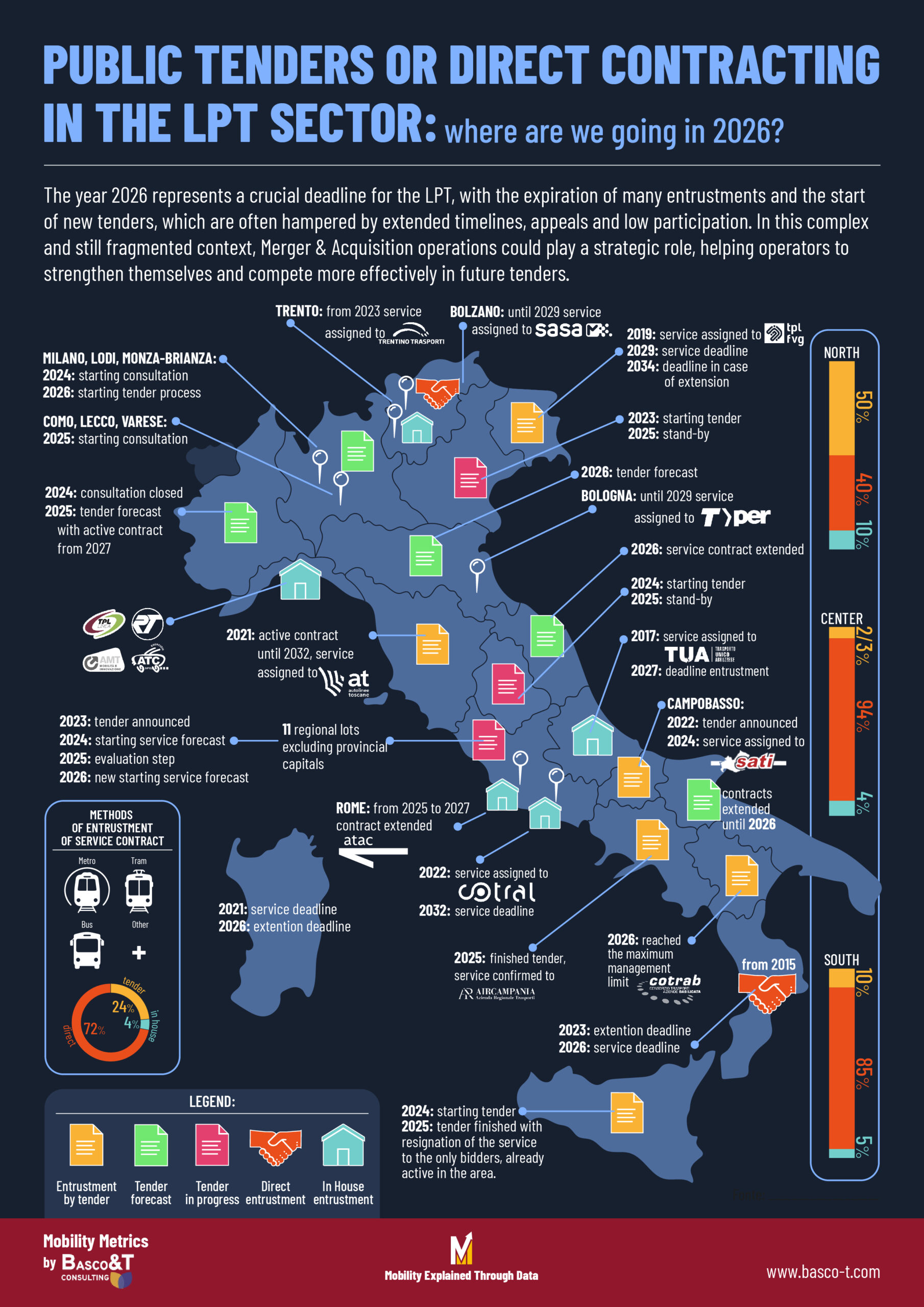
The year 2026 represents a crucial deadline for the LPT, with the expiration of many entrustments and the start of new tenders, which are often hampered by extended timelines, appeals and low participation. In this complex and still fragmented context, Merger & Acquisition operations could play a strategic role, helping operators to strengthen themselves and compete more effectively in future tenders.
Share on:
The regulatory framework of LPT in Italy
The local public transport (LPT) sector in Italy is regulated by an evolving set of regulations, both at the national and European level. The starting point is Legislative Decree 422/1997, known as the “Burlando Decree,” supplemented by Legislative Decree 400/1999.
These regulations introduced a new organizational model for the sector, based on the awarding of services through competitive bidding and the use of the service contract as the main instrument of regulation between public entity and operator.
After an initial phase in which the regions transposed the regulations and transformed the companies into corporations, entrusting by tender encountered numerous difficulties. In many cities, it was preferred to continue with direct entrustments, precisely because of the complexity of the procedures.
The European framework and the interventions of the Transport Regulatory Authority
At the European level, Regulation (EC) No. 1370/2007 introduced new rules for:
- compensation for public service obligations;
- the procedures for awarding service contracts;
- the maximum duration of contracts.
In the national sphere, an important reference is Resolution No. 49/2015 of the Transportation Regulatory Authority (ART), which established guidelines for drafting calls for tenders.
In May 2024, ART Resolution No. 64/2024 updated the rules for the entrustment of LPT services by road, simplifying procedures and standardizing the outline-types of the Entrustment Report and service contracts.
In Italy, most service contracts were extended under the Decree Law issued in March 2022. This measure provides that, in order to support Local Public Transport operators and mitigate the effects of the pandemic, in the event that investments are made, and the related amortization period exceeds the remaining term of the service contract, the latter may be extended, provided that such extension does not exceed the deadline of December 31, 2026.
The state of tenders in Italy
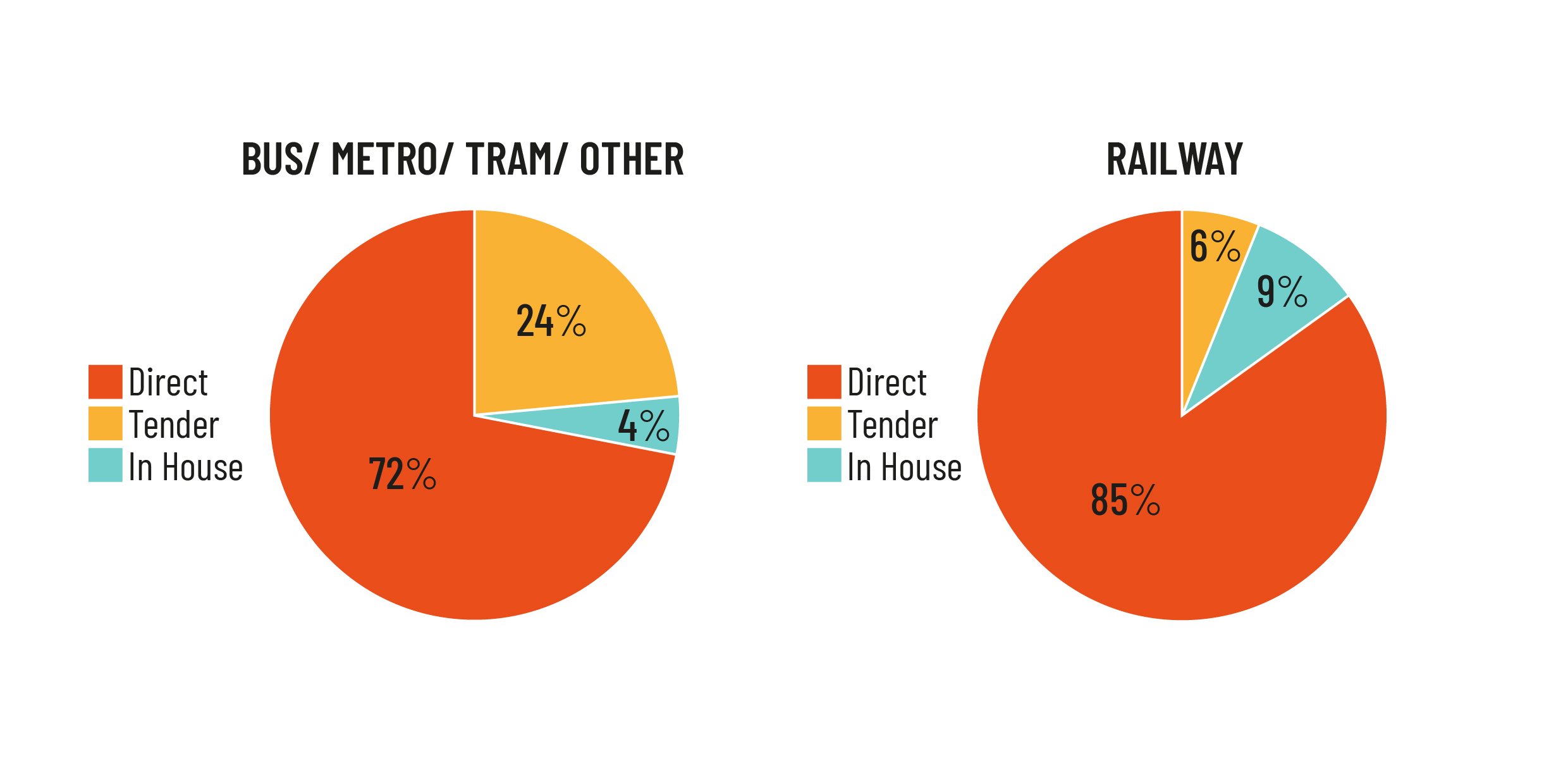
The Osservatorio del Trasporto Pubblico Locale (TPL) ha monitorato per anni l’andamento del settore e il grado di avanzamento della riforma. Anche se sono stati previsti incentivi per favorire la concorrenza, il ricorso allo strumento delle gare pubbliche per l’affidamento dei servizi resta ancora limitato.Nel trasporto ferroviario, la maggioranza of contratti of servizio (circa l’85%) risulta affidata direttamente, mentre solo una piccola parte (intorno al 6%) attraverso gare. Anche nel trasporto su gomma, come autobus, tram e metropolitane, prevale l’affidamento diretto: su oltre mille contratti rilevati, solo circa un quarto (24%) è stato aggiudicato tramite gara.
Methods of entrustment of Service Contracts
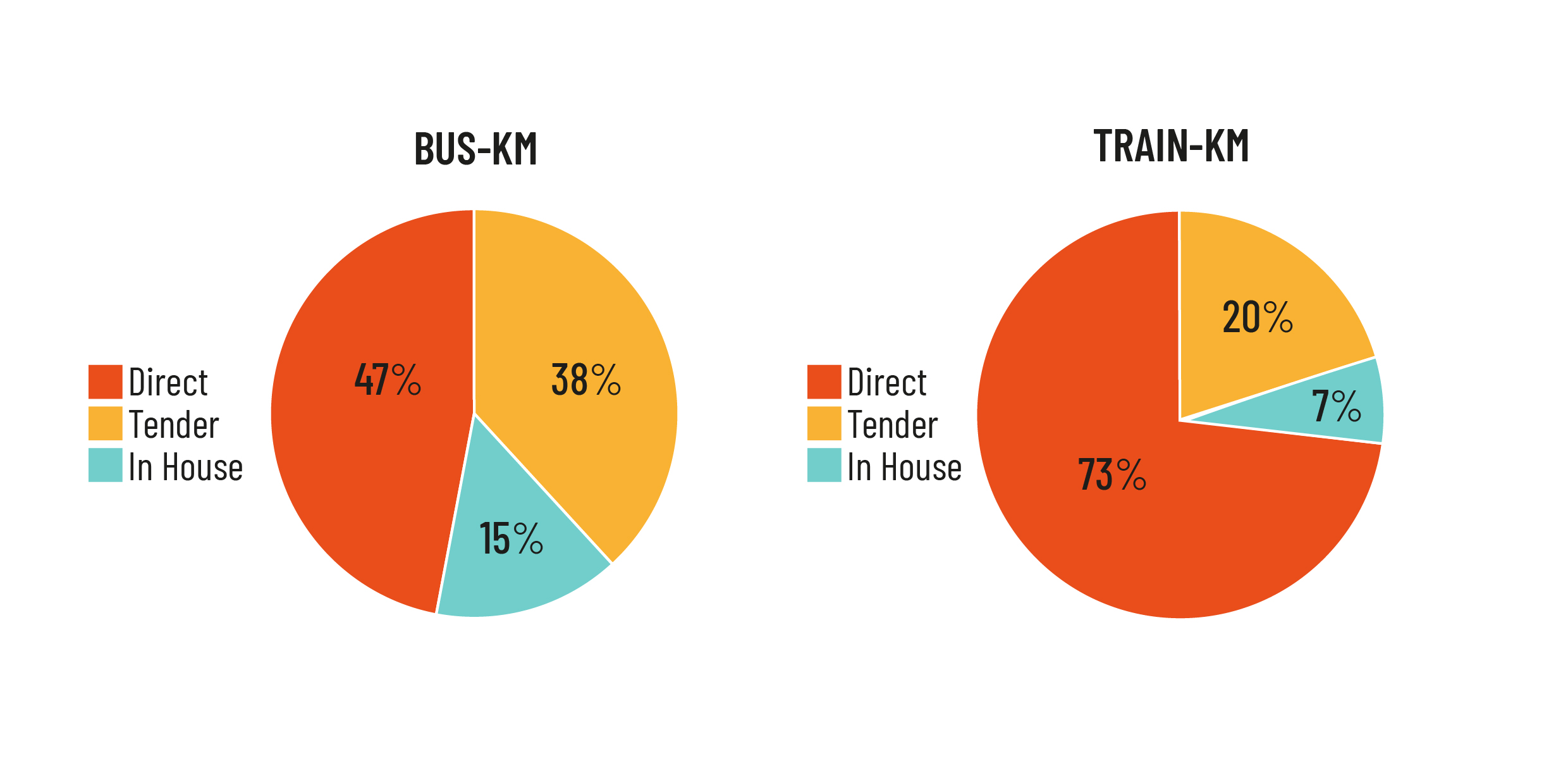
Also in terms of volume of services, tenders are more prevalent in road transport (around 38 percent) than in rail transport (around 20 percent), although direct entrusting still remains the most widely used mode.
% distribution of LPT production based on methods of entrustment of Service Contracts
According to the latest available data from the Observatory, in the North about half of public transport services were awarded by tender, while 40 percent were directly contracted out. A further 10 percent were given out on an “in-house” basis.
In Central Italy, the situation is different: about 9 out of 10 contracts were awarded directly, without a tender. Public tenders were used in only a very few cases (about 2-3%), while in-house contracting covered another 4%. Again, direct management by entities was almost entirely absent.
In the South, the trend is even more pronounced: about 85 percent of contracts were awarded without competitive bidding. Only a small portion (around 10%) were awarded through competitive bidding procedures. In-house awarding involved less than 5 percent of cases. This confirms that, in almost all cases, there was no competition among companies.
The LPT sector in Italy is also highly fragmented: companies are very diverse, both in size and legal form. More than 60 percent are micro or small companies, which makes coordinated and efficient management across the territory difficult.
The implementation of European Regulation 1370/2007 has been very uneven: some regions have tried to open up the market, while others have continued with extensions or direct entrustments. Tenders actually completed and fully operational still remain few. According to the ISFORT 2023 Report, many local governments have preferred to maintain the current status, often for fear of litigation or lack of in-house technical expertise.
How the regions have moved over the past decade
Over the past decade, however, the Italian LPT sector has seen the start of numerous reorganization processes.
In Trentino-Alto Adige, the province of Trento initiated in 2023 the procedure for awarding the local public transport (LPT) service through an in-house arrangement, confirming the current operator, Trentino Trasporti. Similarly, in the Autonomous Province of Bolzano, SASA S.p.A. has been confirmed as the operator through a direct award, with the contract extended until 2029.
In Piemonte, a public consultation concluded in December 2024, involving over 460 stakeholders. The tender, with an estimated total value of around €3 billion, was expected to be launched in spring 2025, with contracts coming into effect in 2027.
In Lombardia, the LPT Agency launched a public consultation in 2024 for organizing tenders in the Milan, Lodi, and Monza-Brianza areas, with procedures scheduled to take place by 2026. For the Como, Lecco, and Varese area, a public consultation has been convened for May 2025, aimed at identifying essential assets necessary for the provision of local bus services.
In Veneto, the Province of Rovigo launched its tender in 2023. Meanwhile, Liguria is moving toward in-house awards.
In Friuli Venezia Giulia, the service was awarded in 2019 to the consortium FVG SCARL through a ten-year contract with an optional five-year extension, meaning the contract is set to expire in 2029—or in 2034 if extended.
In Emilia-Romagna, the regional tender is expected in 2026. Specifically in Bologna, the current contract with TPER S.p.A. has been extended until 2029.
In Toscana, since 2021, the entire regional service has been awarded to Autolinee Toscane via a public tender, with the contract running until 2032.
In Lazio, the tender published in January 2023 is still in the bid evaluation phase. The service start, initially planned for 2024, has been postponed to 2026 (subject to further delays). In Rome, a Service Contract has been signed between the Municipality and ATAC S.p.A. for the 2025–2027 period. The contract for Cotral, awarded in-house in 2022, will expire in 2032.
In Umbria, the tender process for four service lots, launched in spring 2024, is currently on hold.
In Marche, all service contracts have been extended by regional decree until September 2026.
In Abruzzo, in 2015, ARPA, GTM, and Sangritana merged to form TUA S.p.A. Since 2017, TUA has held an in-house service contract with the Region, expiring in December 2027.
In Campania, MetroCampania NordEst, SEPSA, and Circumvesuviana were merged into Ente Autonomo Volturno in 2012. In 2013, Metronapoli and Napolipark were incorporated into ANM. More recently, in February 2025, the management of services in Avellino, Caserta, and Benevento was confirmed for Air Campania.
In Molise, a tender was launched in 2022 for the city of Campobasso, and the service was awarded to SATI S.p.A. in 2024.
In Basilicata, a pre-information notice for the tender was issued in 2022, but service provision has been extended to COTRAB until 2026, exceeding the 15-year maximum limit set by EU regulations.
In Puglia, as in Marche, most contracts have been extended until 2026.
In Calabria, direct awards have been repeatedly extended since 2015. The most recent extension, issued in 2023, prolonged service provision until 2026.
In Sicilia, the tender for the awarding of extra-urban LPT services, launched in 2024 and concluded in February 2025, saw participation exclusively from incumbent operators, who were subsequently reawarded the service.
In Sardegna, in 2023, the Regional Government extended service contracts, which had expired in December 2021, until December 2026.
The critical issues in tenders
Among the main critical issues that emerge in tenders for the awarding of LPT services:
- Long timescales: several years can pass between publication, submission of bids, award and entry into operation, risking rendering obsolete the economic, technical and operational assumptions on which the tender was built.
- Litigation: tenders are often subject to appeals to administrative bodies, which can suspend or cancel procedures, further delaying the start of services.
- Low participation: some tenders have unattractive economic or technical conditions, resulting in limited or no participation, and resort to direct awards due to urgency.
Toward 2026: a key year
The year 2026 represents an important deadline for the sector, with the end of many contracts and the likely start of new tenders. This will result in more stringent requirements, both organizationally and financially.
In this context, Merger and Acquisition (M&A) transactions could be a tool for operators wishing to strengthen themselves in view of competing for new entrustments. In a system that is still highly fragmented, these dynamics could affect the future structure of the industry.
Also read our recent article on the Fragmentation of LPT sector.