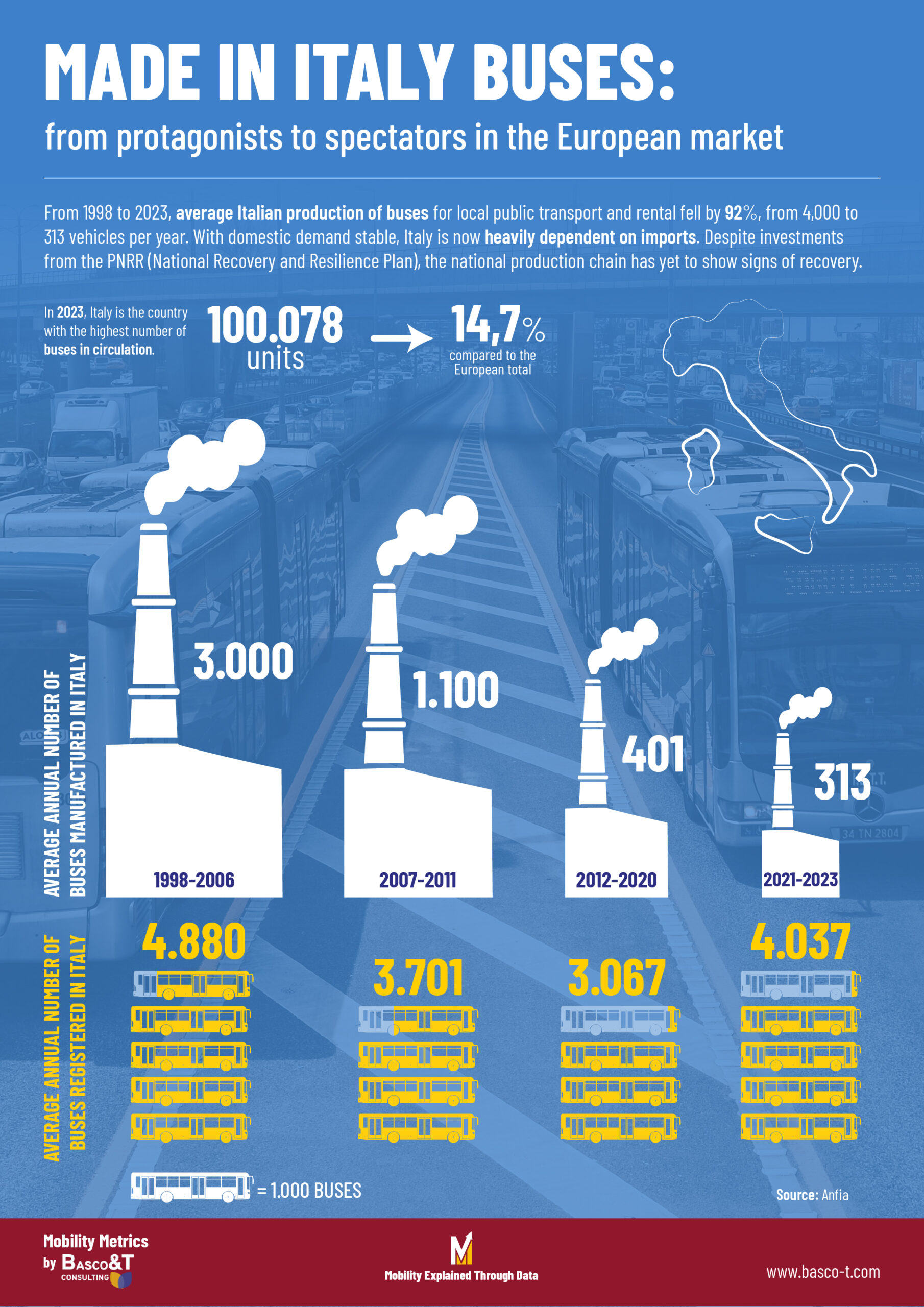
From 1998 to 2023, average Italian production of buses for local public transport and rental fell by 92%, from 4,000 to 313 vehicles per year. With domestic demand stable, Italy is now heavily dependent on imports. Despite investments from the NRRP (National Recovery and Resilience Plan), the national production chain has yet to show signs of recovery.
Share on:
Italy's bus production capacity has fallen from 4,000 units in 1998 to 148 in 2019, a 21-year journey that has led to the almost total importation of the vehicles that transport millions of people in Italy every day.
In 1998, Italy produced around 4,000 buses per year, accounting for 11% of total production in the European Union. This share has fluctuated over time, with periods of contraction alternating with phases of recovery:
- Between 1998 and 2006, production remained at an annual average of about 3,000 units;
- Between 2007 and 2011, there was a significant drop, with an average of 1,100 buses produced each year;
- Between 2012 and 2020, average production dropped further, averaging 401 units per year;
- Between 2021 and 2023, despite the recent opening of IVECO's production hub in Foggia (supported by investments under the National Recovery and Resilience Plan (NRRP)), average production continued to decline, averaging 313 buses produced per year.
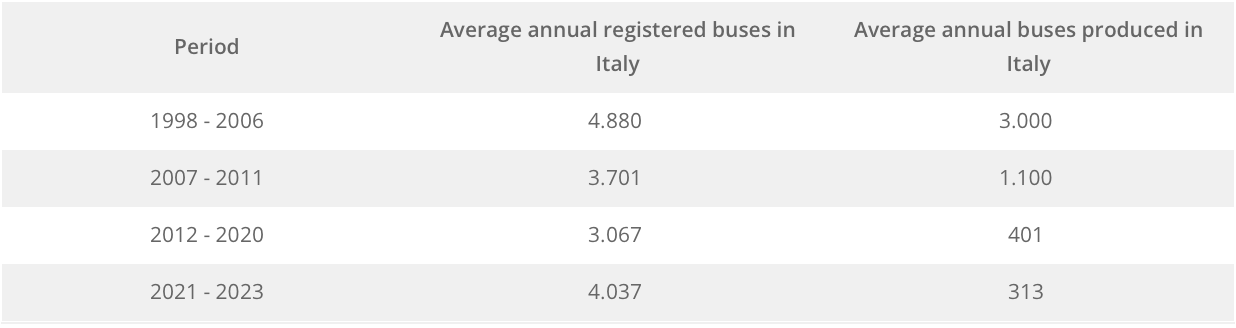
Elaborazione Basco&T consulting su dati Anfia
The figure is even more surprising when one considers that Italy has the largest fleet in the European Union (about 100,078 buses in circulation, or 15 percent of the European Union total), and is second in 2024 in terms of number of registrations (6,594, 14.4 %).
In fact, in 2024, the vehicle registration landscape in Italy is dominated by a small group of ten manufacturers, responsible for nearly nine out of ten vehicles. Altogether, these companies totaled 5,831 new registrations, corresponding to 88.4% of the market, a percentage slightly up from the previous year (88.3% with 4,597 units).
Leading the ranking is Iveco, which alone accounts for more than 44 percent of the market with 2,930 registered vehicles. The second position belongs to Mercedes-Benz, which registered 878 units (13.3%) in 2024, followed by Solaris with 551 vehicles (8.4%). Otokar and Menarinibus occupy the fourth and fifth places, respectively, with 314 (4.8%) and 285 units (4.3%).
Completing the top 10 are Ford (262 vehicles, 4.0 percent), MAN (184, 2.8%), Scania (181, 2.7%), Karsan (134, 2.0%) and Setra (112, 1.7%).
The remaining registrations, attributed to brands outside the top ten, amounted to 763 units in 2024, accounting for 11.6% of the total. This share remains in line with the 2023 figure, when smaller manufacturers had registered 608 vehicles, covering 11.7% of the market.
Until the first half of the 2000s, production trends followed a parallel dynamic to those of registrations, suggesting a link between demand and production capacity.
However, the gradual decline in production has led to a growing dependence on imports, with significant implications for the domestic industrial sector.
In conclusion, an analysis of the evolution of the bus industry in Italy shows an increasingly pronounced disconnect between domestic demand and domestic production capacity. Although Italy maintains a leading role in Europe in terms of vehicle registrations and fleet size, domestic production has been steadily declining for more than two decades. The negative trend has not stopped even in the face of major public investments, such as those of the PNRR or the opening of IVECO's new production hub in Foggia.
In light of this, it seems clear how Italy is wasting a strategic opportunity to revitalize a sector that could play a central role in the transition to a more sustainable and competitive mobility at the European level.
In the article published on 2nd April,European bus market: Italy leads in terms of buses in circulation and registrations in 2024, but production has moved abroad. We analysed the Italian bus market in detail within the European context, highlighting how, despite leading the way in terms of vehicles in circulation and ranking among the top countries for new registrations, Italy remains heavily dependent on foreign production.