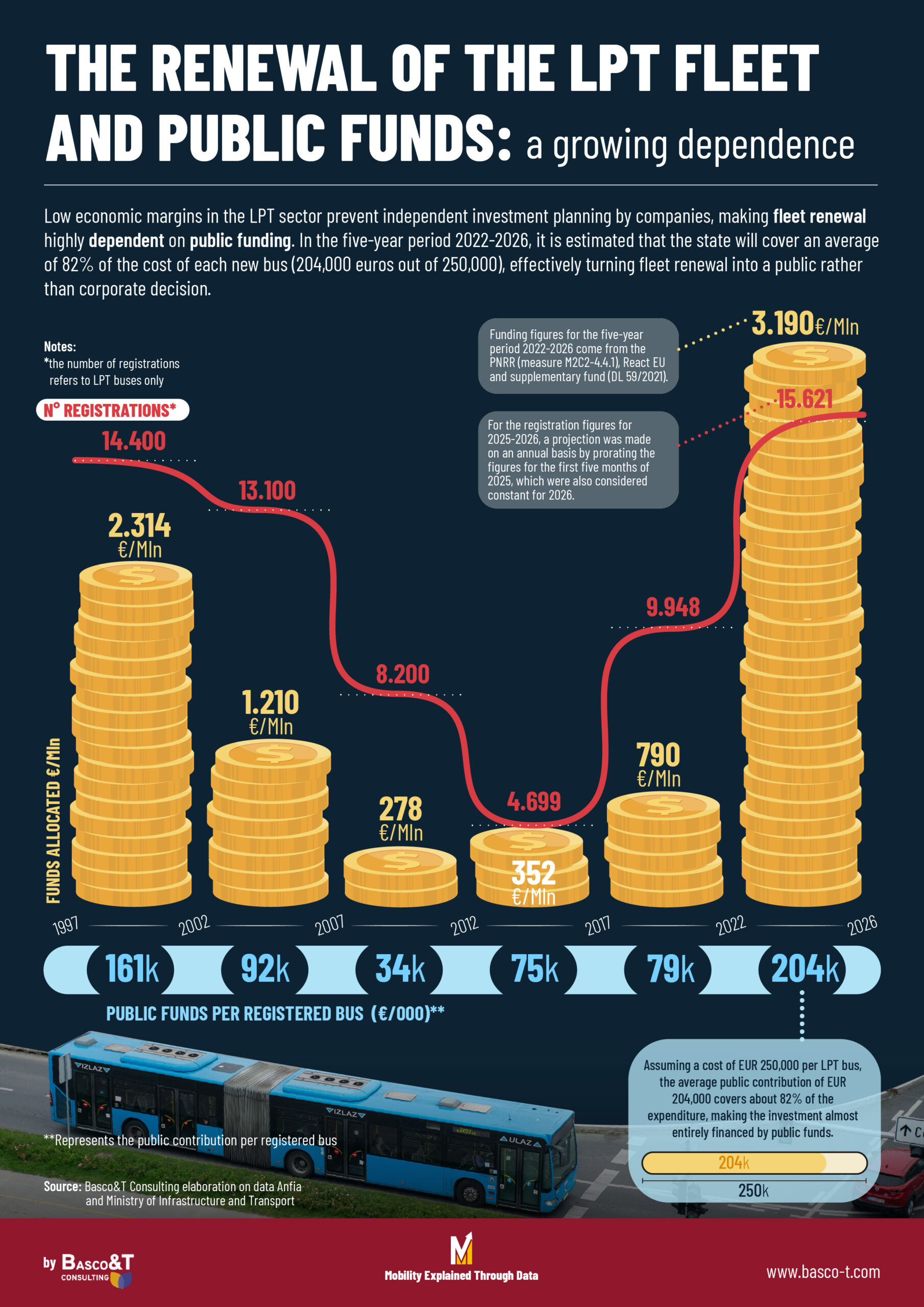
Low economic margins in the LPT sector prevent independent investment planning by companies, making fleet renewal highly dependent on public funding. In the five-year period 2022-026, it is estimated that the state will cover an average of 82% of the cost of each new bus (204,000 euros out of 250,000), effectively turning fleet renewal into a public rather than corporate decision.
Share on:
To assess the correlation between the public funds allocated and the renewal of the bus fleet destined for local public transport (LPT), an analysis was conducted on data on bus registrations destined for LPT in Italy over the period 1997-2026:
- for the years 1997 to 2012, data were estimated on the basis of data provided by Anfia;
- for the years 2013 to 2024, official data extracted from Anfia were used;
- for 2025, a projection was made on an annual basis, proportioning the data collected in the first 5 months of the year, the result was then assumed constant throughout 2026.
Then, the enrollment data were compared with the public funds allocated in the respective five-year periods from 1997 to 2026. Specifically, with regard to the funds for the five-year period 2022-2026, the data came from the NRRP, React EU and Supplementary Fund (DL 59/2021).
Fleet renewal in LPT is an ongoing process, necessitated by technical and regulatory obsolescence of vehicles, as well as extraordinary events such as accidents, breakdowns or scrapping. However, the sector's low profitability severely limits companies' ability to invest independently, making financial support from the state crucial.
The objective of the analysis is to understand how much the provision of public funds actually affects LPT companies' investments in fleet renewal, and whether such renewal is actually dependent on such funding. To do this, the last five years was taken as the main reference, and it was calculated how much of the fund is used on average for the purchase of a bus, assuming an average price of 250 thousand euros in 2024.
Methodology
The analysis is based on four main elements:
- Public funds allocated for the purchase of buses over the period 1997-2026;
- The number of buses registered in Italy over the period 1997-2026;
- Public funds per bus registered which is the average amount of fund used for the purchase of a single bus, expressed in €/000. To calculate it, the ratio of allocated funds to the number of registered buses in the same period was carried out.
This methodology makes it possible to test an intuitively shared hypothesis: as public funds increase, so does the number of registered buses. However, this raises a key question: at what cost?
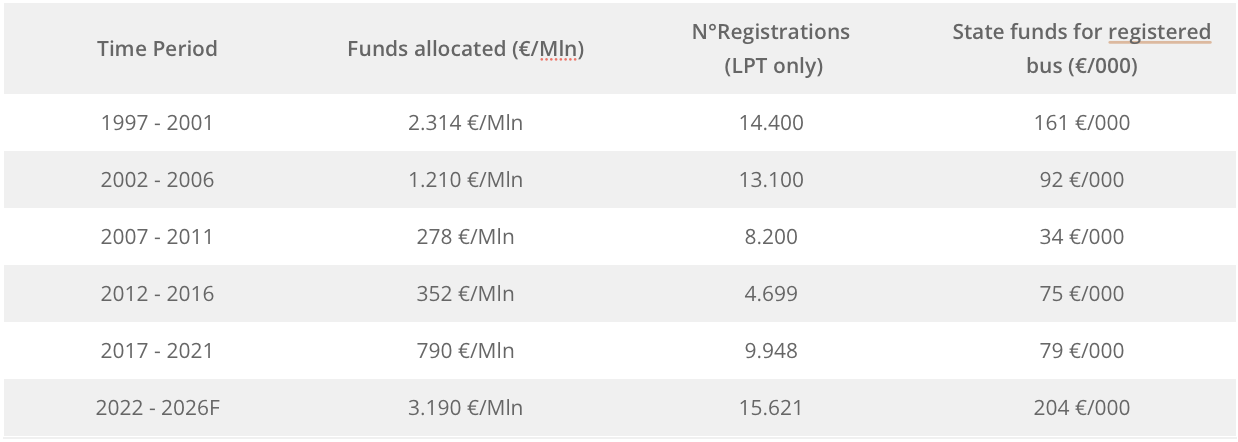
Basco&T Consulting elaboration on data extracted from Anfia and Ministry of infrastructure and Transport
The results of the analysis indicate that over the period 1997-2026, the market has gradually developed a dependence on public funds. This dependence can be attributed on the one hand to the limited self-financing capacity of LPT companies, due to the low margins in the sector, and on the other hand to the continuous disbursement of resources, which have increased significantly in recent years (particularly since 2017). In this context, fleet renewal tends to increasingly take the form of a public policy decision rather than a strategic business choice.
Public Funds per registered bus highlights how the coverage of expenditure through public funding has progressively increased, particularly with the start of the PNRR. Considering, as of today, a cost of 250,000 euros for the purchase of a new bus dedicated to LPT, public funds will cover almost the entire expenditure.
Although the increase in public funds may initially appear as a positive sign - as concrete support for the sector - in the long run it highlights an increasing dependence of the market on these resources. This phenomenon gradually shifts the responsibility for fleet renewal from the companies to the state, transforming it from an autonomous strategic choice to a decision driven by the availability of public funding. However, since the disbursement of funds is neither guaranteed nor constant over time, there is a risk of fueling a fragile system, exposed to sudden disruptions that could halt or drastically slow vehicle replacement.