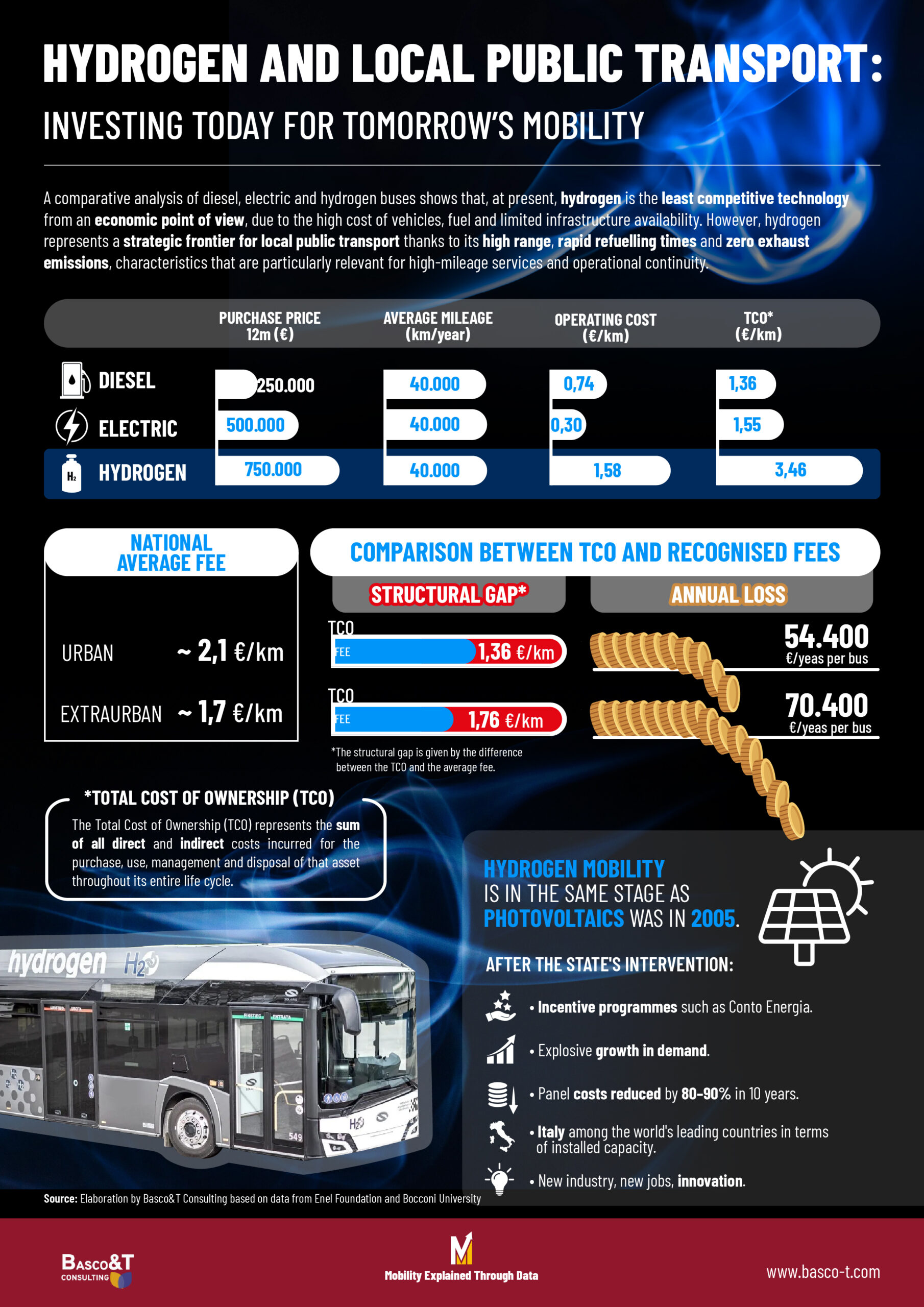
A comparative analysis of diesel, electric and hydrogen buses shows that, at present, hydrogen is the least competitive technology from an economic point of view, due to the high cost of vehicles, fuel and limited infrastructure availability. However, hydrogen represents a strategic frontier for public transport thanks to its high range, rapid refuelling times and zero exhaust emissions, characteristics that are particularly relevant for high-mileage services and operational continuity.
Today, hydrogen is not competitive because the market is too small: costs are high not because of technological limitations, but because of the absence of economies of scale. Without targeted public action, a vicious circle is created in which costs remain high and investments do not get off the ground. Structured policies, on the other hand, can trigger a virtuous circle capable of progressively reducing the cost of vehicles, fuel and infrastructure, as has already happened in the photovoltaic sector.
Share on:
Introduzione
Hydrogen mobility is a potentially decisive technology for the future of local public transport: it offers high autonomy, refuelling in just a few minutes and zero local emissions. Despite these advantages, the purchase and operating costs currently make hydrogen buses uncompetitive compared to diesel and electric solutions.
This scenario does not indicate an intrinsic limitation of the technology, but reflects the initial stage of development of a supply chain that does not yet benefit from economies of scale. In this context, no local public transport company can sustain a significant adoption of hydrogen on its own.
The role of the state, therefore, is not to “replace the market”, but to create the conditions for the market to grow, generate volume, reduce unit costs and make the technology progressively sustainable. This is the same mechanism that made the spread of photovoltaics possible.
Comparative economic analysis (diesel – electric – hydrogen)
Operating costs and TCO – Data and methodology
Data relating to a 12-metre bus were reworked to estimate, for each technology:
- Operating cost (fuel/energy + maintenance; excluding personnel)
- TCO (Total Cost of Ownership) per km, calculated as purchase cost per km + operating cost per km.
Summary table
| Diesel | Elettrico | Idrogeno | |
| Prezzo d’acquisto 12m (€) | 250.000 | 500.000 | 750.000 |
| Percorrenza media (km/anno) | 40.000 | 40.000 | 40.000 |
| Vita Media (anno) | 10 | 10 | 10 |
| Percorrenza totale (km/10 anni) | 400.000 | 400.000 | 400.000 |
| Costo d’acquisto (€/km) | 0,63 | 1,25 | 1,88 |
| Consumo (l/kWh/kg per km) | 0,35 | 1,10 | 0,11 |
| Prezzo unitario (€/l – €/kWh – €/kg) | 1,39 | 0,12 | 13,00 |
| Costo Consumo (€/km) | 0,49 | 0,13 | 1,43 |
| Manutenzione (€/km) | 0,30 | 0,17 | 0,10 |
| Costo Esercizio (€/km) | 0,79 | 0,30 | 1,53 |
| TCO (€/ km) | 1,41 | 1,55 | 3,41 |
Basco&T Consulting elaboration on data from Bocconi University, Enel Foundation and Ministry of the Environment and Energy Security
Notes: Values exclude VAT. Personnel costs are not included in the calculation.
Operating costs
The operating cost is the sum of consumption and maintenance:
- Diesel: 0,74 €/km
- Electric 0,30 €/km
- Hydrogen 1,58 €/km
The most significant factor is that the cost of hydrogen is currently driven by the price of the molecule (€/kg), which is still high due to limited production and distribution scale.
Total Cost of Ownership (TCO)
The Total Cost of Ownership (TCO), on the other hand, represents the sum of all direct and indirect costs incurred for the purchase, use, management and disposal of that asset throughout its entire life cycle.
The TCO per km shows a clear difference:
| Tecnologia | TCO (€/km) |
| Diesel | 1,36 |
| Elettrico | 1,55 |
| Idrogeno | 3,46 |
Basco&T Consulting elaboration
It follows that hydrogen has a TCO +154% compared to diesel and +129% compared to electric, highlighting that, under current conditions, it is not economically sustainable without forms of compensation and industrial policy.
Comparison between TCO and fees paid to companies
Current fees and future scenarios
The average national fee paid to local public transport companies for the provision of transport services has been estimated. To this end, the fees applied by the main local public transport companies operating in Italy were analysed in order to obtain a representative average value.
The analysis highlights significant regional differences: some regions, such as Lombardy (€4.1/km) and Lazio (€3.62/km), have fee levels significantly higher than the national average. However, considering all the available data, the national average fee can be traced back to the following indicative values:
| Service | Corrispettivo Medio Nazionale |
| Urbano | ~ 2,1 €/km |
| Extraurbano | ~ 1,7 €/km |
These values are used as a reference to compare the TCO of technologies with the remuneration currently paid to operators.
The economic gap of hydrogen
With a TCO pari a 3,46 €/km per un autobus a idrogeno, i corrispettivi medi riconosciuti risultano significativamente inferiori:
- Urbano: 2,1 €/km
- Extraurbano: 1,7 €/km
This results in a structural gap of:
- Urbano: 3,46 − 2,10 = 1,36 €/km
- Extraurbano: 3,46 − 1,70 = 1,76 €/km
Quantification of annual loss (40,000 km/year)
- Urbano: 1,36 × 40.000 = 54.400 €/anno per bus
- Extraurbano: 1,76 × 40.000 = 70.400 €/anno per bus
Therefore, with an average annual mileage of 40,000 km, a hydrogen bus generates a loss of between approximately €55,000 and over €70,000 per year, making its adoption economically unsustainable without a public compensation mechanism.
Why hydrogen costs so much today (structural and NON-permanent causes)
The high costs of hydrogen are not due to technological inefficiencies, but to immature market conditions:
- Lack of economies of scale on vehicles
H2 bus production is still limited → higher prices.
- Costo della molecola dell’idrogeno
Green H2 production is not yet industrialised, which keeps prices high.
- Virtually non-existent infrastructure
A refuelling station costs €3–6 million.
Without subsidies, no company can install one.
- Incomplete supply chain
There is a lack of suppliers, specialised maintenance technicians and established standards.
The strategic role of the State: transforming a vicious circle into a virtuous circle
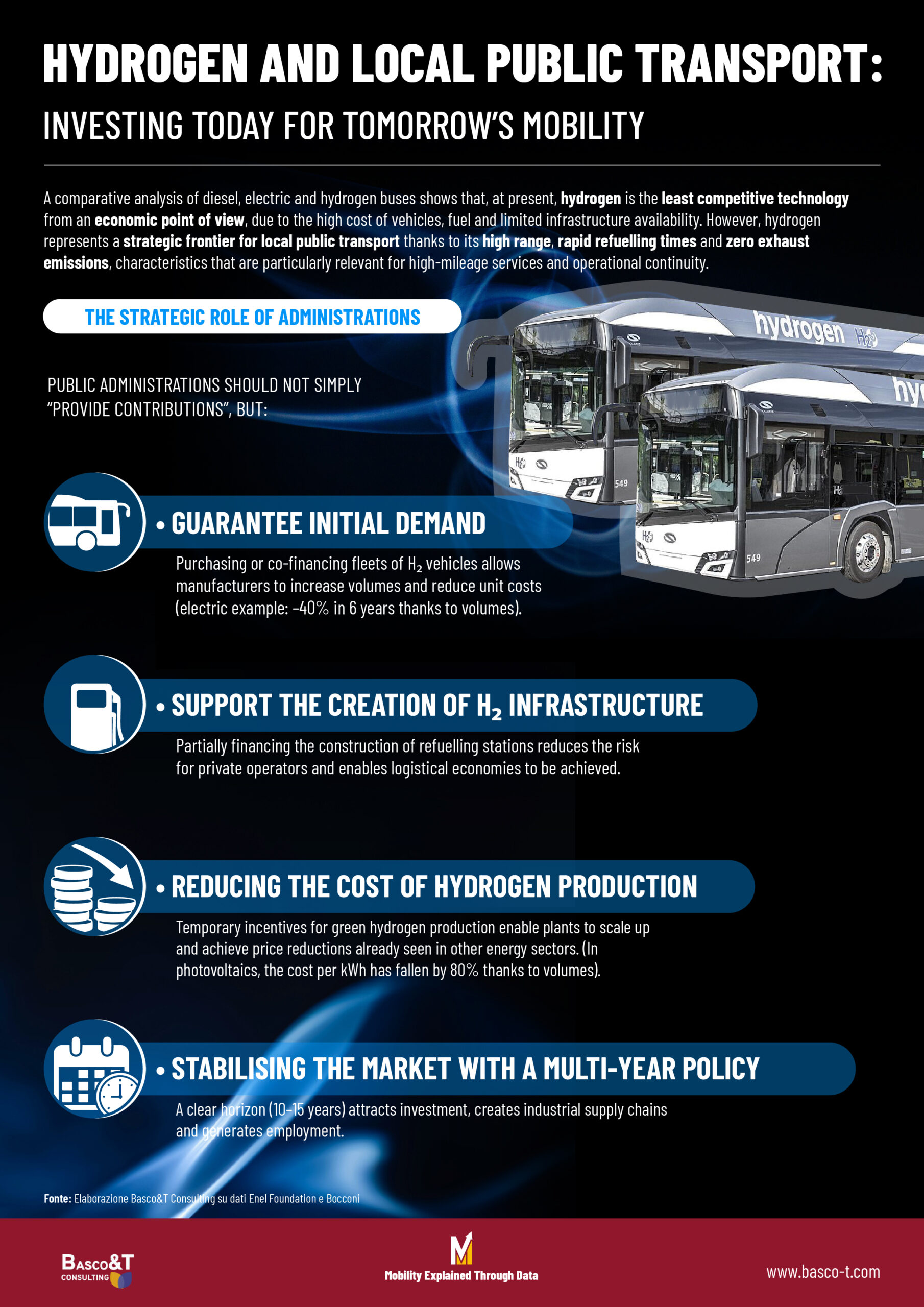
Public administrations should not simply “give grants”, but rather:
- Guarantee initial demand
Purchasing or co-financing fleets of H₂ vehicles allows manufacturers to increase volumes and reduce unit costs (electric example: -40% in 6 years thanks to volumes)
- Support the creation of H₂ infrastructure
Partially financing the construction of refuelling stations reduces the risk for private operators and allows for logistical economies to be initiated.
- Reduce the cost of the molecule
Temporary incentives for green hydrogen production allow for plant scaling and price reductions already seen in other energy sectors. (In photovoltaics, the cost per kWh has fallen by 80% thanks to volumes)
- Stabilise the market with a multi-year policy
A clear horizon (10–15 years) attracts investment, creates an industrial supply chain and generates employment.
The historical precedent: the photovoltaic revolution
Photovoltaics is the perfect example of how an initially expensive technology can become competitive thanks to a combination of:
- initial incentives
- regulatory stability
- growth in demand
- automatic economies of scale
Before incentives:
- Very expensive photovoltaic modules
- Few installers
- No industrial supply chain
- Zero economic convenience
After government intervention:
- Incentive programmes such as Conto Energia
- Explosive growth in demand
- Panel costs reduced by 80–90% in 10 years
- Italy among the world's leading countries in terms of installed capacity
- New industry, new jobs, innovation
Today, photovoltaics is the most economical source of energy.
This result would never have been achieved without the initial phase of public support. senza la fase di sostegno pubblico iniziale.