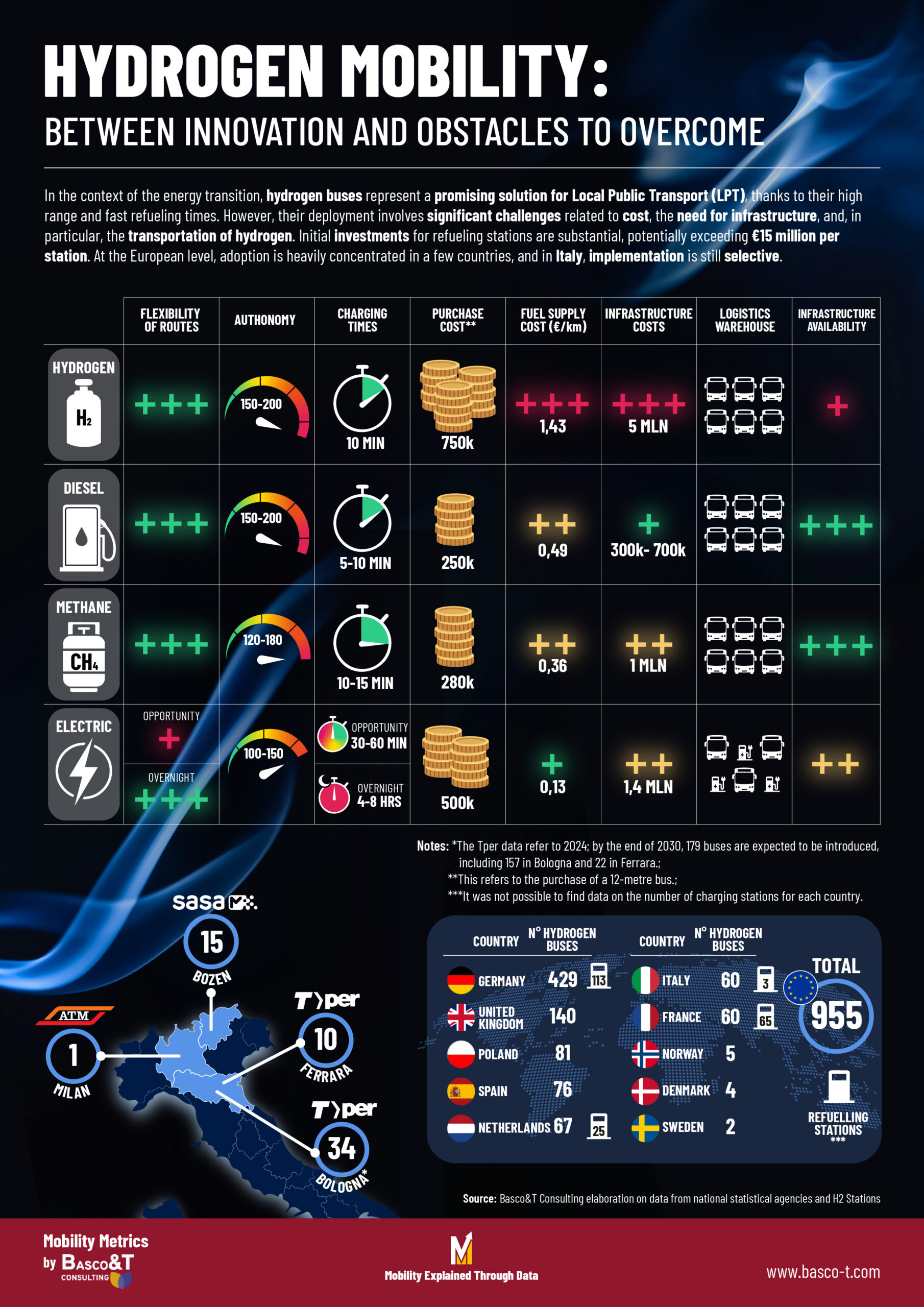
In the context of the energy transition, hydrogen buses represent a promising solution for Local Public Transport (LPT), thanks to their high range and fast refueling times. However, their deployment involves significant challenges related to cost, the need for infrastructure, and, in particular, the transportation of hydrogen. Initial investments for refueling stations are substantial, potentially exceeding €15 million per station. At the European level, adoption is heavily concentrated in a few countries, and in Italy, implementation is still selective.
Share on:
Data and methodology
We analyzed the average daily kilometers, recharging times, and main costs for each bus type, comparing them.
Subsequently, we compiled a general Italian and European mapping of hydrogen buses in circulation and the number of infrastructures present in the territory.
How Hydrogen Buses Really Work
Hydrogen production for buses primarily uses green hydrogen (from renewable sources) and, in some cases, grey or blue hydrogen (derived from natural gas). Transportation, whether in compressed form at high pressure or liquid form at very low temperatures, is complex: not only is it expensive to produce, but transporting it involves significant energy losses, while also raising environmental concerns related to potential polluting emissions.
Di conseguenza, l’infrastruttura per i bus a idrogeno è oggi la più costosa tra le alternative disponibili: una stazione di rifornimento può richiedere investimenti tra i 5 e i 15 milioni di euro. L’infrastruttura Diesel, in confronto, è già consolidata e ha costi contenuti.
Electric infrastructure, with depot charging points, while less expensive than Hydrogen, still has significantly higher investment costs than Diesel. Furthermore, the limitation of electric is its lower operational flexibility, due to range constraints and long charging times—a problem that fuel solutions like Diesel and Hydrogen do not present.
Daily range and charging compared
(Figures in thousands)
| Autonomia richiesta | Tecnologie più adatte | |
| Urbane | 100–150 km/giorno | Elettrico, Metano, Diesel |
| Extraurbane | 150–250 km/giorno | Diesel, Idrogeno, Metano |
| Lunga percorrenza | >250 | Diesel, Metano |
(Figures in thousands)
| Tecnologia | Idrogeno | Diesel | Metano | Elettrico |
| Costo acquisto (12m) | 750 | 250 | 280 | 500 |
| Costi infrastrutture (€) | 5.000 per l’infrastruttura complessiva 1.200 per l’infrastruttura di produzione | 300 – 700 | 1.00 | 7.40 |
| Autonomia Giornaliera (Km) | 150-200 | 150-200 | 120-180 | 100-150 |
| Tempi di ricarica | 10 min | 5 -10 min | 10 -15 min | Overnight (4–8 ore) Opportunity(30–60 min) |
| Flessibilità percorsi | Molto flessibile, nessuna limitazione di percorso e possono coprire qualsiasi tratta se sono presenti stazioni di rifornimento | Molto flessibile, può coprire qualsiasi tipo di tratta e possono subire deviazioni senza vincoli di ricarica | Flessibilità simile a quella di Diesel ed Idrogeno | Meno flessibile, il bus è vincolato a linee che hanno un capolinea attrezzato per la ricarica e quindi non può subire deviazioni dal percorso stabilito |
| Costo alimentazione (€/km) | 1,43 | 0,49 | 0,36 | 0,13 |
| Logistica Depositi | Rifornimento serale che necessità di pochi minuti e parcheggio notturno ravvicinato | Come l’idrogeno | Come l’idrogeno | Per la ricarica Overnight i bus vengono ricaricati mentre sono fermi in deposito. Ciò comporta che debbano essere installate molte colonnine, richiedendo più spazio e personale operativo |
The choice of the most suitable technology for public transport is closely linked to the daily range required and charging or refuelling times.
Electric vehicles (BEVs) are mainly suited to urban use and short journeys. Their limited range (100–150 km) affects operational efficiency, which is based on two charging modes:
- Overnight charging, which is slow and prolonged, carried out in the depot.
- Opportunity charging, which is fast but carried out exclusively at the terminus.
Due to these range limitations, approximately 1.2 electric buses are needed to replace one diesel bus. This translates into higher initial investment costs for the purchase of more vehicles, but this is offset by significant energy savings and lower emissions.
On the contrary, technologies such as methane and diesel offer maximum operational flexibility for urban and extra-urban routes, thanks to their high range and very fast refuelling times (5–15 minutes).
Despite this, hydrogen is proposed as the direct successor to diesel in terms of logistical efficiency: thanks to comparable range and refuelling times of around 10 minutes, it guarantees a 1:1 operating ratio compared to diesel.
In summary, hydrogen is so efficient that, if the necessary infrastructure were widespread, it could completely replace diesel, maintaining the same level of operation and flexibility on all routes, without requiring an increase in the number of vehicles as would be the case with electric vehicles.
General mapping and comparison of countries
| Città | Bus ad Idrogeno | Incidenza su Tot |
| Bologna | 34 | 57% |
| Bolzano | 15 | 25% |
| Ferrara | 10 | 17% |
| Milan | 1 | 2% |
| Total | 60 | 100% |
Notes: The data provided by Tper refer to 2024; further registrations are expected in 2025.
The spread of hydrogen buses in Italy is still limited and selective, but is concentrated in a few pioneering cities that are leading the transition. Currently, a total of 60 hydrogen buses are in operation, supported by three dedicated infrastructures. Bologna leads the way with 34 vehicles, representing 57% of the national total, followed by Bolzano with 15 buses (25%) and Ferrara with 10 (17%), while Milan has only one vehicle (2%).
These figures highlight that adoption is still linked to the availability of infrastructure and the local willingness to invest in low-emission technologies. Looking ahead, adoption is set to expand significantly: thanks to PNRR funds, Bologna alone has already ordered 157 new hydrogen buses, which are expected to be delivered by 2030.
| Paese | Bus ad Idrogeno | Incidenza su Tot |
| Germany | 429 | 44,9% |
| United Kingdom | 140 | 14,7% |
| Polonia | 81 | 8,5% |
| Spain | 76 | 8,0% |
| Netherlands | 67 | 7,0% |
| Italy | 60 | 6,3% |
| France | 60 | 6,3% |
| Norvegia | 5 | 0,5% |
| Danimarca | 4 | 0,4% |
| Sweden | 2 | 0,2% |
| Total | 955 |
Notes: The data, sourced from national statistical agencies and dating back to 2024, refer to the fleet H2
In the European hydrogen-powered public transport landscape, Germany stands out with 429 buses, representing 44.9% of the continent's total fleet.
It is followed by the United Kingdom with 140 vehicles (14.7%) and Poland with 81 (8.5%), while Spain and the Netherlands have 76 and 67 units respectively. Italy and France share a similar presence, with 60 buses each and a 6.3% share. Nordic countries such as Norway, Denmark and Sweden, on the other hand, still show marginal uptake.
These figures, updated to 2024, highlight a strong concentration of the technology in a few leading countries, while others are still in the experimental or start-up phase.
| Paese | Stazioni Rifornimento |
| Germany | 113 |
| France | 65 |
| Netherlands | 25 |
| Italy | 3 |
Notes: The data, from a study by H2 Stations, dates back to 2024.
An analysis of the number of hydrogen refuelling infrastructures in Europe shows Germany in the lead with 113 operational stations, followed by France with 65 and the Netherlands with 25. Italy has just three stations, located in Ferrara, Bolzano and Mestre, highlighting a significant delay in the development of national infrastructure.
It should be noted that, for other European countries, it was not possible to find updated or official data for comparison.
In the next analysis
We then explored the topic of hydrogen in greater depth, calculating the operating cost and Total Cost of Ownership (TCO) of the various refuelling technologies, with the aim of understanding which is currently the most cost-effective for public transport companies.