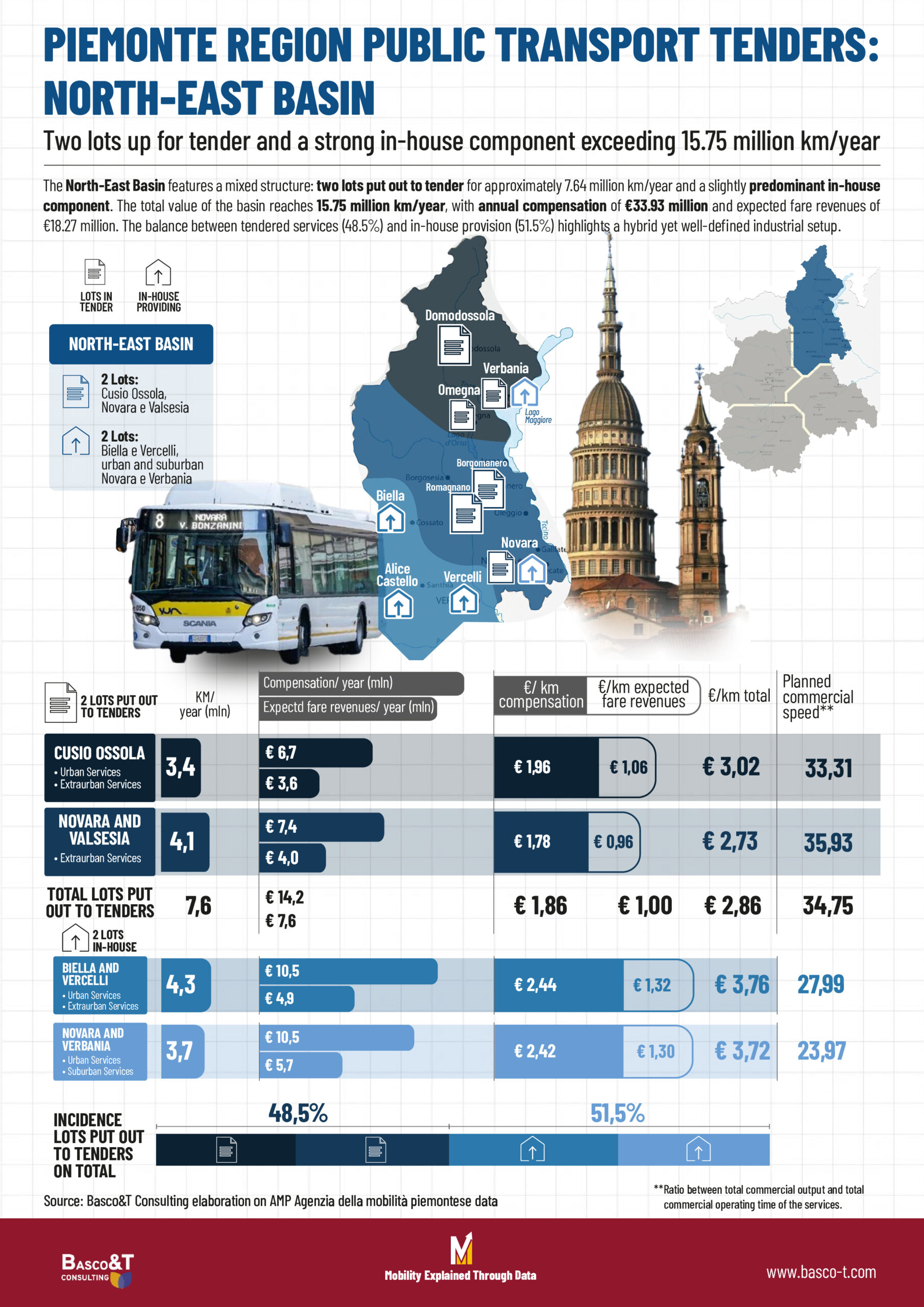
The North-East Basin features a mixed structure: two lots put out to tender for approximately 7.64 million km/year and a slightly predominant in-house component. The total value of the basin reaches 15.75 million km/year, with annual compensation of €33.93 million and expected fare revenues of €18.27 million. The balance between tendered services (48.5%) and in-house provision (51.5%) highlights a hybrid yet well-defined industrial setup.
Share on:
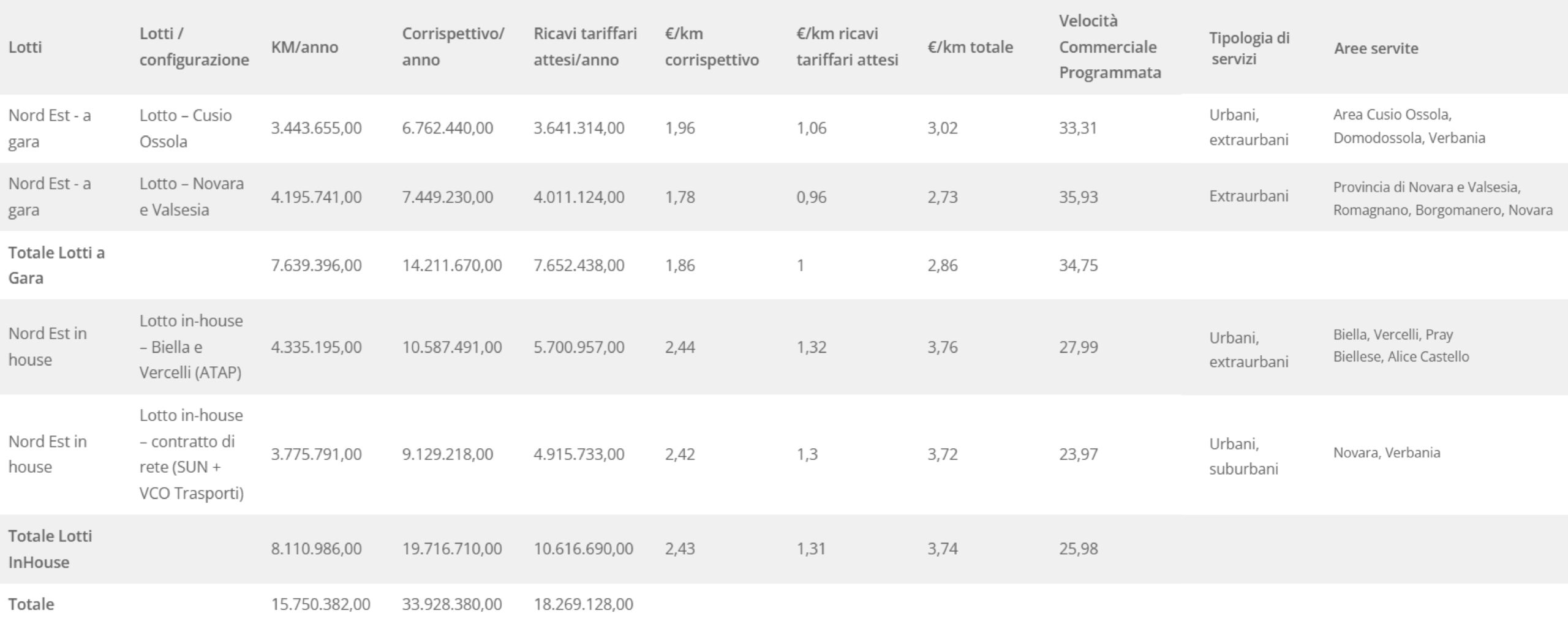
In the North-East Basin, the configuration of services reflects a structured model in which tendered and in-house components coexist in a broadly balanced way. The overall scope amounts to 15,750,382 km/year, with annual compensation of €33,928,380 and expected fare revenues of €18,269,128. The average value is around €3.74/km for the in-house component and €2.86/km for the tendered one, with differences attributable to the characteristics of the services and the territories served.
The portion awarded through competitive tender consists of two clearly identified lots.
The Cusio Ossola Lot covers the Domodossola and Verbania area, totaling 3,443,655 km/year, with annual compensation of €6,762,440 and expected fare revenues of €3,641,314. The overall value reaches €3.02/km, with a planned commercial speed of 33.31 km/h, reflecting a mix of urban and extra-urban services.
The Novara and Valsesia Lot covers a wider area including Novara, Borgomanero, and Valsesia, totaling 4,195,741 km/year. Annual compensation amounts to €7,449,230, with expected revenues of €4,011,124 and an overall value of €2.73/km. The planned commercial speed is slightly higher (35.93 km/h), consistent with a greater share of extra-urban services.
Overall, the two tendered lots total 7,639,396 km/year, with €14,211,670/year in compensation and €7,652,438/year in expected fare revenues. The average value stands at €2.86/km and the planned commercial speed at 34.75 km/h. This represents a significant competitive scope, though not predominant within the basin.
The in-house component accounts for a slightly larger share (51.5%) and is organized into two main blocks.
The first is the lot managed by ATAP in the Biella and Vercelli area, totaling 4,335,195 km/year, with €10,587,491 in compensation and €5,700,957 in fare revenues. The average value reaches €3.76/km, with a commercial speed of 27.99 km/h, indicating a stronger presence of urban or lower-speed services.
The second is the in-house lot based on a network contract (SUN and other operators), totaling 3,775,791 km/year, with €9,129,218 in compensation and €4,915,733 in revenues. The average value is €3.72/km, while the planned commercial speed drops to 23.97 km/h, highlighting a more complex operating context.
Overall, the in-house component totals 8,110,986 km/year, with €19,716,710 in compensation and €10,616,690 in expected fare revenues, maintaining a significant economic and operational weight within the basin.
The North-East Basin therefore emerges as a structured and balanced system, in which competitive tendering complements rather than replaces a consolidated public component. The served areas cover heterogeneous territories—from Verbano-Cusio-Ossola to the Novara plains, up to the hubs of Biella and Vercelli—and reflect planning that takes into account territorial differences, demand, and operating conditions.
Compared to the Metropolitan Basin model, a clearer choice of balance between competitive tendering and direct management emerges here, which could influence operators’ industrial strategies and the structure of future tenders. The overall design already appears well defined: lots are identified, economic figures are clear, and the relationship between tendered and in-house services is explicitly quantified.