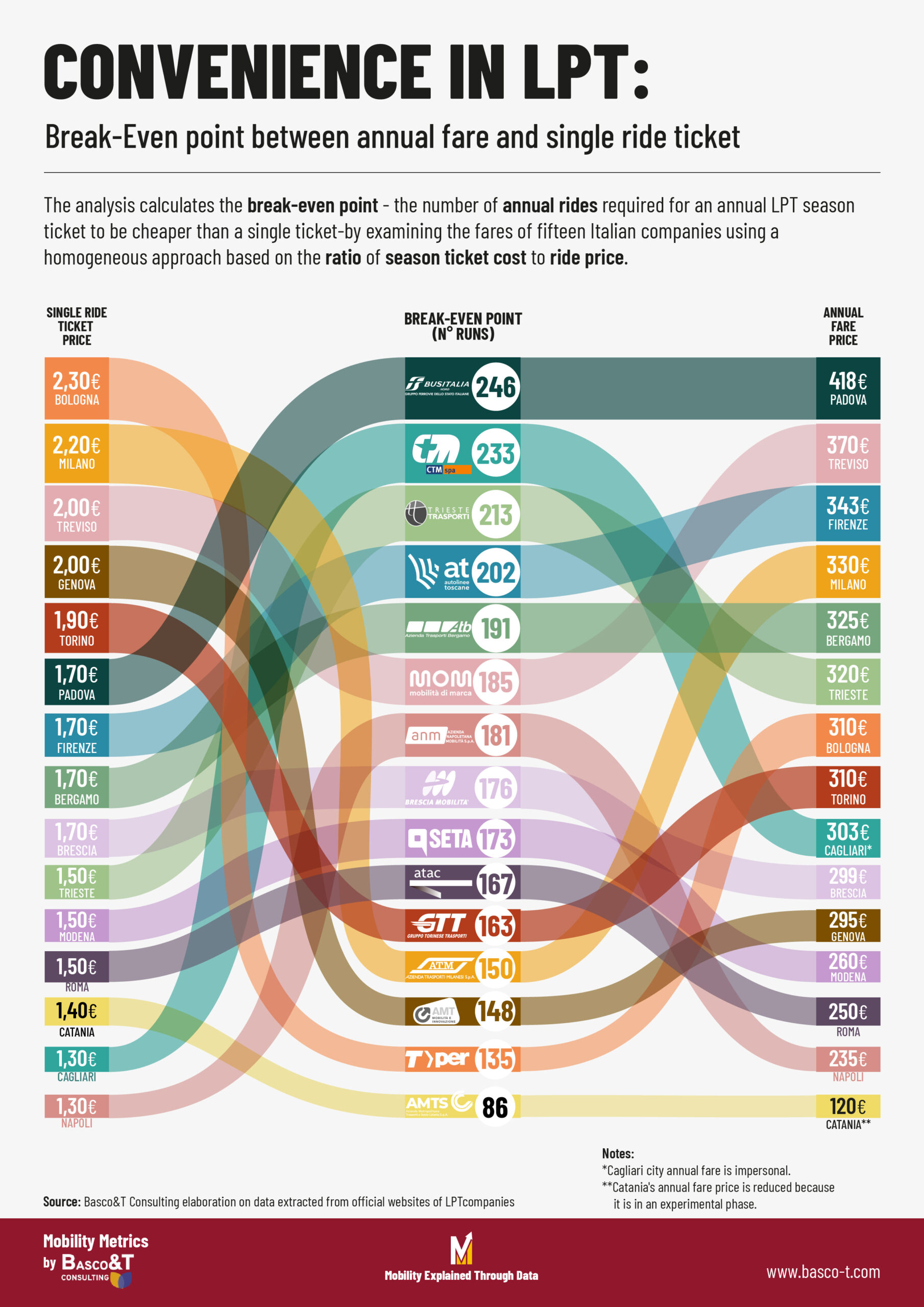
The analysis calculates the break-even point- the number of annual rides required for an annual LPT season ticket to be cheaper than a single ticket-by examining the fares of fifteen Italian companies using a homogeneous approach based on the ratio of season ticket cost to ride price.
Share on:
In today's analysis, we continue our in-depth look at tickets and subscriptions by introducing the break-even point, a key indicator for measuring the affordability of urban public transport. To this end, we examined the 2025 fares of fifteen Italian cities to determine how many annual trips are needed for a season ticket to be more cost-effective than buying individual tickets.
Methodology
Single ticket and “standard” (i.e., not subject to discounts or rebates) annual pass prices were collected directly from the official fares of the respective city transportation operators. For each city, break-even was calculated through the following formula:
Break even (rides/year) = annual subscription cost/one-way ticket cost
This methodology allows a homogeneous and immediate comparison between heterogeneous fare realities.
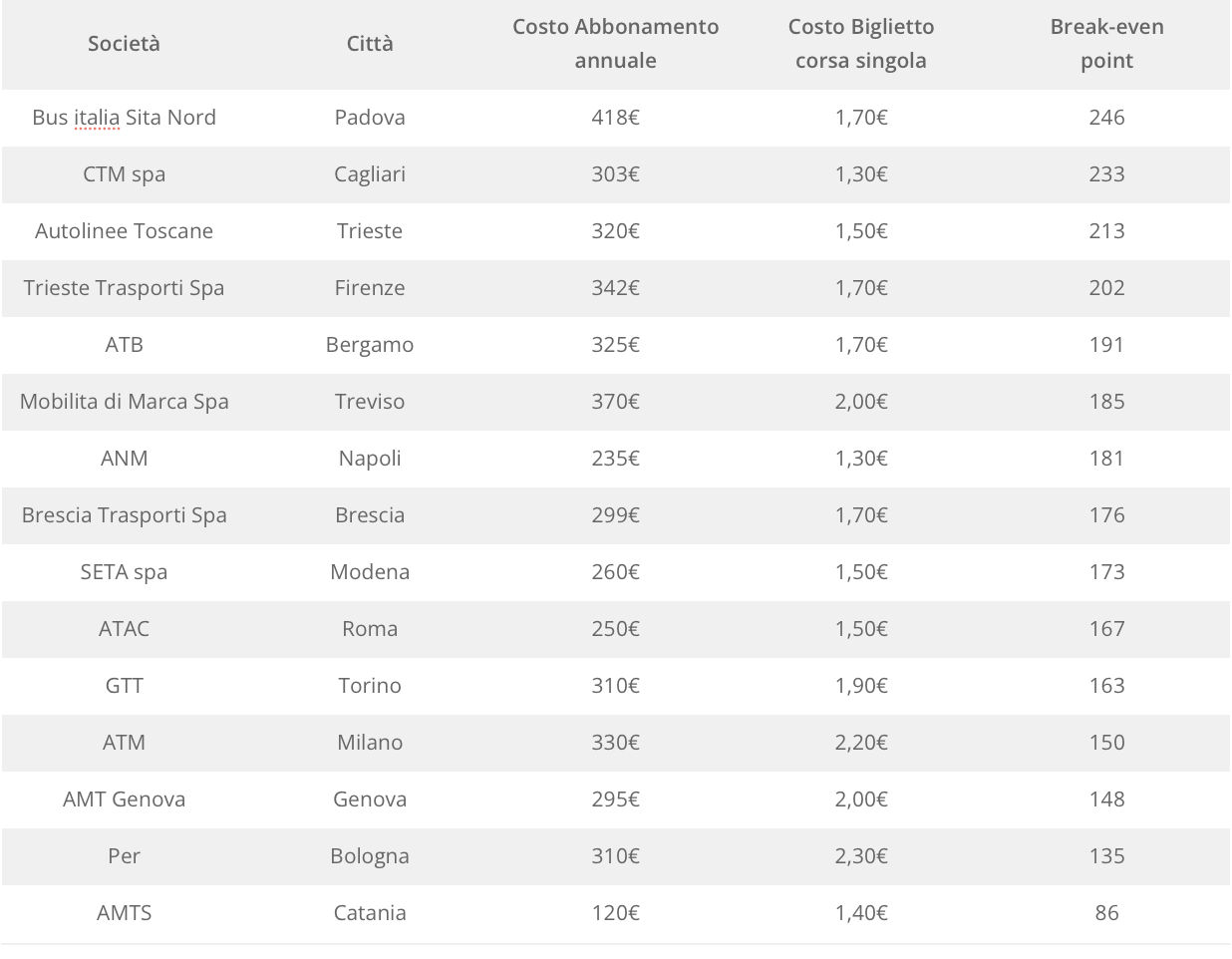
Elaborazione Basco&T Consulting su dati estratti dai siti ufficiali delle aziende TPL
Results
Processing shows that, on average, a user needs to make 178 trips per year (about 3.4 trips per week) to break even on the cost of the subscription. However, the observed value varies widely:
- Minimum value: Catania - 86 runs/year
- Maximum value: Padua - 246 rides/year
Other significant findings include:
- Bologna (135 runs)
- Genova (148 runs)
- Firenze (223 runs)
- Cagliari (233 runs)
The differences found are symptomatic of different management choices and demand patterns. Subscriptions with particularly low break-even, as in Catania (AMTS) and Bologna (Tper), suggest a policy geared toward encouraging daily and continuous use of the service-typical of commuter or student users. In contrast, in cities with a high convenience threshold (Padua, Cagliari), the fare structure rewards intensive use, discouraging sporadic travel.
From the individual traveler's point of view, break-even becomes a practical tool for planning mobility expenditures: those who plan to make fewer than 100 trips per year will find it more advantageous to purchase single tickets or carnets, while a user of more than 200 trips should consider a season ticket, especially in cities with break-even less than 180.
Conclusion
Break-even point analysis clearly shows how the ratio of annual season ticket cost to single ticket price varies markedly among the fifteen Italian cities examined, ranging from 86 rides/year (Catania) to 246 rides/year (Padua), with an average value of 178 rides. This synthetic indicator uniquely quantifies the affordability of urban public transport, making different fare realities immediately comparable. The variation in this ratio alone, calculated solely on the basis of official price lists, is sufficient to explain the differences in potential savings for the user in each municipal context.
In the previous article, Travel Tickets in the LPT: Affordability Index and Annual fares in the LPT: Affordability Indexwe calculated the price perception of one-way ticket and annual season tickets according to the local purchasing power of 15 Italian cities, defining an Affordability Index: an indicator that shows how much prices in LPT are really perceived according to purchasing power.