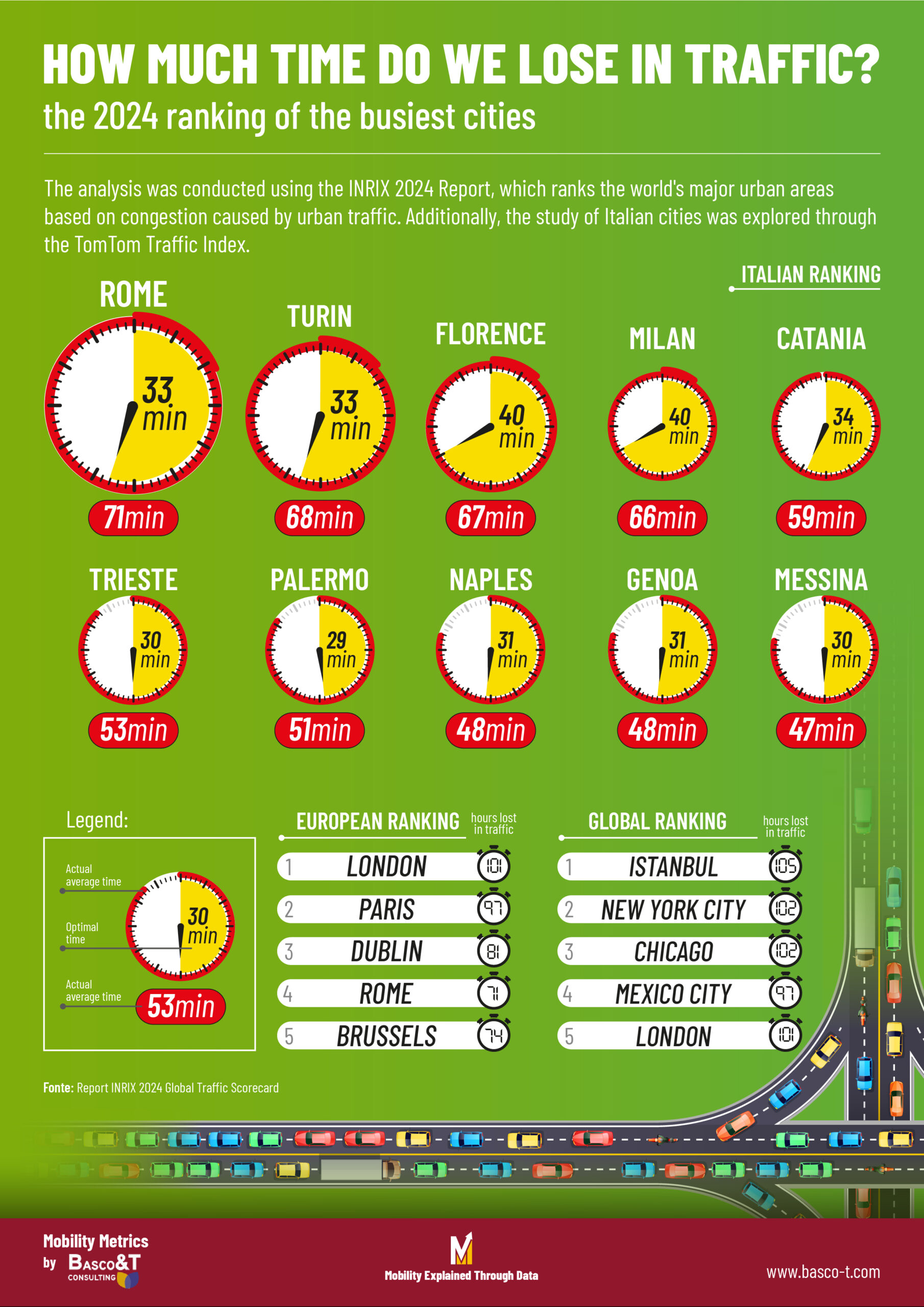
The analysis was conducted using the INRIX 2024 Report, which ranks the world's major urban areas based on congestion caused by urban traffic. Additionally, the study of Italian cities was explored through the TomTom Traffic Index.
Share on:
Italian Focus – TomTom Traffic Index
The analysis of urban traffic in Italy, based on TomTom Traffic Index data, highlights key trends and criticalities related to congestion in the country's major cities.
1. Travel Time and Congestion
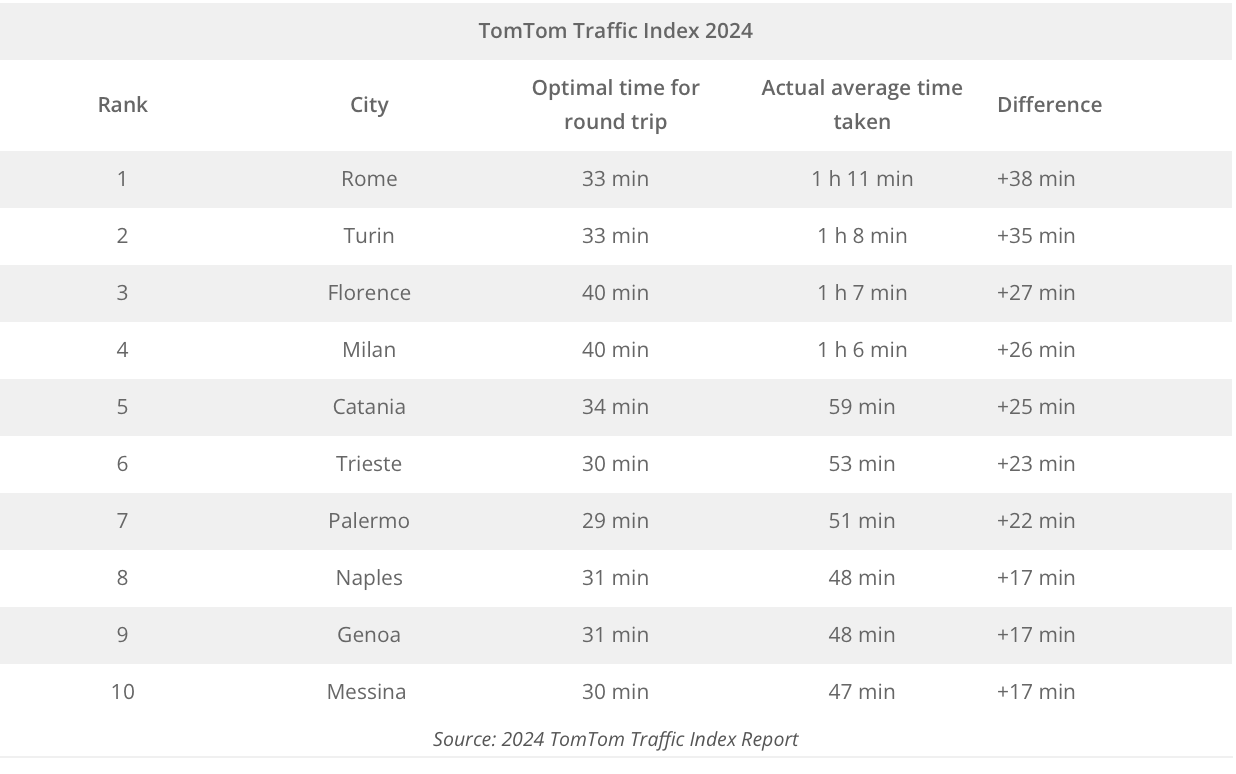
Data reveals that in the most traffic-congested cities—such as Rome, Turin, Florence, and Milan—the average time to cover 10 km varies between 27 and 30 minutes, showing an increase compared to the previous year.
- Rome is among the most congested cities, with 30 minutes per 10 km, leading to a total 71 hours lost annually in traffic.
- Milan and Florence show similar travel times, around 27-28 minutes, significantly impacting the hours lost by drivers.
Conversely, cities such as Trieste, Naples, and Messina have lower travel times (around 21-22 minutes per 10 km) but remain subject to fluctuations depending on peak hours.
2. Difference Between Theoretical and Actual Travel Time (Peak Hours vs. Optimal Conditions)
The analysis compares the theoretical time required for a 20 km daily trip (round trip) with the actual time spent by drivers depending on traffic conditions.
- Rome: Ideally, a 20 km journey should take 33 minutes, but during peak hours, it increases to 1 hour and 11 minutes (+38 minutes).
- Turin and Florence: The theoretical travel time is 33 and 40 minutes, respectively, but during heavy traffic, it rises to 1 hour and 8 minutes for Turin and 1 hour and 7 minutes for Florence, resulting in delays of 30-35 minutes.
- Naples and Palermo: A 20 km ideal journey should take 29-30 minutes, but real travel time during peak hours reaches 51-53 minutes, with an increase of 22-23 minutes.
Global context – INRIX Index 2024
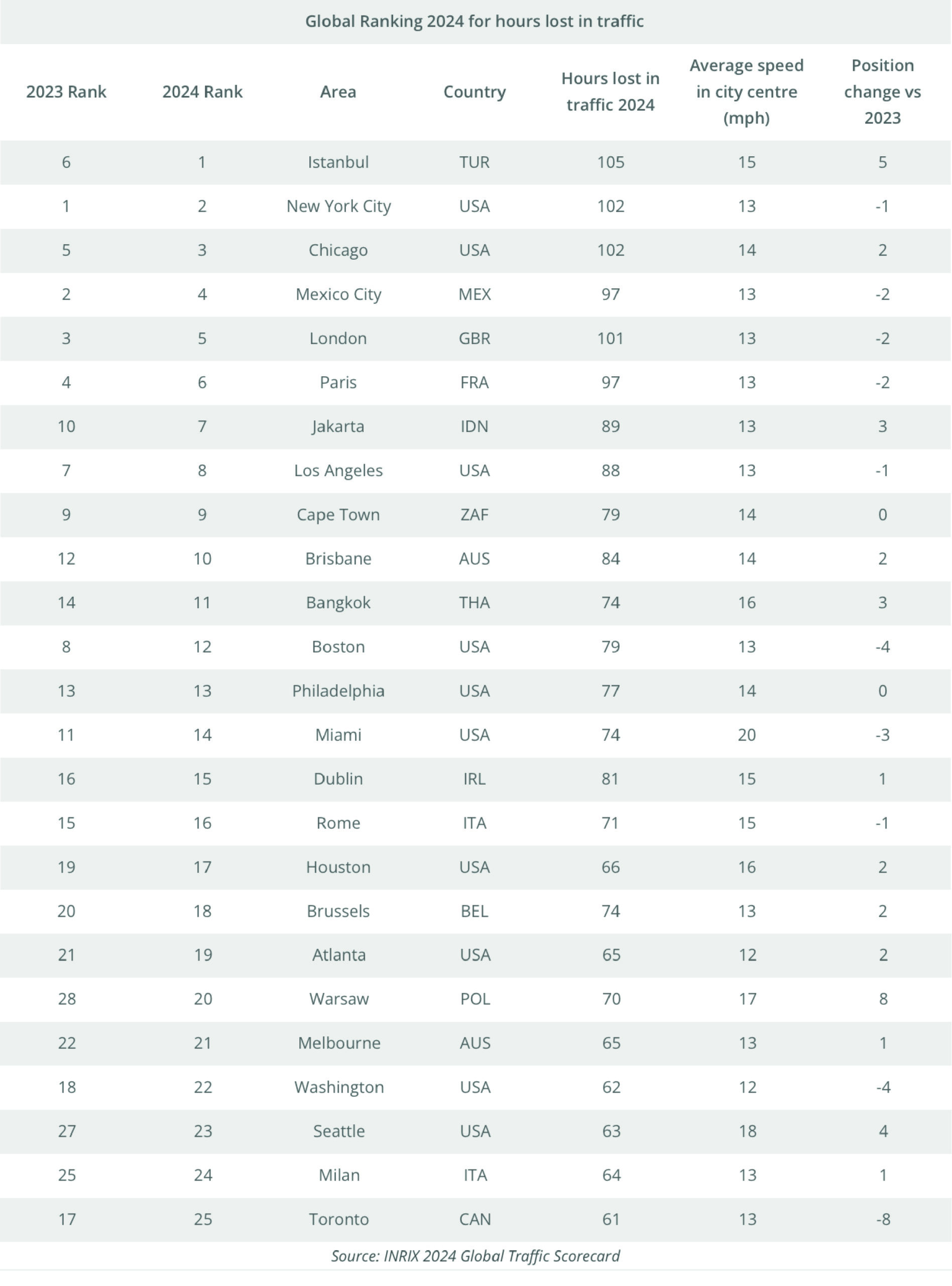
In 2024, Istanbul (Turkey) ranked first, where drivers lost an average of 105 hours in traffic, marking a 15% increase compared to 2023.
The five most congested cities in the world in 2024 are:
- Istanbul, Turkey – 105 hours lost (+5)
- New York City, USA – 102 hours lost (+1)
- Chicago, USA – 102 hours lost (+2)
- Mexico city, Mexico – 97 hours lost (-2)
- London, United Kingdom – 101 hours lost (-2)
Among the cities that recorded the most significant increase in congestion, Jakarta (Indonesia) moved from 10th to 7th place with a 37% increase (from 65 to 89 hours lost in traffic). Bangkok (Thailand) saw a 17% increase, while Brussels (Belgium) and Philadelphia (USA) recorded an increase of 9% and 12%, respectively.
Some cities, on the other hand, experienced a reduction in traffic compared to 2023. These included Los Angeles (-1%), Cape Town (-5%), and Boston (-10%), which dropped from 8th to 12th place.
Italy appears in the ranking with Rome (16th) and Milan (24th). Rome saw a 3% increase, while Milan recorded a 7% increase, reaching 64 hours lost in traffic
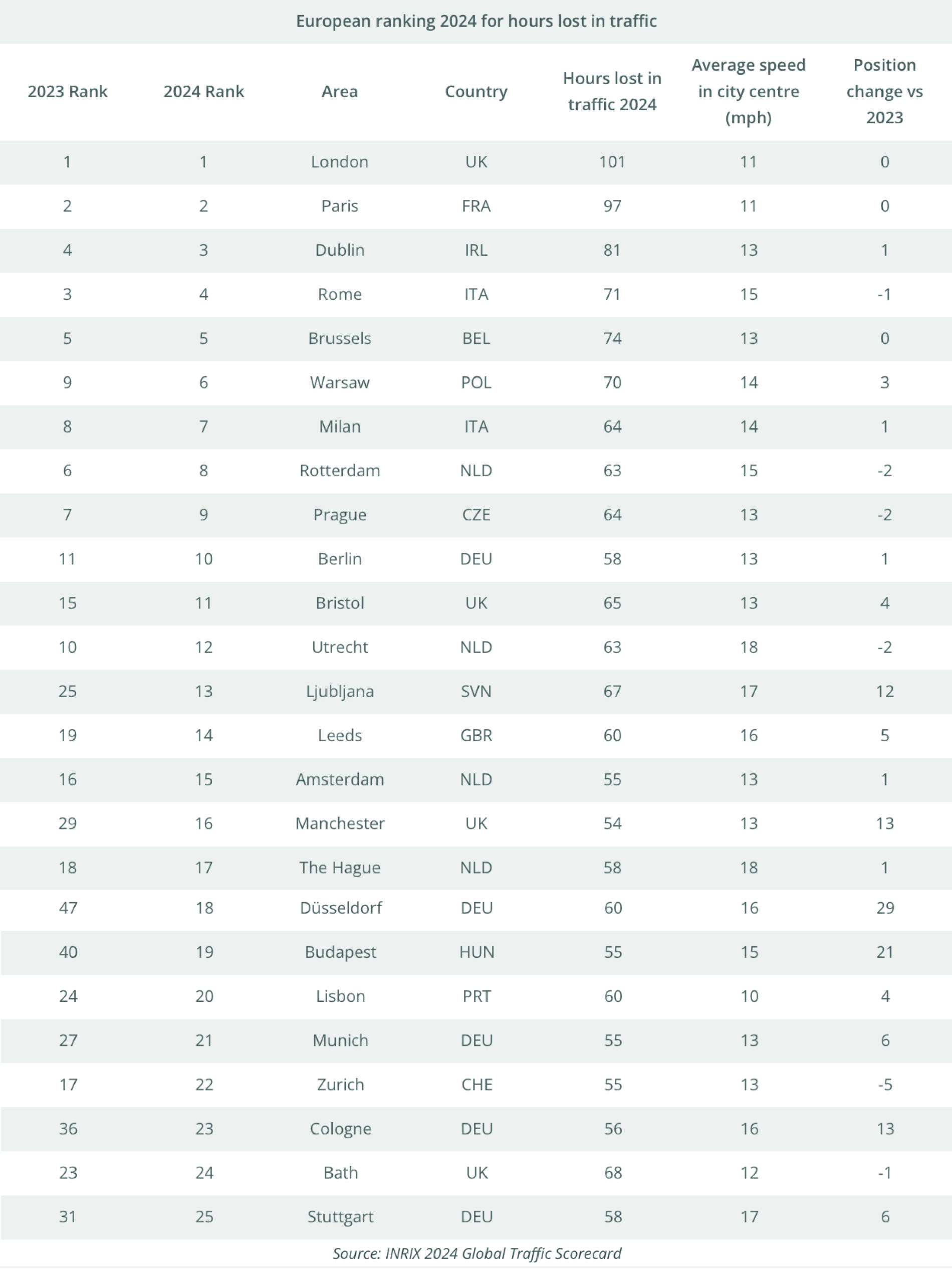
At the European level, London remains the most congested city, with 101 hours lost, followed by Paris (97 hours) and Dublin (81 hours).
The five most congested cities in Europe in 2024 are:
- London, United Kingdom – 101 hours lost (stable)
- Paris, France – 97 hours lost (stable)
- Dublin, Ireland – 81 hours lost (+1)
- Rome, Italy – 71 hours lost (-1)
- Brussels, Belgium – 74 hours lost (stable)
Notably, Warsaw (Poland) recorded a 15% increase compared to the previous year, while Düsseldorf (Germany) climbed 29 positions in the European ranking.
We analyzed what our users say on the TPL in the main Italian cities: find out more here.