Con Mobility Lens , we analysed the impact of new public transport infrastructure on cities, measuring the relationship between local public transport services and property values neighbourhood by neighbourhood. This research has given rise to a series of in-depth studies dedicated to different urban contexts: real “zooms” that reveal the identity of places and highlight their sensitivity to changes in mobility and the possible evolution of the property market.
Share on:
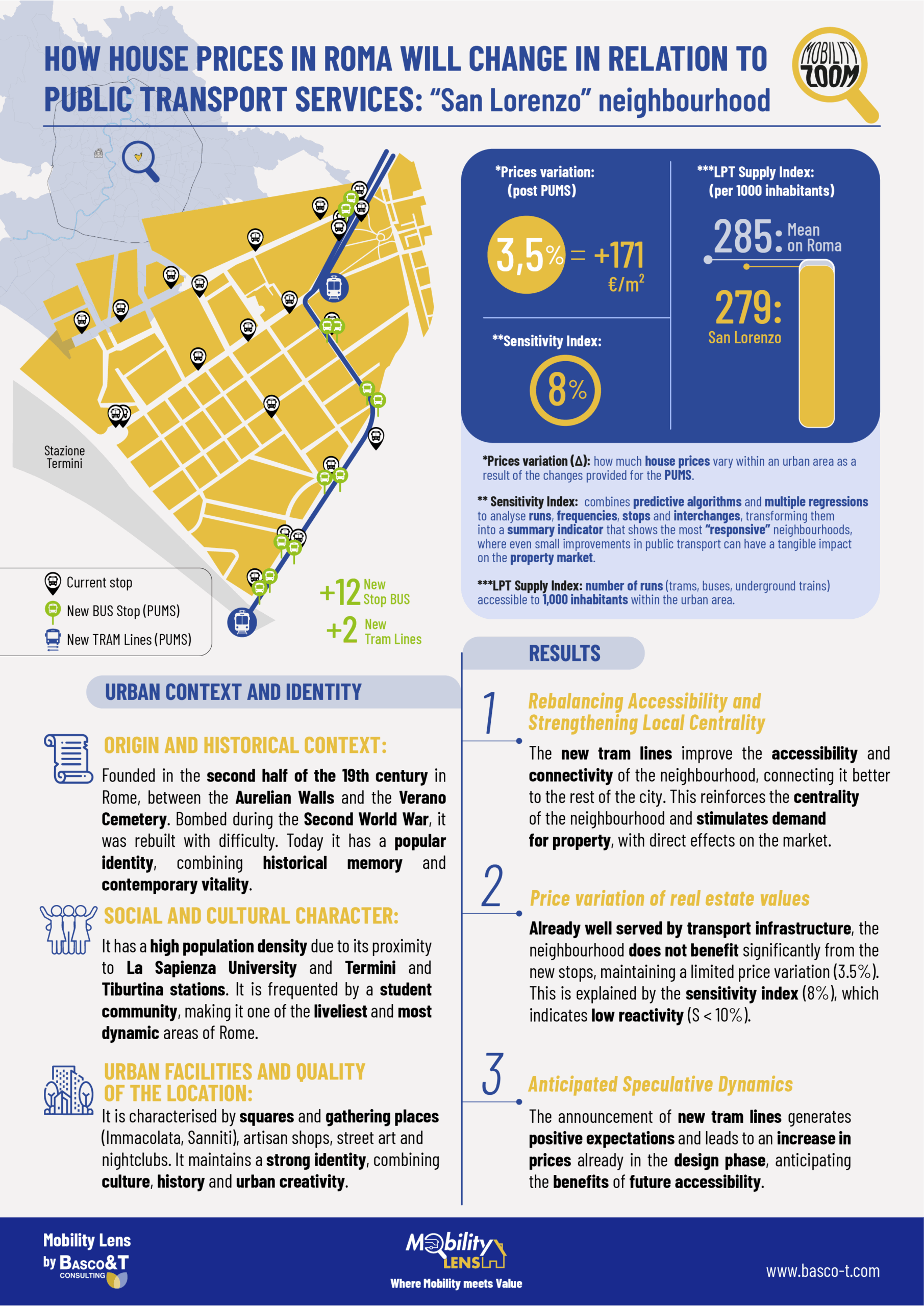
The first focus is on San Lorenzo, a neighbourhood that symbolises popular and creative Rome, now undergoing an infrastructure transformation that promises to enhance its accessibility and appeal.
Urban context and identity
Origins and historical context
San Lorenzo, founded in the second half of the 19th century as a working-class neighbourhood of Rome, lies between the Aurelian Walls and the Verano Cemetery. Partially destroyed during the bombings of the Second World War, its reconstruction was long and difficult. Today, it retains a strong popular identity, suspended between historical memory and contemporary vitality.
Social and cultural character
The neighbourhood is now densely populated, attracted by its proximity to La Sapienza University and Termini and Tiburtina stations, and frequented by a significant student and creative community. This element of socio-cultural vitality has contributed to defining San Lorenzo as one of the most stimulating and dynamic areas of the city.
Urban amenities and quality of place
San Lorenzo has many squares and meeting places – in particular Piazza dell'Immacolata and Piazza dei Sanniti – and is criss-crossed by a lively commercial fabric, artisan workshops, street art and nightlife. It stands out for its strong identity, which combines culture, history and urban creativity.
Observation of the results
The forecast model identifies an increase in average property value of +171€/m² (3.5%) resulting from the future construction of 12 new stops and 2 new tram lines in the neighbourhood:
Rebalancing accessibility and consolidating local centrality
The new tram lines, with numerous stops, substantially increase San Lorenzo's connectivity: they reduce travel times, improve access to public transport and connect the neighbourhood more effectively with other parts of the city. This promotes the perception of greater centrality and accessibility, boosting demand for real estate. San Lorenzo already has a strong appeal: population density, students, local commerce and cultural activities. The new infrastructure acts as a lever to enhance these elements.
Sensitivity Index: Change in property values
The neighbourhood has seen a modest change in prices (3.5%) following the introduction of new lines and stops. This change is partly explained by the neighbourhood's sensitivity index (S), which stands at 8%. This means that the neighbourhood has low responsiveness (S < 10%): already equipped with adequate infrastructure to meet the needs of the population, it does not benefit significantly from the addition of new stops, and as a result, the change in prices remains limited.
Anticipated speculative dynamics
The market tends to price in expected benefits in advance: the announcement of new tram lines creates expectations of positive change. This pushes prices up even at the design stage, anticipating future improved accessibility.
For a more accurate and in-depth reading of the results obtained from our new project, please refer to the dedicated page.