New metro lines, smart bus shelters, and public transport mobility influence property values in the Capital.
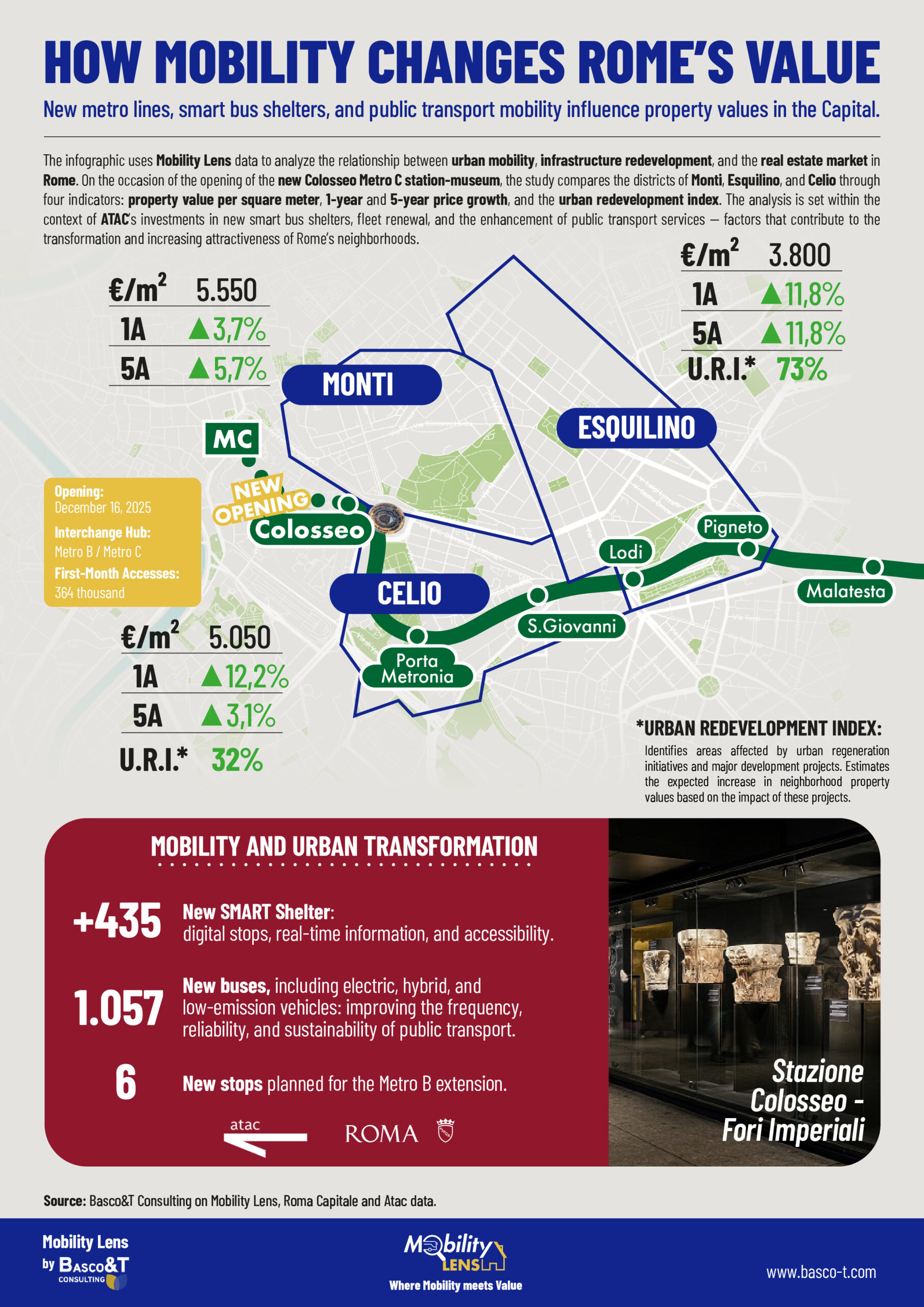
The infographic uses Mobility Lens data to analyze the relationship between urban mobility, infrastructure redevelopment, and the real estate market in Rome. On the occasion of the opening of the new Colosseo Metro C station-museum, the study compares the districts of Monti, Esquilino, and Celio through four indicators: property value per square meter, 1-year and 5-year price growth, and the urban redevelopment index. The analysis is set within the context of ATAC’s investments in new smart bus shelters, fleet renewal, and the enhancement of public transport services — factors that contribute to the transformation and increasing attractiveness of Rome’s neighborhoods.
Share on:
A Certain Effect on Mobility
The new Colosseo–Fori Imperiali station on Metro C has already produced a concrete and documented impact: it entered service on December 16, 2025, enabled a direct interchange with Metro B, and expanded the line to 24 stations across 22 kilometers. In its first month, ATAC recorded 363,851 validated entries at the Fori Imperiali/Colosseo station, including 199,721 from pass holders, a sign that the new station has already tangibly changed accessibility and public transport usage in the heart of Rome.
Mobility Lens numbers
What cannot yet be stated with the same certainty is that the opening of the station alone has already increased property prices in the Colosseum area. The platform is presented as a tool that combines transport networks, accessibility, and territorial data to interpret the urban context and identify its impact on property values.
Mobility Lens analyzes the performance of neighborhoods that have experienced the strongest growth in recent years and compares them with infrastructure forecasts. On the occasion of the opening of the new Colosseo Metro C station-museum, the study compares the neighboring districts of Monti, Esquilino, and Celio through four indicators: value per square meter, 1-year and 5-year price growth, and the urban redevelopment index.
Monti records a property value of €5,550/m², with prices increasing by 3.7% in the first year and up to 5.7% over the next five years. Celio records a value of €5,050/m², with a 12.2% increase in the first year and 3.1% over the next five years, alongside an urban redevelopment index of 32%. Esquilino, meanwhile, records €3,800/m², with an 11.8% increase projected over the next five years and an urban redevelopment index of 73%.
The Most Relevant Roman Precedent
A study by the Bank of Italy shows that the start of construction work near new metro stations reduced housing prices by around 5% in the following three years, particularly for higher-end properties. This phenomenon is linked to the fact that construction sites often have a negative short-term impact on the real estate market, while accessibility benefits tend to emerge later.
The strongest correspondence with reality lies in the projects effectively carried out by Roma Capitale and ATAC. In addition to the new Metro C extension to the Colosseum, the Smart Stops Plan includes 435 new bus shelters, 405 digital stop signs, and the redevelopment of more than 9,600 bus stop facilities. On the fleet side, the 2023–2026 plan includes 1,057 new buses, with 110 electric buses arriving in 2025 and another 301 in 2026. These are tangible and verifiable investments that improve service quality, passenger information, and the overall attractiveness of public transport.
Conclusion
The new Colosseo–Fori Imperiali station-museum has genuinely improved connections, interchange opportunities, and the urban attractiveness of the area. It is part of a broader investment package being carried out by ATAC and Roma Capitale across metro lines, bus stops, and public transport fleets to improve mobility throughout the Italian capital. At present, however, there is still no solid written evidence allowing the increase in property prices to be attributed solely to the opening of the station. The percentages shown in the infographic come from the predictive model developed by Mobility Metrics, which combines territorial data, transport networks, and accessibility indicators to interpret the urban context.