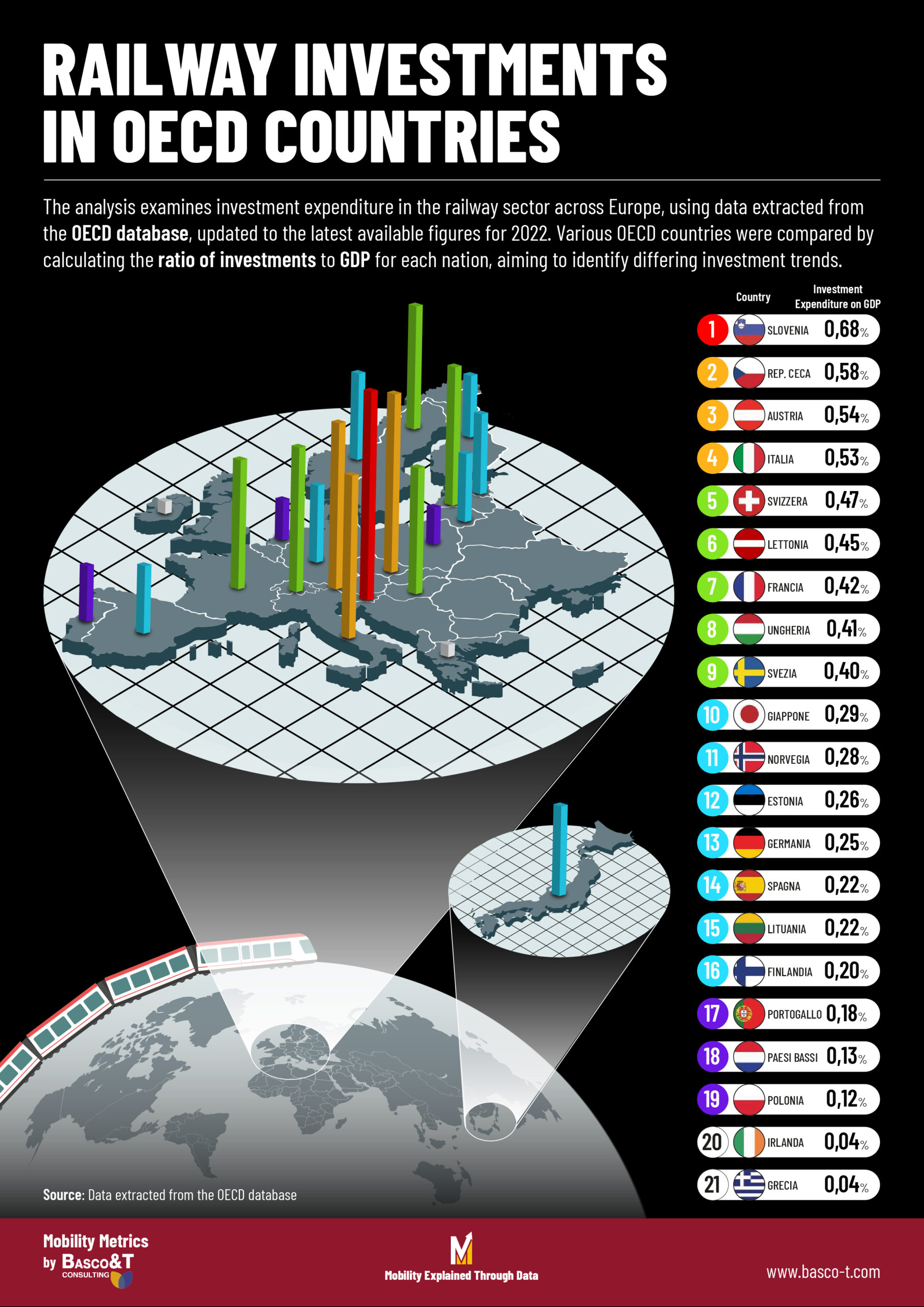
The analysis examines investment expenditure in the railway sector across Europe, using data extracted from the OECDdatabase, updated to the latest available figures for 2022. Various OECD countries were compared by calculating the ratio of investments to GDP for each nation, aiming to identify differing investment trends.
Share on:
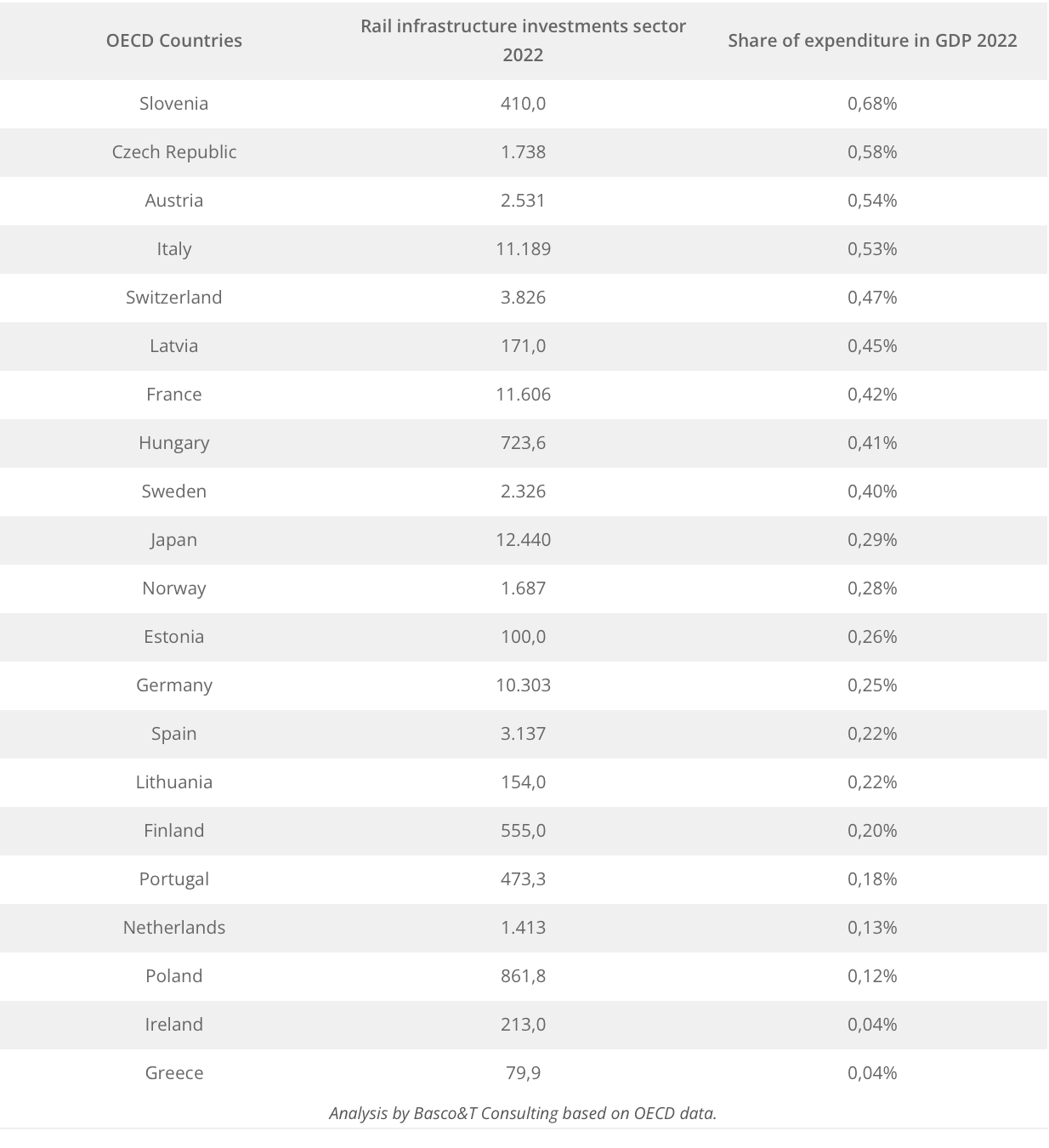
Notes:
*For Italy and Norway, due to the unavailability of infrastructure investment data for 2022, figures from 2021 were utilized.
The railway's investment expenditure
According to OECD definitions, railway infrastructure investment includes: construction of new railway infrastructure or extensions of existing infrastructure; reconstruction and renewal of existing railway networks without altering their overall performance; significant modifications enhancing infrastructure performance or capacity. This category encompasses investments in land, permanent works, fixed installations, and infrastructure-related plants and equipment. This definition excludes investments in rolling stock (trains, locomotives, carriages), which do not fall within the scope of infrastructure.
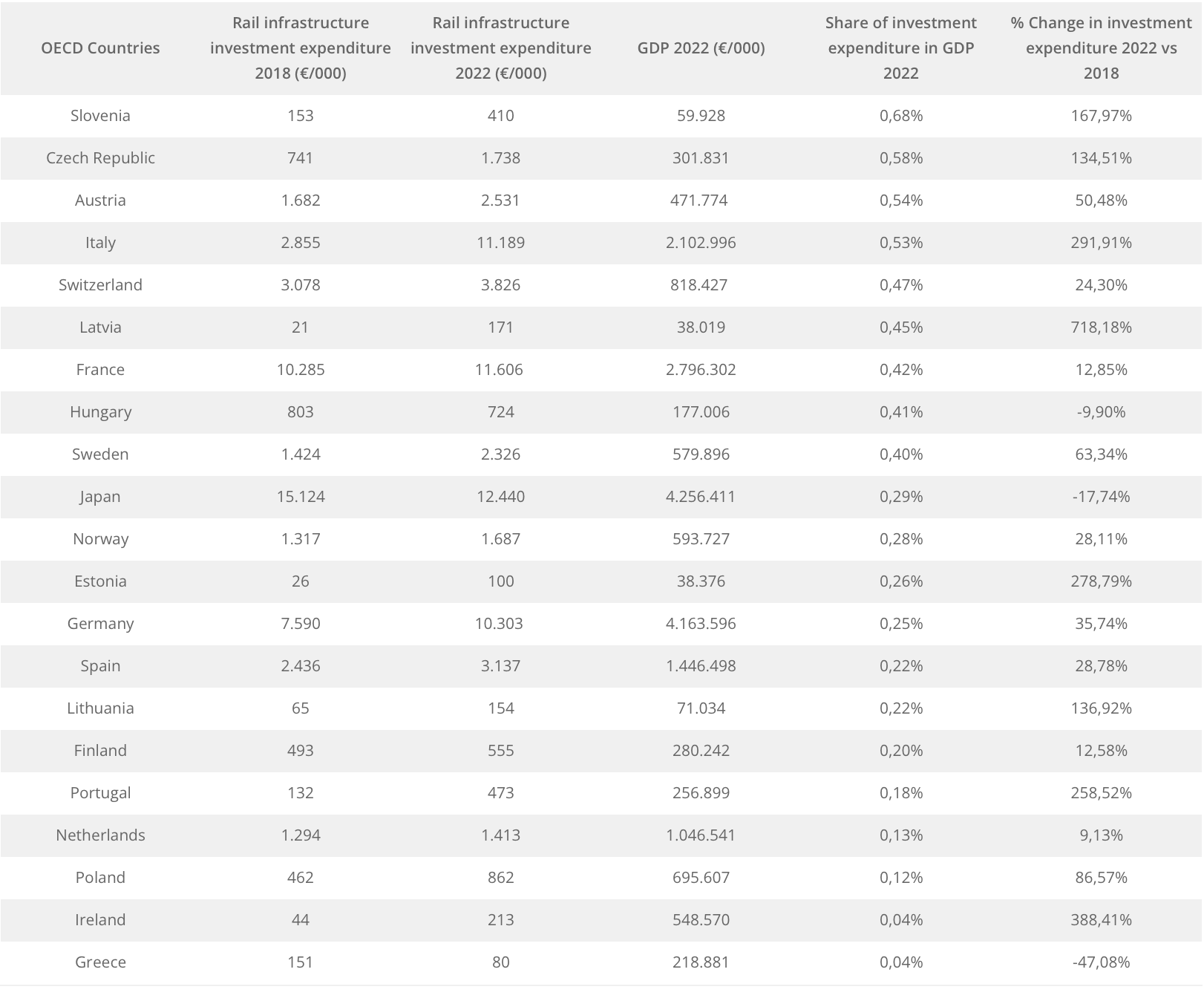
Between 2018 and 2022, most analyzed countries significantly increased their railway infrastructure investments. France recorded the highest absolute expenditure, investing €11.6 billion with a 12.8% increase compared to 2018, followed by Germany, which spent €10.3 billion, marking a 35.7% increase.
Italy notably raised its spending by 292%, from €2.8 billion to over €11 billion, partly due to funds related to the National Recovery and Resilience Plan (NRRP). Even more pronounced increases occurred in Ireland (+388%), Latvia (+718%), and Estonia (+278%), although their initial investment levels were considerably lower than Italy's.
Conversely, some countries reduced railway infrastructure investments. Greece saw the most significant decline (-47%), effectively cutting its expenditure by more than half. Hungary experienced a more modest decrease (-9.9%), while Japan, despite a notable reduction of -17.7%, continues to rank among the leading investors in the sector.
Comparing railway investment expenditure against GDP for each country in 2022 helps illustrate the proportion of national economic capacity dedicated to railway infrastructure.
Countries with the highest ratio of railway infrastructure investment to GDP in 2022 include:
- Slovenia: 0,68%
- Czech Republic: 0,58%
- Austria: 0,54%
- Italy: 0,53%
- Switzerland: 0,47%
- Latvia: 0,45%
- France: 0,42%
- Hungary: 0,41%
- Sweden: 0,40%
These nations allocate a substantial share of their GDP to railway investments, indicating proactive infrastructure policies. Slovenia and the Czech Republic lead the rankings, with ratios of 0.68% and 0.58%, respectively. Italy, at 0.53%, ranks among the highest of the major European economies, demonstrating a robust commitment to railway investment.
Advanced economies such as Germany, Japan, France, and Spain allocate substantial resources to railway infrastructure; however, their high GDP levels result in comparatively lower investment-to-GDP ratios. Specifically, Germany, despite investing over €10 billion, reports a spending-to-GDP ratio of 0.25%, lower than both Italy and France.
Data used:
A previous depth study has examined the position of Italy and Trenitalia in the european ranking of the railway transport.