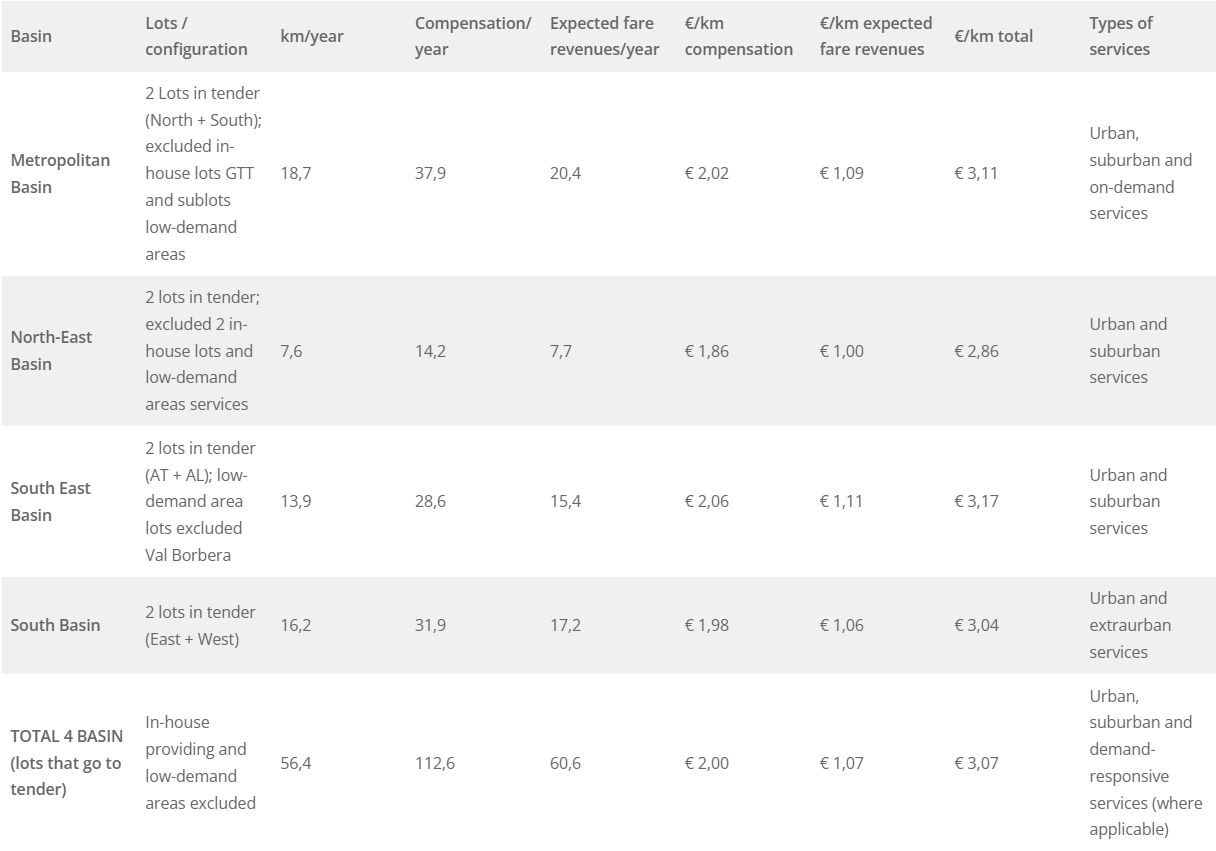
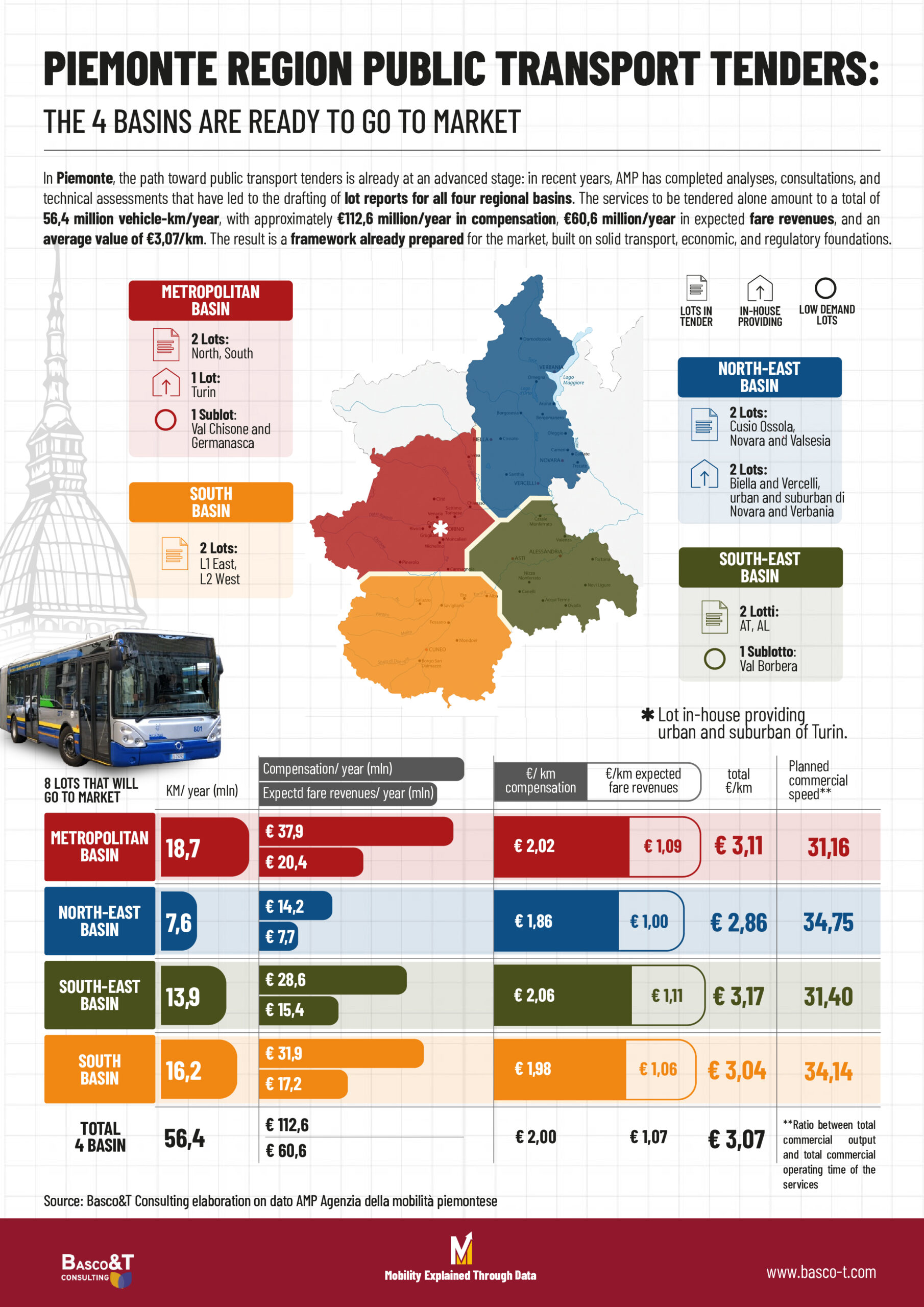
In Piemonte, the path toward public transport tenders is already at an advanced stage: in recent years, AMP has completed analyses, consultations, and technical assessments that have led to the drafting of lot reports for all four regional basins. The services to be tendered alone amount to a total of 56,4 million vehicle-km/year, with approximately €112,6 million/year in compensation, €60,6 million/year in expected fare revenues, and an average value of €3,07/km. The result is a framework already prepared for the market, built on solid transport, economic, and regulatory foundations.
Share on:
Piemonte is entering the new phase of public transport tenders with a clearly defined approach and a solid technical foundation. The key point is not only that procedures will need to start, but that extensive upstream work has already been carried out in terms of analysis, consultation, and definition of tender scopes. This clearly emerges from the framework of the four regional basins.
In recent years, AMP has conducted preparatory activities that led to the drafting of lot reports for all Piedmont basins: Metropolitan, South, South-East, and North-East. These reports define the services to be tendered, isolate in-house components, separate services in low-demand areas where necessary, and quantify the main industrial and economic variables: annual kilometers, compensation, expected fare revenues, commercial speeds, and unit values per km.
The first key element is the clarity of the service scopes. In the Metropolitan Basin, for example, the portion actually subject to tender consists of two lots, North and South, while the in-house GTT lot and the sub-lot in low-demand areas are excluded. The services to be tendered amount to 18.7 million km/year, with compensation of €37.9 million/year and expected fare revenues of €20.4 million/year. The overall average value is €3.11/km. Geographically, the lots cover a very wide portion of the basin: Chivasso, Ivrea, Canavese, Val di Susa, Lanzo Valleys, Carmagnola, Chieri, Pinerolo, and Val Pellice.
In the South Basin, the configuration is equally straightforward: two lots to be tendered, East and West, totaling 16.2 million km/year. Annual compensation amounts to €31.9 million, while expected fare revenues reach €17.23 million. The average value is €3.04/km, with €1.98/km in compensation and €1.06/km in expected revenues. The basin includes the entire Province of Cuneo, with major centers such as Alba, Bra, Cuneo, Fossano, Mondovì, Saluzzo, and surrounding valleys, and is currently served by the Granda Bus Consortium, grouping 13 companies.
In the South-East Basin, the model consists of two lots to be tendered, corresponding to the AT and AL areas, excluding the lot dedicated to the low-demand Val Borbera area. The services open to competition total 13.9 million km/year, with compensation of €28.6 million/year and expected fare revenues of €15.4 million/year. The overall average value is €3.17/km. The territorial scope includes Asti, Canelli, Villanova d’Asti, Alessandria, Casale Monferrato, Altavilla, Novi Ligure, and Ovada, in a context characterized by multiple operators.
The North-East Basin has a more complex structure, as it retains in-house service areas alongside those to be tendered. However, the portion to be tendered is clearly identified: two lots, excluding two in-house lots and services in low-demand areas. The tendered lots amount to 7.64 million km/year, with compensation of €14.21 million/year and expected fare revenues of €7.65 million/year. The average value stands at €2.86/km, the lowest among the four basins, with €1.86/km in compensation and €1.00/km in expected revenues. The areas served include Cusio Ossola and the Novara-Valsesia area.
Looking at the overall picture, a very significant figure emerges: the services to be tendered across the four Piedmont basins amount to 56.4 million km/year, with €112.6 million in compensation, €60.6 million in expected fare revenues, and an average of €3.07/km. This scale not only reflects a set of lots but also defines the industrial profile of Piedmont’s tenders: a substantial critical mass distributed across four basins with different characteristics but a common underlying structure.
The level of maturity of the process is further demonstrated by the fleet associated with the tendered basins: a total of 1,420 buses and 1,702 PAO, confirming that these are not marginal or residual segments, but a very significant portion of Piedmont’s public transport supply.
The underlying message is therefore simple yet very strong: in Piedmont, the necessary analyses and in-depth assessments have already been carried out. AMP has laid the groundwork for the four basins to go to tender with a clear, transparent, and robust structure, distinguishing between what goes to the market, what remains in-house, and what requires specific arrangements for low-demand areas. In a sector where the main issue is often the lack of preliminary definition, this represents a decisive step.
Rather than a preparatory phase still to be initiated, this can be described as an already configured system. The economic data, service scopes, and lot structures show that Piedmont has already completed the most delicate task: transforming the existing system into a concrete platform for future tenders.