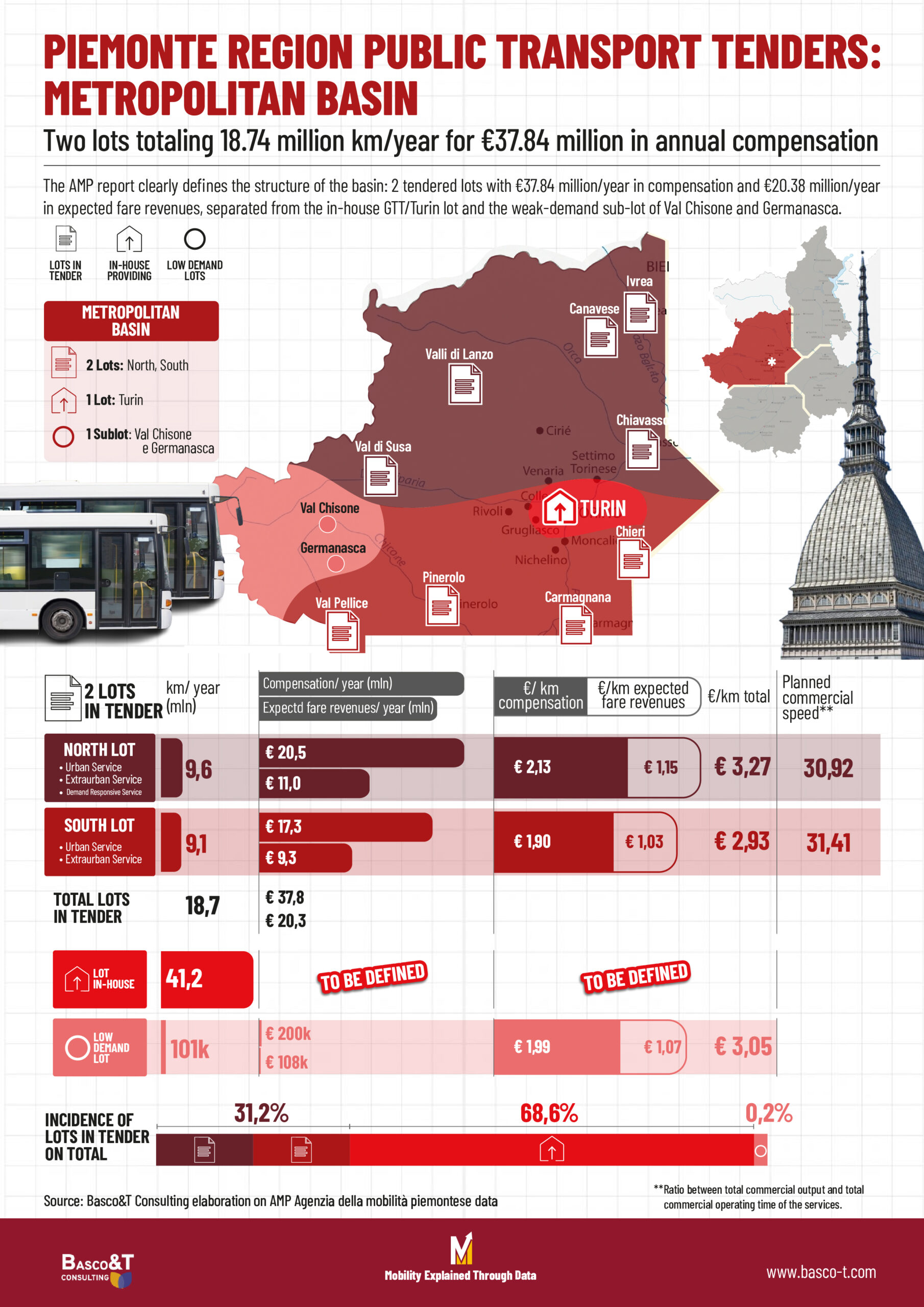
The AMP report clearly defines the structure of the basin: 2 tendered lots with €37.84 million/year in compensation and €20.38 million/year in expected fare revenues, separated from the in-house GTT/Turin lot and the weak-demand sub-lot of Val Chisone and Germanasca.
Share on:
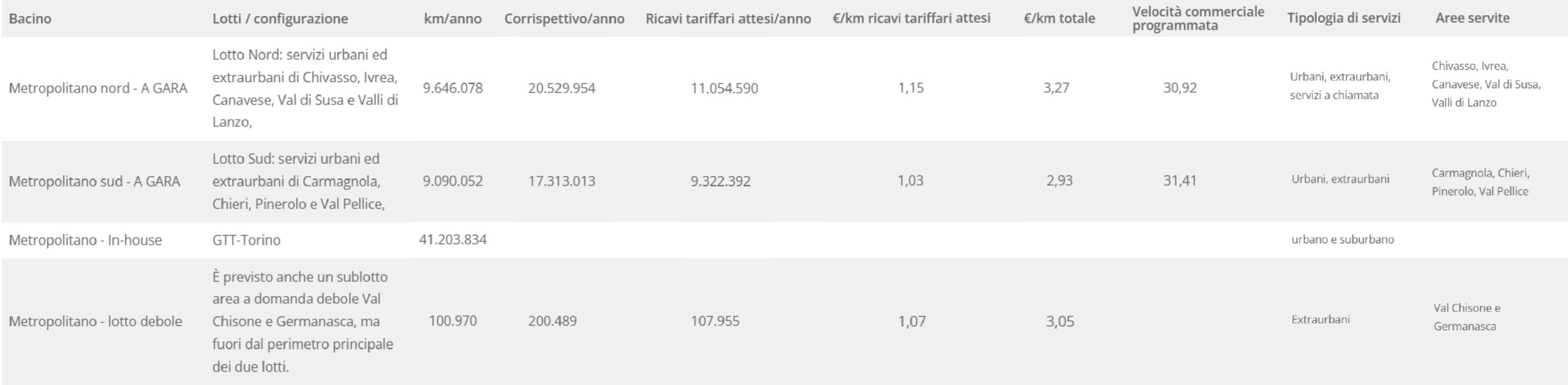
In the Metropolitan Basin, the service configuration is already technically defined, providing a clear tender perimeter, distinct from components that will follow different arrangements. The AMP report identifies 2 lots for tender, North and South, totaling 18,736,130 km/year, with annual compensation of €37,842,966, expected fare revenues of €20,376,982, an average total value of €3.11/km, and a planned commercial speed of 31.16 km/h.
The North Lot covers the areas of Chivasso, Ivrea, Canavese, Val di Susa, and the Lanzo Valleys, totaling 9,646,078 km/year, with €20,529,954/year in compensation and €11,054,590/year in expected revenues.
The South Lot includes Carmagnola, Chieri, Pinerolo, and Val Pellice, totaling 9,090,052 km/year, with €17,313,013/year in compensation and €9,322,392/year in expected revenues. These are two lots that are clearly defined not only quantitatively, but also from a territorial and industrial perspective, structured along recognizable geographic corridors within the metropolitan basin.
Two distinct components remain outside the competitive perimeter. The first is the in-house GTT/Turin lot, referring to the Turin urban area, which alone accounts for 41,203,834 km/year. The second is the weak-demand sub-lot in Val Chisone and Germanasca, totaling 100,970 km/year, which is treated separately from the two main lots. This distinction confirms that the basin design was not developed uniformly, but rather by separating services suitable for competitive tendering from those requiring different awarding models.
The picture is completed by a current fleet of 481 buses and 576 PAO, confirming the industrial scale of the basin and the relevance of the analyzed perimeter. Overall, the Metropolitan Basin appears to be structurally mature: the lots are identified, the service areas are defined, the economic figures are quantified, and the boundary between tendered services, in-house provision, and weak-demand areas is clearly established.