Con Mobility Lens we analysed how new public transport infrastructure can influence property values in Rome, assessing the relationship between the local public transport network and the property market neighbourhood by neighbourhood. Comparing different neighbourhoods reveals some interesting dynamics: some areas, already well served, show low sensitivity to change, with modest price increases; other areas that are less well connected and with room for improvement in the local public transport network react more markedly, showing significant increases in property values. These “zooms” on neighbourhoods reveal not only the identity of the places themselves, but also how their accessibility and integration into the public transport network can shape the evolution of the property market.
Share on:
In this in-depth analysis, we compare two neighbourhoods, which have the same number of new stops planned by the PUMS, but have two different sensitivity indices:
- a low sensitivity index describes a neighbourhood that is already well served, where supply meets or exceeds demand, and which does not need new infrastructure.
- a high sensitivity index corresponds to a neighbourhood where house prices are responsive to changes in public transport supply. It may describe a neighbourhood that is poorly connected or underserved, which could therefore benefit from additional public transport.
GROTTAROSSA OVEST: a neighbourhood already well served
Grottarossa Ovest, in Rome's XV Municipality, is a neighbourhood that combines tranquillity and residential living. Here we find mainly small villas surrounded by greenery and small apartment buildings, in a low-density residential area. Its location, between the Grande Raccordo Anulare ring road and the River Tiber, already guarantees good connections to both the city centre and the suburbs.
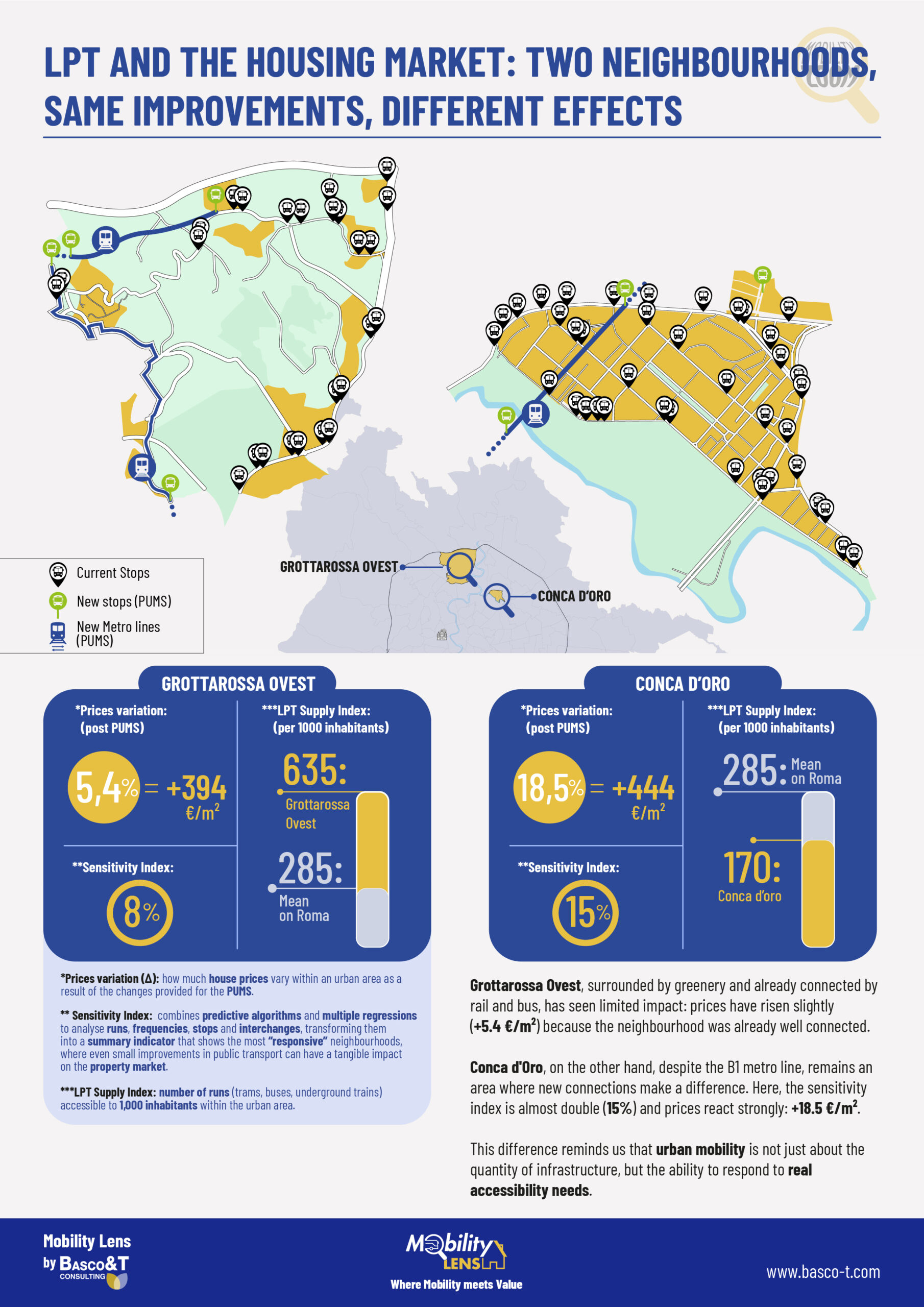
In terms of transport, the neighbourhood is served by the Rome–Viterbo railway line, with Grottarossa station providing easy access to the city centre, and bus line 029, which runs to Sant'Andrea Hospital. This combination of rail, bus and proximity to major roads means that the neighbourhood is already well connected: the addition of new infrastructure, as envisaged by the PUMS, therefore has a relatively limited impact. In practical terms, our sensitivity index confirms this situation: only 8%, with an increase in house prices of around +5.4 €/m². In other words, Grottarossa Ovest benefits little from the additions because it is already well served.
CONCA D’ORO: a neighbourhood with room for improvement
Conca d'Oro, located in Municipality III, is a more densely populated neighbourhood with a greater variety of residential and commercial buildings. Here, the underground (line B1) has already improved accessibility to the centre, but some areas are still less well served by public transport than other areas of the city.
Several bus lines complete the transport network, but there is still room for infrastructure improvements. This means that every new measure planned by the PUMS can make a difference: improving connections means increasing the attractiveness of the neighbourhood. This is why Conca d'Oro's sensitivity index is higher, at 15%, and why the impact on property prices is much more pronounced: +18.5 €/m². In essence, new infrastructure here is not just a “bonus”, but represents real added value.
Neighbourhood Sensitivity and House Prices
Local public transport (LPT) services are expanding in both neighbourhoods under consideration. The introduction of new underground lines and stations will improve accessibility and integration with the existing network.
The additions for the neighbourhoods are:
- Grottarossa Ovest: +2 stops; +2 lines
- Conca D’Oro: +3 stops; +1 line
In both cases, the overall increase in supply is equal to 4 units, and one would expect the model to predict effects of similar magnitude. However, this is not the case, as the two neighbourhoods show different sensitivity to changes in public transport, as measured by the Sensitivity Index.
Grottarossa Ovest is characterised by low sensitivity (8%). It is a residential neighbourhood well connected to the city centre and, following an increase in supply, property prices have risen by only €5.4/m².
Conca d'Oro, on the other hand, shows high sensitivity (15%). The area already has a dense network of bus lines and stops and benefits greatly from the addition of three new metro stops, which provide faster connections to the city centre. The effect on house prices is marked: the expected increase is +18.5 €/m², about three times that of Grottarossa Ovest, despite starting from very similar average values (4222 €/m² in Grottarossa vs 3924 €/m² in Conca d'Oro).
Comparing the two neighbourhoods, one point emerges clearly: in Rome, it is not individual infrastructure projects that determine the increase in property values, but rather the overall public transport network and the degree of integration of each addition. If a neighbourhood is already well connected, such as Grottarossa Ovest, even new developments have limited effects. If, on the other hand, a neighbourhood is less well served, such as Conca d'Oro, each new stop or line can have a significant impact on property values.
In other words, the property market reacts more strongly where infrastructure really helps to fill gaps in urban mobility.
For a more accurate and in-depth reading of the results obtained from our new project, please refer to the dedicated page.