Con Mobility Lens we analysed the impact of new public transport infrastructure on cities, measuring the relationship between local public transport services and property values neighbourhood by neighbourhood. This research has given rise to a series of in-depth studies dedicated to different urban contexts: real “zooms” that reveal the identity of places and highlight their sensitivity to changes in mobility and the possible evolution of the property market.
Share on:
The second focus is dedicated to La Pisana, a predominantly residential neighbourhood on the western outskirts of Rome, developed along the axis of Via della Pisana. Already equipped with a good public transport network but marked by infrastructure problems and the absence of new PUMS works, the neighbourhood sees urban and environmental redevelopment as the key to increasing the attractiveness and quality of public spaces.
The La Pisana district: urban planning and infrastructure overview
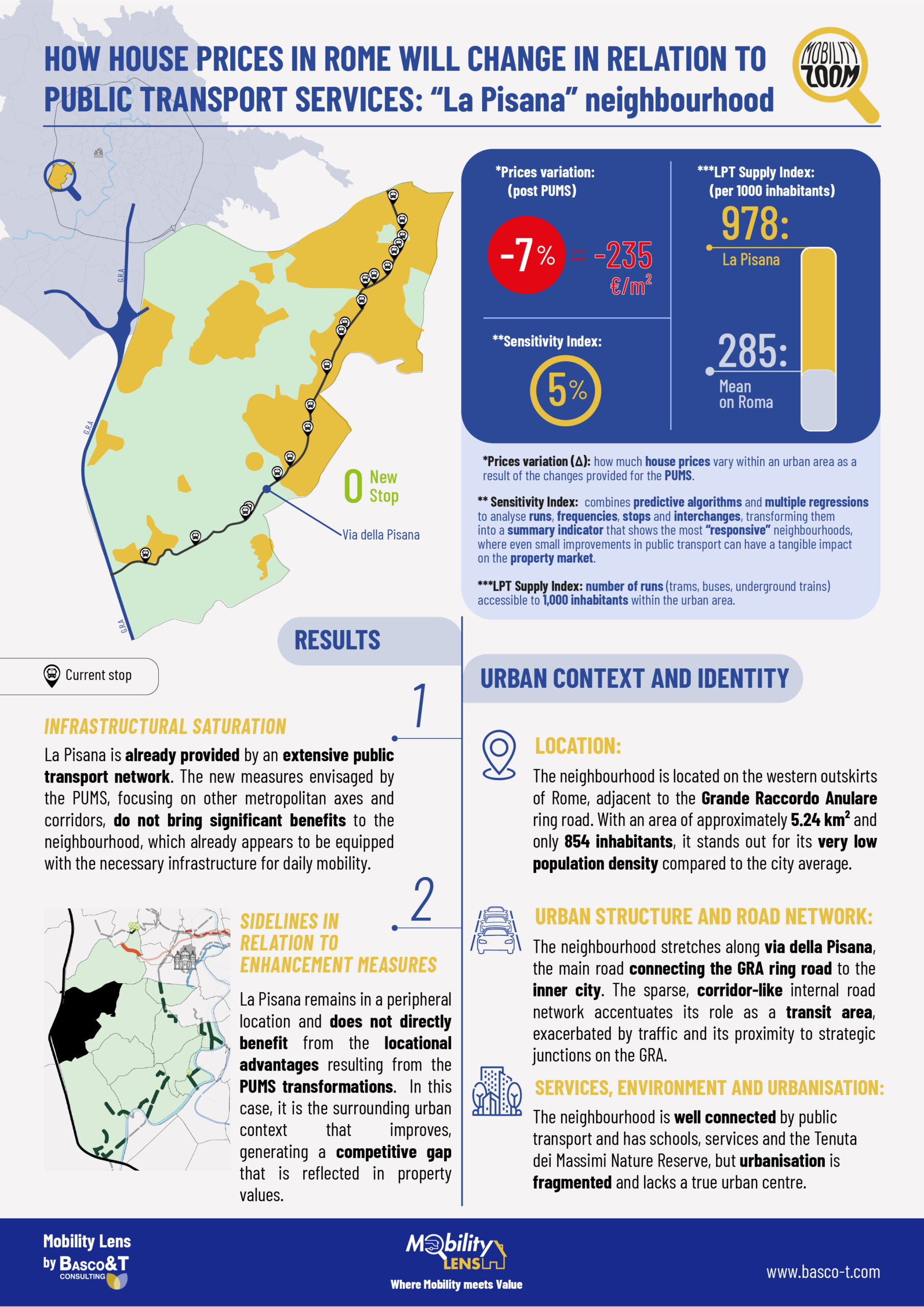
The La Pisana neighbourhood (Z. XLIV) is located on the western outskirts of Rome, halfway between the Grande Raccordo Anulare ring road and Via Portuense. With an area of approximately 5.24 km² and a resident population of just 854 inhabitants, it is characterised by an extremely low population density compared to the city average.
From a morphological point of view, La Pisana is a linearly developed neighbourhood: its main axis is Via della Pisana, approximately ten kilometres long, which acts as a backbone connecting the GRA ring road and the inner urban fabric. This road is flanked by a few other major roads, such as Via del Pescaccio, while the internal road network is sparse and weak in terms of defining a complete urban grid.
This ‘narrow’, almost corridor-like layout accentuates the perception of a neighbourhood that is more of a transit point than a residential area, a condition aggravated by the heavy traffic due to both the commuter use of the main road and the proximity to strategic junctions of the GRA ring road.
In terms of services and facilities, La Pisana appears to be well served by local public transport: numerous bus routes provide direct connections to the city centre and underground lines, making the area well served in terms of public transport. Added to this are the presence of educational institutions, commercial services and proximity to the Tenuta dei Massimi Nature Reserve, which contributes to defining a valuable environmental setting.
However, urbanisation is discontinuous and selective, with mainly residential settlements built after the war (e.g. INCIS houses) and recent subdivisions distributed along the main roads. The result is a neighbourhood without a strong urban centre, dominated instead by its function as a connection and crossing point.
What are the reasons for this result?
Predictive analysis conducted on property price trends in relation to future scenarios outlined in the PUMS (Urban Sustainable Mobility Plan) indicates a negative change of approximately €235 (-7%) for La Pisana.
This outcome is justified by various urban planning and infrastructure factors:
- Infrastructure saturation
- La Pisana is already served by an extensive public road transport network. The new measures envisaged by the PUMS, which focus on other metropolitan axes and corridors, do not bring any significant additional benefits to the neighbourhood, which already appears to have the necessary infrastructure for everyday mobility.
- Marginality with respect to enhancement measures
While other neighbourhoods benefit directly from new high-capacity infrastructure (e.g. tram lines, transport hubs), La Pisana remains in a peripheral position and does not directly reap the locational advantages coming from the PUMS transformations. This means that the adjacent urban context improves, generating a competitive gap that is reflected in property values.
The PUMS does not only introduce new lines, but also redistributes resources, priorities and flows.
- If elsewhere the metro, tram or priority lanes are upgraded, the Pisana district – which remains unchanged – may lose its relative appeal.
- In other words: it is not the neighbourhood that is deteriorating, but others that are improving, creating a competitive gap that is reflected in property values.
The absence of new measures means that structural problems remain unchanged. With the general increase in metropolitan traffic flows (as predicted by the PUMS), this may result in greater local pressure without compensation (new lines, relief measures).
Furthermore, property markets react more to expectations of improvement than to the current situation:
- where the PUMS announces new lines, values increase (positive speculation);
- where nothing changes, the market interprets this as a lack of prospects and may generate a slight decline, especially if the area is already considered “stressed” by traffic and compressed urban planning.
Therefore, the negative variation (-€235) can be explained by the fact that the PUMS does not provide for direct interventions in La Pisana → the neighbourhood does not improve, while the surrounding urban context does.
This is a classic example of differential growth: it is not only what you achieve that counts, but also what others achieve.
Sensitivity Index
The sensitivity index is low (5%), which means that the neighbourhood is not responsive to the introduction of new lines or stops. As noted above, Pisana is a well-served neighbourhood where growing demand would require a measured supply. This is not the case, so infrastructure problems remain unchanged and differential growth means that low price elasticity produces a negative increase.
Conclusion
The negative change in property values in the La Pisana neighbourhood should not be seen as an exceptional phenomenon, but rather as the natural consequence of its linear and congested urban layout, existing infrastructure saturation and marginality with respect to the benefits expected from the new PUMS works.
Looking ahead, the lever for the neighbourhood's revaluation will not be linked to new transport infrastructure, but rather to urban and environmental redevelopment projects capable of restoring the quality of public space and reducing the impact of vehicular traffic.
For a more accurate and in-depth reading of the results obtained from our new project, please refer to the dedicated page.