This analysis compares public transport companies in different European cities, assessing the relationship between average staff salaries and the local cost of living. To measure the real purchasing power of workers, the Salary Adequacy Index (SAI) has been introduced. This index correlates the average personnel cost with a composite cost-of-living index (source: Numbeo). This indicator helps determine where salaries provide the best conditions relative to local prices.
Share on:
Company Sizes and Personnel Costs
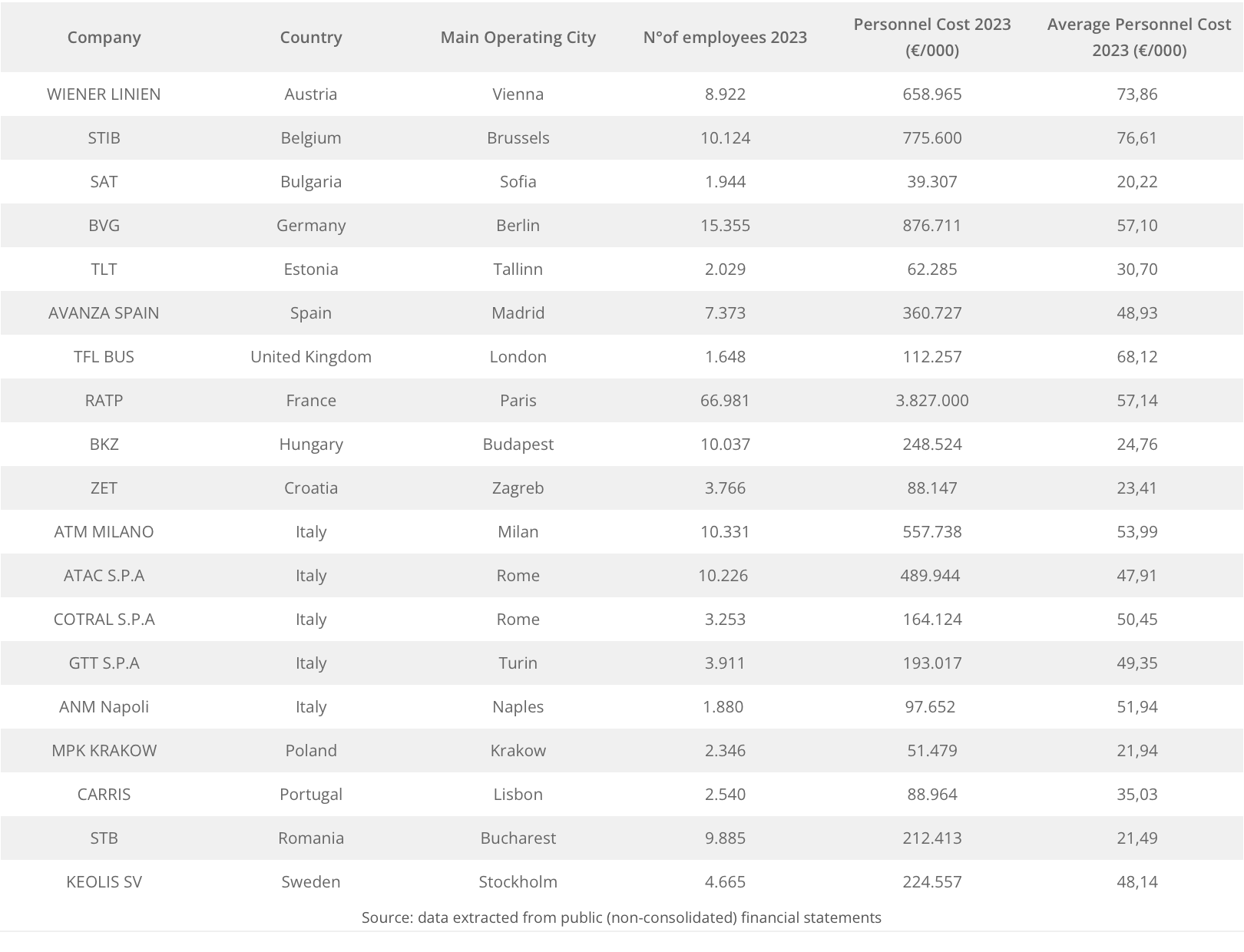
Notes:
*ANM Naples data refers to 2022 (latest available data).
**The sample of companies was selected starting from major European capitals and then based on company size, prioritizing those primarily operating urban public transport services by bus.
*** The average personnel cost was calculated by dividing the total personnel expense by the number of employees. It should be noted that this figure includes all staff categories, including executives, which can significantly impact the final value.
The companies of public transport at Europe exhibit ddifferent significant in terms of the number of employees and personnel expenses. RATPoperating mainly in Paris, has a population of 66.981 employees with an annual expenditure of almost €4 billion. Follow BVG (Berlin) with 15.355 employees and a charge of $ 876 million, STIB (Brussels) with 9.601 employees and an expense of €775 million, and Wiener Linien (Vienna), which employs 8.922 people with a cost of €659 million.
In Italy, ATM Milan has 10,331 employees and a personnel expense of €558 million, while ATAC (Rome), with 10,226 employees, registers a cost of €490 million. GTT Turin and ANM Naples have personnel expenses of €193 million and €97 million, respectively.
In Eastern Europe, although public transport companies are similar in size to those in Western Europe, personnel costs are significantly lower. For example, MPK Krakow employs around 3,000 people, STB Bucharest about 11,000, and BKZ Budapest around 10,000, with overall lower personnel costs.
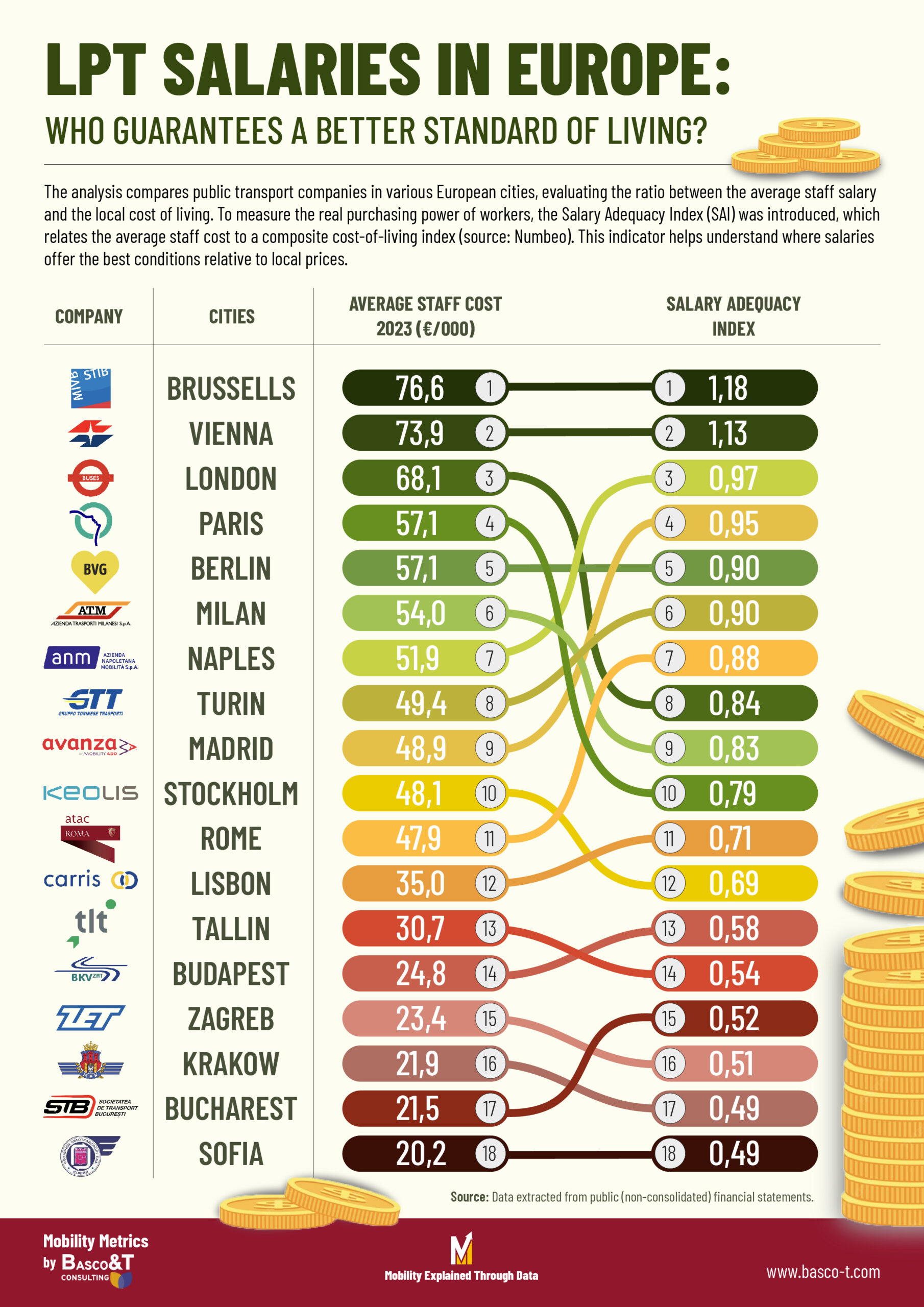
A look at the average personnel cost reveals significant differences. The highest values are recorded in Brussels (€76,610), Vienna (€73,858), Berlin (€57,096), and Paris (€57,136). In Eastern European cities, the gap is evident: MPK Krakow (€21,943), SAT Sofia (€20,220), and STB Bucharest (€28,365) offer much lower salaries.
Italian companies are positioned in the middle of the ranking: ATM Milan (€53,987), ATAC Rome (€47,912), GTT Turin (€50,453), and ANM Naples (€51,943).
The Relationship Between Personnel Costs and Cost of Living: Salary Adequacy Index (SAI)
To assess the real purchasing power of public transport employees, the ratio between average personnel cost and cost of living was calculated. The cost-of-living index used is from Numbeo, which measures the prices of essential consumer goods (food, transport, utilities, and restaurants), excluding rent and mortgages. This index takes New York City as a reference point: for instance, if a city has an index of 80, it means that the cost of living is estimated to be 20% lower than in NYC.
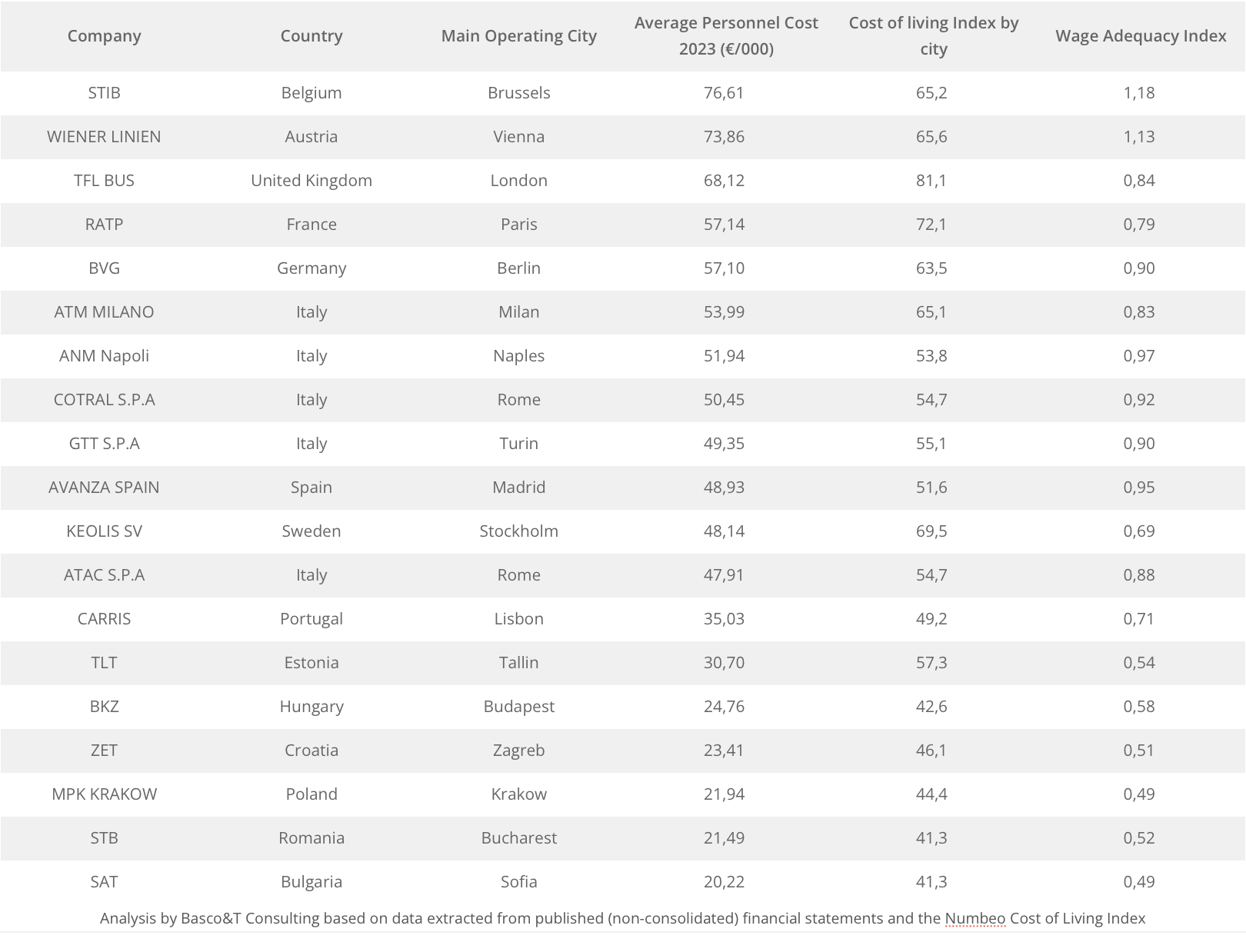
The ratio between average salary and cost of living provides an indication of the real purchasing power of public transport workers. The higher the value, the greater the ability to afford goods and services relative to local prices:
- if the value is top to 1, il salario risulta proporzionalmente più alto rispetto al costo della vita locale, consentendo una greater spending capacity.
- if the value is equal to or close to 1, c’è in balance with the cost of livingcovering essential expenses without special margins or restrictions.
- If the value is below 1, the cost of living is relatively high compared to salaries, reducing spending capacity.
The cities where public transport workers benefit the most from this ratio are:
- Brussels (1.18) and Vienna (1.13): Salaries provide high purchasing power relative to local prices.
- Naples (0.97) and Madrid (0,94) si posizionano bene, suggerendo salari adeguati.
- Rome (0.88) and Turin (0.92) show relatively positive values, while Milan (0.83) ranks slightly lower.
On the other hand, some cities have high costs of living compared to salaries:
- Paris (0.79) is among the worst performers: Despite high nominal wages, the cost of living significantly impacts earnings.
- Berlin (0.90) ranks in the middle, with a purchasing power that is not particularly high relative to salaries.
Focus on Italy
The analysis shows that the le aziende di trasporto pubblico italiane offrono retribuzioni inferiori rispetto alle realtà europeebut the purchasing power varies from city to city. Naples, in spite of an average wage that is lower than in Milan, offers the best ratio between salary/cost of living, the more favorable. Milan, despite having salaries that are nominally the most high, is less advantageous because the cost of living is higher. Rome and Turin are positioned in an intermediate zone.
Infine, le città dell’Est Europa presentano indici più bassi, riflettendo paghe più contenute rispetto al costo della vita: Zagabria (0,51), Budapest (0,58) e Cracovia (0,49).
Comparing Rankings: Average Personnel Cost vs. Salary Adequacy Index
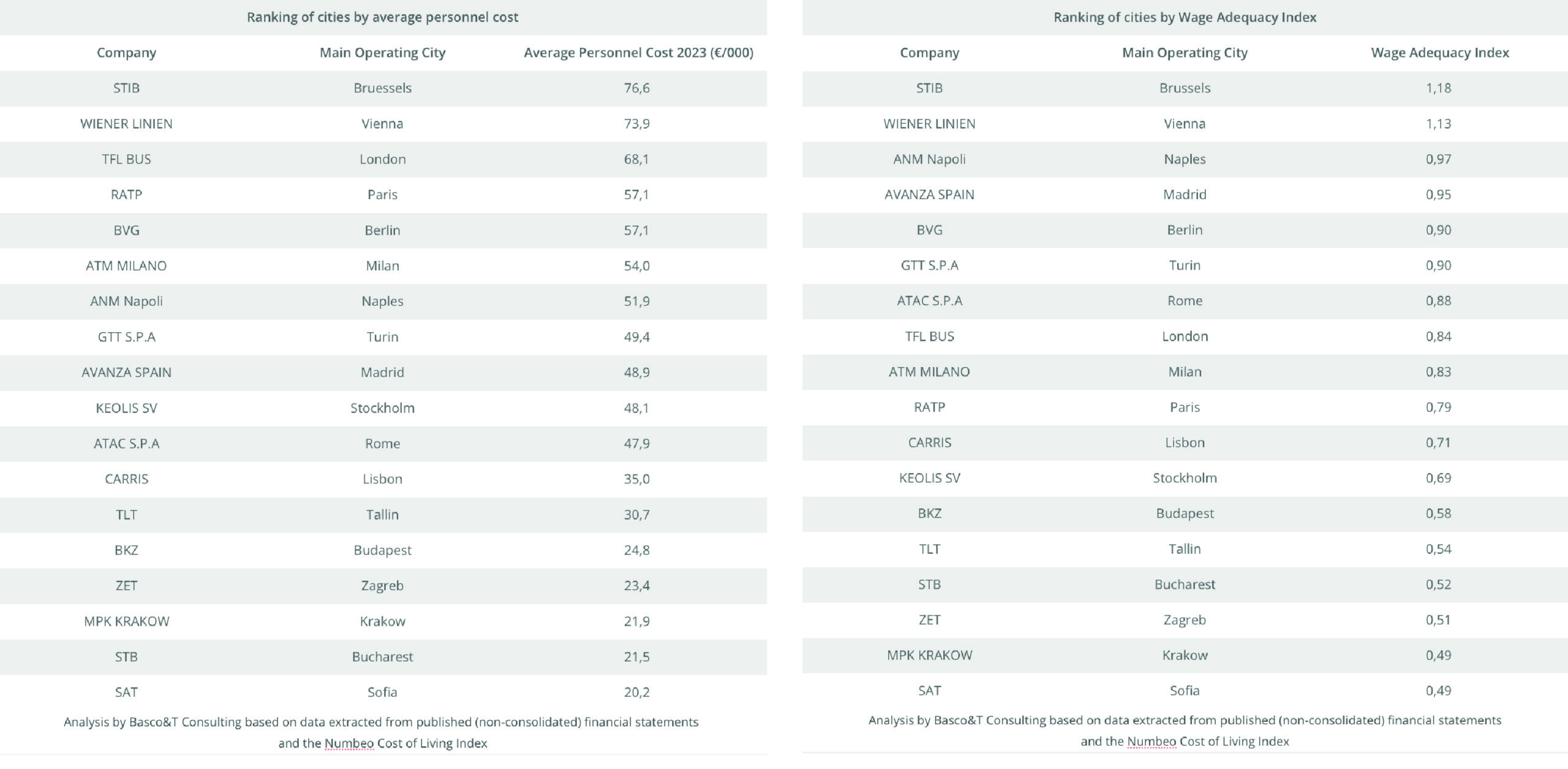
If you watch only the ranking for average personnel costs, Brussels and Vienna rank at the top of the ranking, followed by London, Paris and Berlinall over the 57,000 € per year. Also Milan is one of the top positions, with a value of 54,000 €, while Naples, Turin and Rome you attest under the 52.000 €. To close ranking, we find the cities of Eastern Europe, with Sofia, Bucharest and Krakow, where wages are significantly lower.
However, when incorporating the cost-of-living indicator through the Salary Adequacy Index, the ranking changes:
- Naples and Madriddespite having lower salaries than in Milan or London, earn different positions in the ranking. Naplesin particular, salt from the seventh to the third place, while Madrid retrieves five positions, demonstrating that in these cities the cost of living is more content
Milan, Paris, and London drop in the ranking:
- London is a prime example: while it ranked third in salary levels, it drops five positions in the Salary Adequacy Index, falling to eighth place—highlighting the significant impact of living costs on wages.
Brussels and Viennainstead, to confirm their leadership in both charts, while the cities of Eastern Europe remain in the bottom of the rankings in both measurements, a sign that lower wages will not compensate the cost of local life.
Thus, Brussels and Vienna emerge as the most advantageous cities, where salaries ensure a good standard of living relative to local prices. Naples, Madrid, Turin, and Rome provide fairly balanced conditions, while Milan and Paris show a less favorable ratio, indicating that high living costs significantly impact earnings.
Eastern European cities confirm the economic gap with Western Europe, where lower wages limit purchasing power.