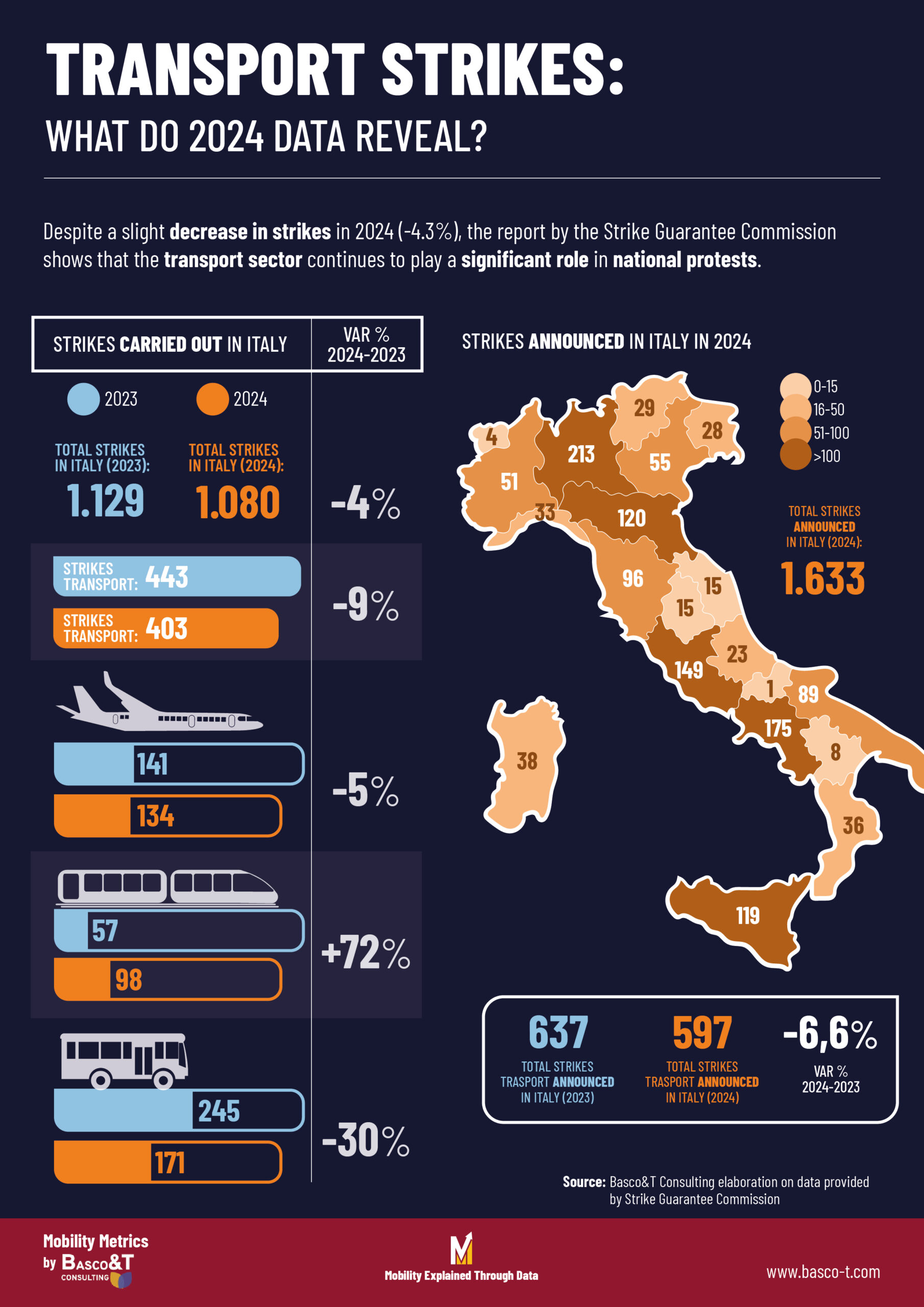
Despite a slight decrease in strikes in 2024 (-4.3%), the report by the Strike Guarantee Commission shows that the transport sector continues to play a significant role in national protests.
Share on:
The analysis is based on data provided by the Strike Guarantee Commission nella relazione annuale dell’attività svolta nel 2024. Lo studio si concentra sui settori e sulle regioni maggiormente coinvolte, analizzando la variazione annua e l’incidenza sul totale nazionale.
Analysis of the sector and incidence on the national total
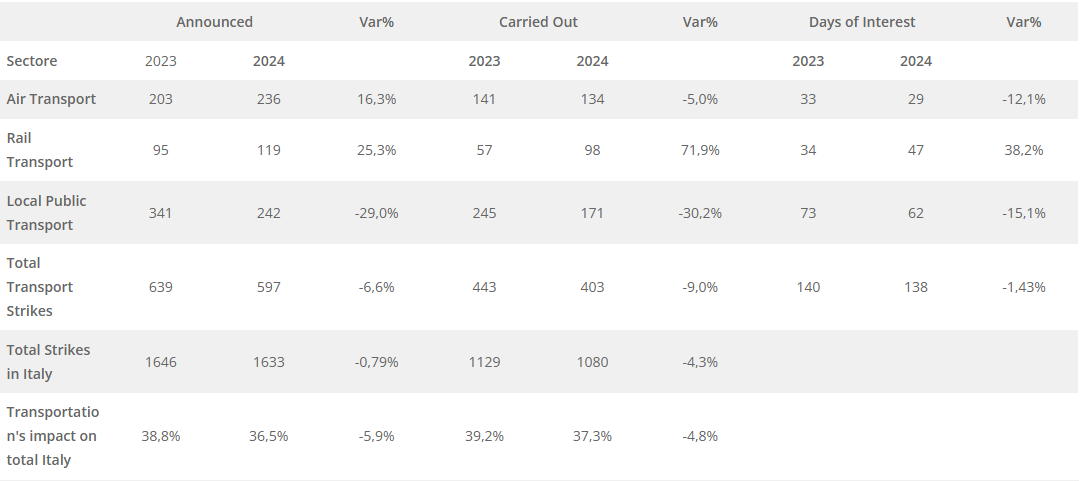
In 2024, 1,633 strikes were called in Italy, of which 1,080 were actually carried out.
Basco&T Consulting elaboration on data provided by Strike Gurantee Commission
Notes: *The transport sector used does not take into account maritime transport and freight transport, whether by road or rail.
**GG refers to the days on which protests took place, including national, regional, and local strikes.
Transport strikes called in 2024: 597 (compared to 639 in 2023, -6.6%)
Scioperi Effettuati nei trasporti nel 2024: 403 (contro 443 del 2023, -9%)
Peso del settore dei Trasporti sul totale scioperi: diminuito dal 38,8% al 37,31% (-1,49%)
By analyzing the portfolios specific:
- Air Transport:
Announcements: 236 in 2024 (+16.3%)
Actual strikes: 134 in 2024 (-5%)
Days affected: 29 in 2024 (-12.1%)
- Rail transport:
Announcements: 119 in 2024 (+25.3%)
Actual: 98 in 2024 (+71.9%)
Days affected: 47 in 2024 (+38.2%)
- Local Public Transport:
Announcements: 242 in 2024 (-29%)
Actual: 171 in 2024 (-30.2%)
Days affected: 62 in 2024 (-15.1%)
In 2024, the strike landscape in the Italian transport sector showed contrasting dynamics, with significant variations between the different sectors.
Air transport saw an increase in announcements (+16.3%), but a slight decrease in strikes actually carried out (-5%) and in days affected (-12.1%), a sign of a greater tendency towards revocation or mediation.
On the contrary, rail transport recorded a marked increase in both strike notices (+25.3%) and strikes carried out (+71.9%), with an increase of 38.2% in the number of days, highlighting growing tension in the sector.
Local public transport, on the other hand, experienced a sharp decline: fewer announcements (-29%), fewer actual strikes (-30.2%) and a reduction in days affected (-15.1%), probably linked to a different union strategy or containment measures.
Overall, transport strikes decreased by 6.6% in announcements and 9% in actual events, in line with a slight decline in the national total.
However, the transport sector's share of total protests remains high, at 37.3%, confirming the central role that this sector continues to play in the country's conflict dynamics.
Regional analysis
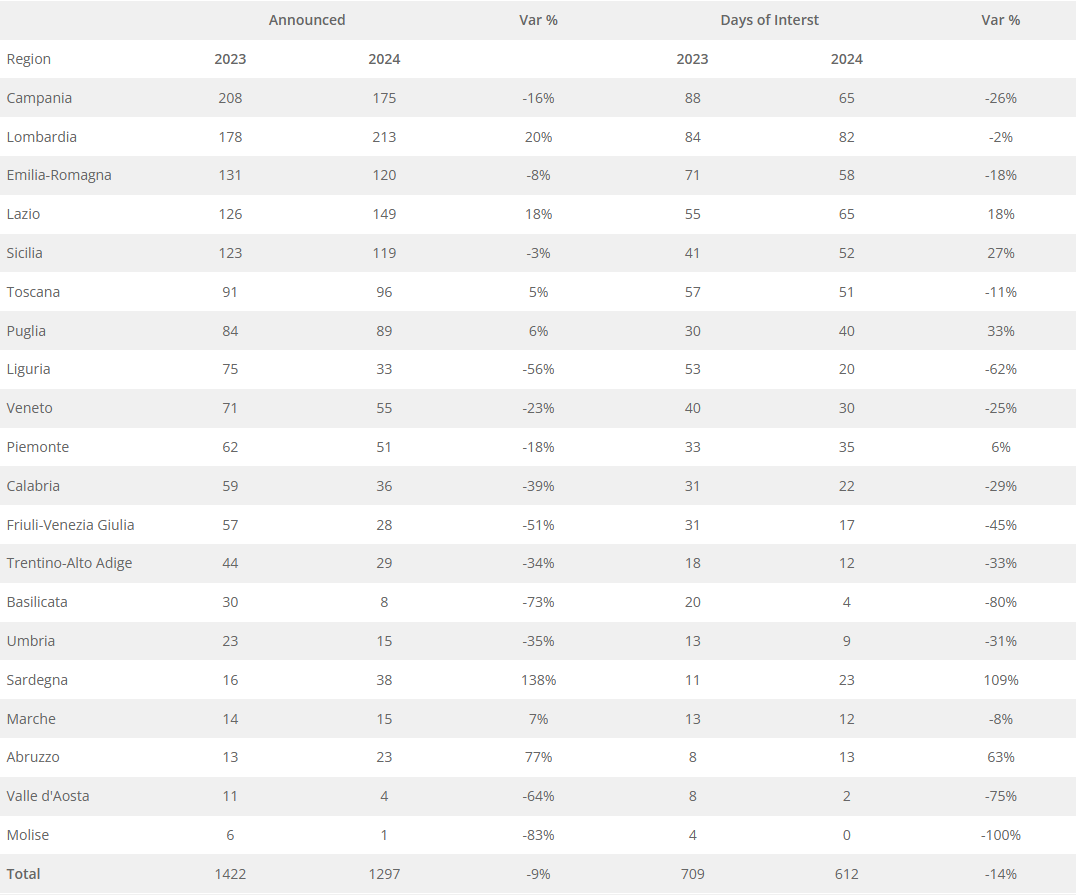
At the regional level, 1,297 strikes were called in 2024, but they were unevenly distributed geographically.
Basco&T Consulting elaboration on data provided by Strike Gurantee Commission
Notes: The table refers to strike announcements at the local/regional level
It also includes strike announcements of national significance (336).
When comparing 2023 and 2024, regional data on strike announcements and days affected show a general downward trend, albeit with some significant exceptions. The total number of strikes announced fell from 1,422 to 1,297 (-9%), while the number of days actually affected fell from 709 to 612 (-14%).
However, some regions recorded an increase: Lombardy, for example, saw a 20% increase in strikes called, while the number of days affected remained stable.
Lazio also showed growth, with 149 strikes called in 2024 compared to 126 in the previous year (+18%), and an increase in the number of days affected from 55 to 65.
On the contrary, regions such as Campania and Liguria recorded significant declines, of 16% and 56% respectively.
In general, the picture shows an uneven distribution of unrest across the country, with some areas where social conflict has intensified and others where it seems to have subsided.
Conclusion
In 2024, strikes in the transport sector showed an overall decline, but the sector remains one of the most active in the Italian protest landscape.
Although local public transport saw a sharp decline, rail transport recorded an overall increase, signaling growing tensions. At the regional level, the distribution is uneven: some areas such as Lombardy and Lazio saw an increase, while others such as Campania and Liguria recorded a decline.
The study confirms that, despite the decline, transport continues to be a social barometer for the country.
In una precedente analisi “Scioperi in Italia: cosa ci dicono i dati del 2023?” abbiamo analizzato la situazione degli scioperi in Italia dal 2019 al 2023