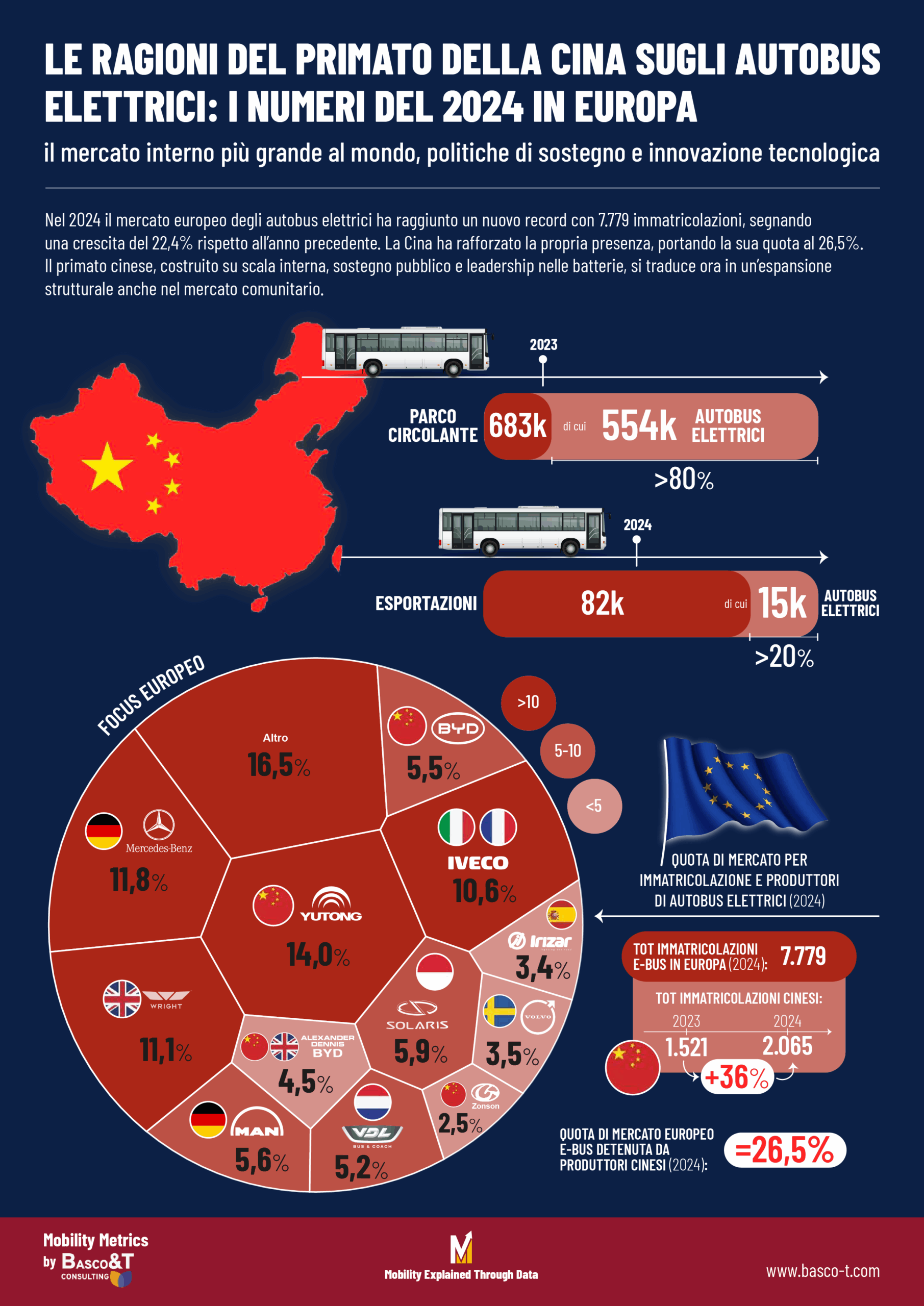
The year 2024 closes with a new record for the electric bus market in Europe: 7,779 electric vehicles were registered, marking a 22.4% growth over the previous year. A figure that confirms the ongoing transition in European urban public transport, which is increasingly oriented toward sustainable solutions.
Share on:
Also emerging strongly is another phenomenon: the concentration of the market around a few large manufacturers. The leading companies, shown below, covered 83.5 percent of the market, up from 78% in 2023.
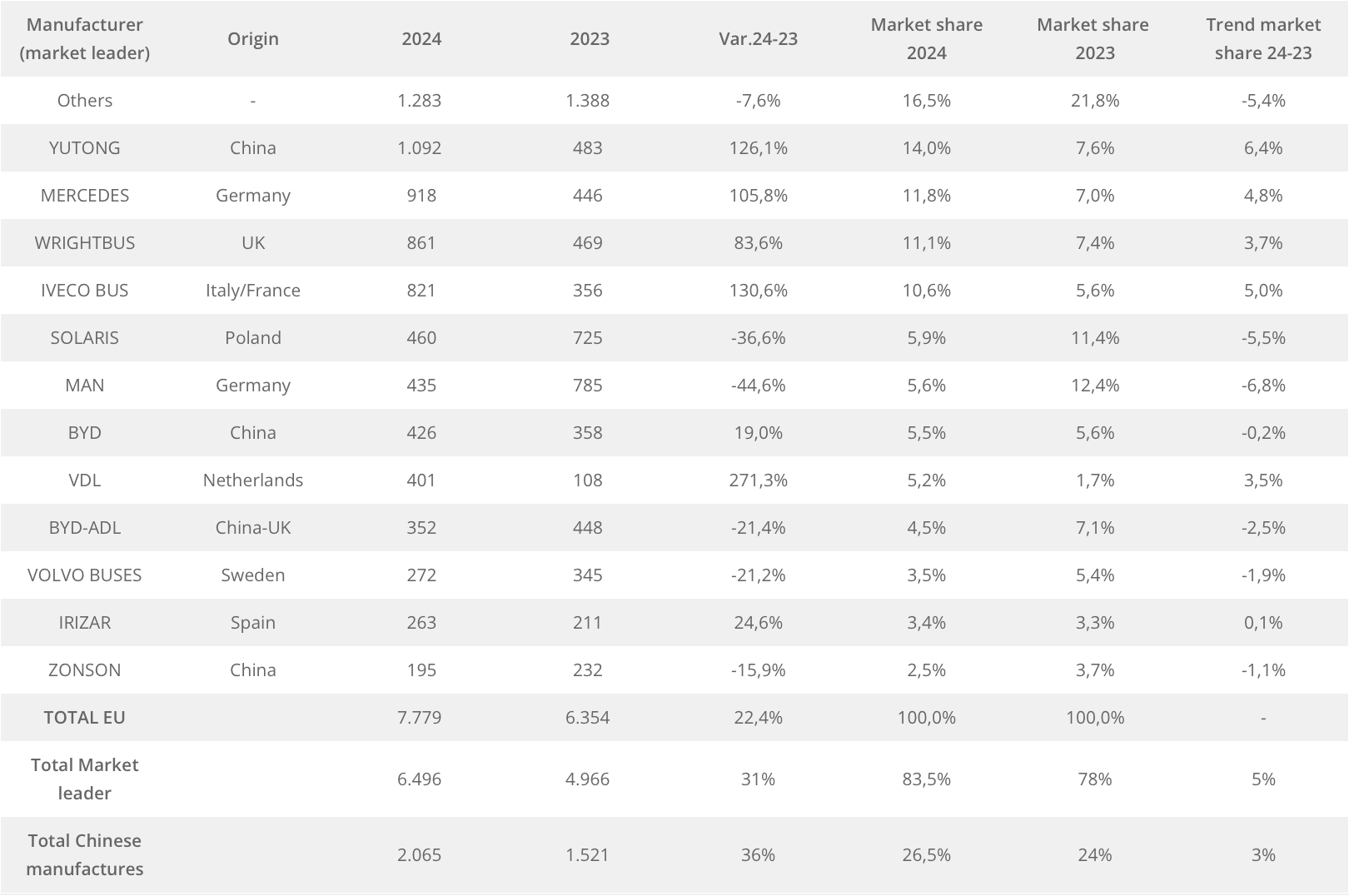
Dati estratti da Sustainable Bus
Note: Data sorted by market share 2024
Key players in 2024 include:
- Yutong, a Chinese company, which, with more than 1,000 buses sold, takes absolute leadership of the European market, doubling its registrations and reaching 14 percent share.
- Mercedes and Wrightbus stand out with growth rates above 80 percent, a sign of consolidation by European players as well.
- Iveco Bus, with +130% growth, demonstrates the dynamism of the Italian-French industry in seizing the opportunities offered by electric mobility.
- BYD, although with lower growth, maintains a stable position.
Not everyone, however, ends the year with a plus sign. Two historical brands, MAN and Solaris, register a sharp contraction (-44.6% and -36.6%), losing relevance in an increasingly competitive scenario.
China accelerates: more than one in four electric buses is Chinese
One of the most significant figures for 2024 concerns the performance of Chinese manufacturers. Companies from China registered 2,065 electric buses in Europe (accounting for about 13% of China's global electric bus exports), up +36% from the previous year. Their market share increased from 24 percent to 26.5 percent, consolidating a now clear trend: China is becoming a major player in European public transport as well.
In fact, China is the largest market for electric buses in the world, with more than 554,000 electric vehicles out of 682,500 on the road. This huge domestic market has created the conditions for a robust industry, capable of exporting 15,444 electric buses in 2024 out of a total of 81,820 vehicles, with an annual growth rate of +28.3%.
China's leadership in the sector is not the result of chance, but the result of a combination of strategic factors. The country represents the world's largest market for electric buses, supported by rapid urban expansion and growing domestic demand for sustainable public transport solutions. This is complemented by targeted government policies that have consistently incentivized both the production and purchase of electric vehicles, thus fostering an ideal environment for the adoption of low-emission technologies.
A key aspect is also China's role in the electric vehicle battery manufacturing supply chain. Leading companies such as CATL and BYD are developing cutting-edge technologies that can reduce costs and achieve economies of scale through high production volume. These industrial advantages have enabled China to establish itself in the global market and strengthen its international presence through a growing export flow.
Overall, China has been able to turn industrial and technological advantages into a strategic projection toward Europe, consolidating its presence even in a mature and regulated market like the EU.
In a recent in-depth study, we analyzed the role of Chinese e-bus manufacturers globally, examining the dynamics and motivations behind their rise.