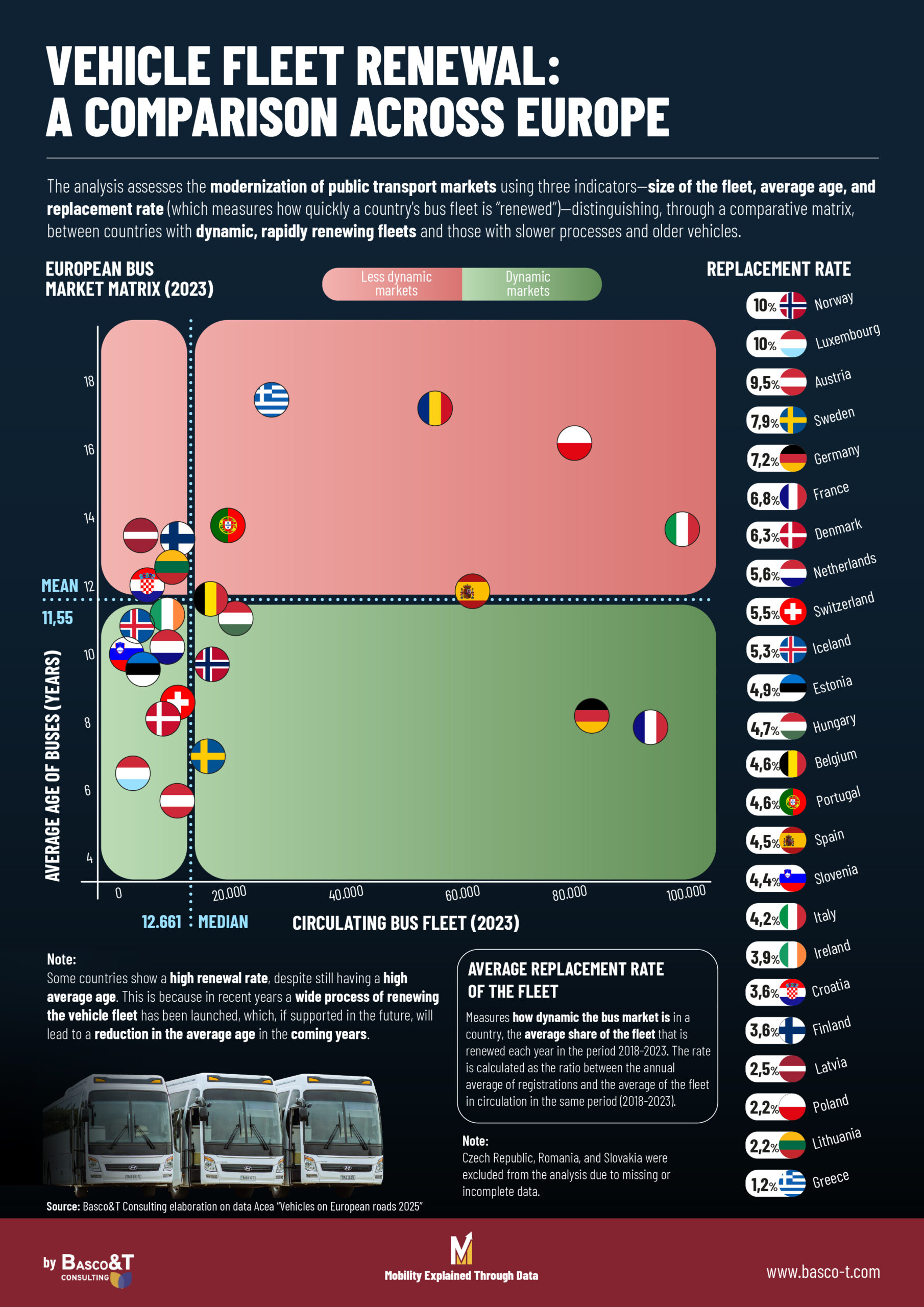
The analysis assesses the modernization of public transport markets using three indicators—size of the fleet, average age, and replacement rate (which measures how quickly a country's bus fleet is “renewed”)—distinguishing, through a comparative matrix, between countries with dynamic, rapidly renewing fleets and those with slower processes and older vehicles.
Share on:
The renewal of bus fleets is now one of the most significant indicators for assessing the health of European local public transport (LPT) systems. In a context characterised by stringent decarbonisation targets, the advance of the energy transition and increased demand for sustainable mobility, understanding how European countries are renewing their fleets is essential for planning effective and consistent policies.
L’analisi è basata sui dati ACEA Vehicles on European roads 2025 and datasets updated to 2023, provides a clear picture: Europe shows significant heterogeneity in terms of bus fleet replacement rates and modernisation levels.
Why it is important to analyse fleet renewal
The analysis was created with the aim of providing a comparative tool for interpreting the dynamics of bus fleet renewal in Europe.
Renewing the bus fleet means:
- increasing the operational efficiency of transport networks;
- reducing fuel consumption, emissions and maintenance costs;
- improving safety, reliability and service quality;
- introducing more modern and cleaner technologies;
- supporting the transition to electric and low-emission mobility.
However, the pace of change is not uniform across Europe. To understand where renewal is proceeding rapidly and where it is slowing down, a comparative model has been constructed based on three key indicators:
- Size of the fleet in circulation (2023)
- Average age of buses
- Average replacement rate, which measures the percentage of the fleet replaced each year (average 2018–2023)
How to measure the average turnover rate
The average replacement rate is calculated as follows:
(Annual average of registrations 2018–2023 / Average of vehicles in circulation 2018–2023) × 100
The higher the value, the more dynamic the market and the faster the fleet is renewed. A low value, on the other hand, indicates stagnation and a potential increase in the risk of technological and environmental obsolescence.
At European level, the average rate is around 5%, but with significant national differences.
A matrix for interpreting European markets
To better compare countries, the analysis uses a matrix with two axes:
- Horizontal axis: size of the fleet in circulation
- Vertical axis: average age of buses
The European medians – 12,661 vehicles for fleet size and 11.55 years for average age – divide the matrix into four quadrants, which distinguish:
- Dynamic markets:characterised by younger fleets and sustained renewal rates, signalling a market where the fleet is effectively renewed on a regular basis.
- Less dynamic markets, are markets with low replacement rates, requiring targeted investment policies for fleet renewal.
This reading clearly shows which countries are already investing systematically and which are showing structural delays.
Europe renews itself: the most dynamic countries
| PAESE | TASSO MEDIO DI RICAMBIO % |
| Norvegia | 10,0% |
| Luxembourg | 10,0% |
| Austria | 9,5% |
| Sweden | 7,9% |
| Germany | 7,2% |
| France | 6,8% |
| Danimarca | 6,3% |
| Netherlands | 5,6% |
| Switzerland | 5,5% |
| Islanda | 5,3% |
| Estonia | 4,9% |
| Ungheria | 4,7% |
| Belgium | 4,6% |
| Portogallo | 4,6% |
| Spain | 4,5% |
| Slovenia | 4,4% |
| Italy | 4,2% |
| Irlanda | 3,9% |
| Croazia | 3,6% |
| Finland | 3,6% |
| Latvia | 2,5% |
| Polonia | 2,2% |
| Lituania | 2,2% |
| Greece | 1,2% |
Only four countries exceed an average replacement rate of 7%, confirming themselves as the most advanced ecosystems in the process of modernising local public transport:
- Norway – 10%
- Luxembourg – 10%
- Austria – 9.5%
- Sweden – 7.9%
These are markets with strong investment capacity, modern procurement systems and public policies geared towards sustainability. In these countries, the transition process has already been underway for years, with tangible effects on the average age of fleets.
The other side of the coin: the difficulties facing Mediterranean and Eastern Europe
In several southern and eastern European countries, renewal levels are below average:
- Italy – 4.2%
- Spain – 4.5%
- Hungary – 4.7%
- Poland – 2.2%
- Greece – 1.2%
These are markets where the average age of fleets tends to be higher and where the replacement process does not proceed regularly. The combination of limited resources, administrative complexity and slowdowns in public investment contributes to keeping replacement rates at levels that are insufficient for full modernisation.
Countries with high average age but growing replacement rate
An interesting phenomenon emerges from certain markets that show a high replacement rate despite a still high average age.
This occurs in countries where a major renewal programme has been launched in recent years, but which has not yet had time to significantly reduce the overall average age of the fleet. If this trend continues over time, these countries will see a gradual improvement in indicators.
When turnover is too slow: the risk of markets below 3%
A replacement rate of less than 3% indicates a market in serious difficulty: at this rate, it would take over 30 years to replace the entire fleet.
This timeframe is incompatible with:
- European targets for 2030 and 2050;
- the need to introduce electric and low-emission vehicles;
- the growing pressure of urban environmental standards;
- the technological renewal required by the sector.
Conclusion
The analysis confirms the existence of a two-speed Europe:
- on the one hand, countries capable of planning and financing rapid, structural renewal;
- on the other, markets where modernisation is proceeding slowly and requires more decisive action.
The experience of the most dynamic countries shows that when the renewal process is planned and supported on an ongoing basis, results are achieved: more modern fleets, reduced operating costs and immediate benefits for citizens, operators and territories. Italy fits into this picture with a process that has been underway in recent years, thanks in part to the resources of the PNRR, which are helping to gradually reduce the average age of the national bus fleet. However, this improvement cannot be taken for granted: if investments do not continue over the next decade, the average age will inevitably start to rise again, undoing the progress made.
The renewal of the bus fleet is not just a matter of public transport management: it is a strategic lever for the competitiveness of cities, passenger safety, environmental sustainability and the achievement of European climate targets.