
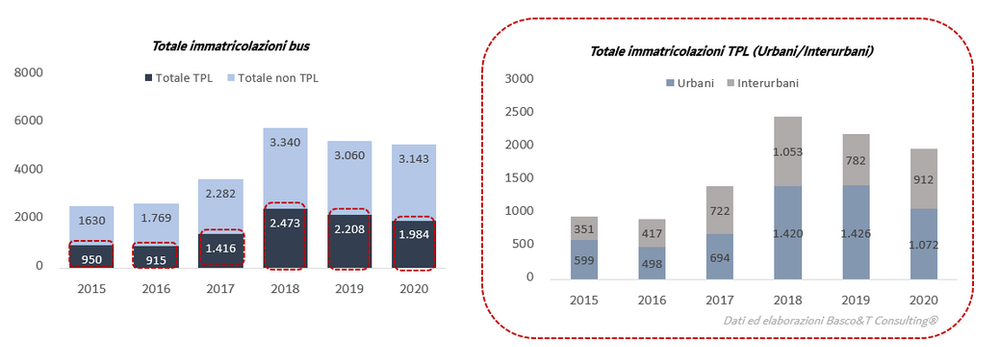
About 40% of the registrations of buses in 2020 were made by bus to the TPL. Of these, 54% are urban buses, and 46% for intercity.
State resources for the purchase and replacement of the means of transport, in the course of the last 20 years, have undergone a sudden braking.
We passed, in fact, from the more than 2,300 million euros in the period 1997-2011 to 495 million euros in the period 2012-2016.
As can be seen from the two graphs, there is a perfect correlation between the funds made available to the companies of the TPL for the purchase of buses and the number of registrations.
Politics have influenced and will influence future investment companies TPL


Today, the main source of investment comes from the PNRR that contains the whole of the pillar “Renewable energy, hydrogen, network, and sustainable mobility” from €23,78 billionthe funds dedicated to sustainable development of the local transport (€ 3,64 billion).
The measure provides three operations:
- Renewal of the fleet of buses with vehicles with low environmental impact
- Renewal of the fleet of trains for regional transport and intercity transport with alternative propulsion
- Renewal of vehicles of the Fire Brigade
The renewal of the fleet with buses with a low environmental impact is accelerating
the implementation of the National Strategic Plan for Sustainable Mobility and provides for the gradual renewal of the bus for the local public transport and the creation of charging infrastructure dedicated to it. In particular, it is planned to purchase by 2026 about 3.360 bus low emissions. About a third of the resources will go to the main Italian cities.
Are 1.9 billion euros, the funds allocated from the PNRR (National Plan for Recovery and Resilience) for the purchase of electric buses and hydrogen in large Municipalities.
A measure that aims to promote sustainable mobility, which is the way to move linked to the concept of sustainability, territorial, and oriented towards the reduction of the risk of pollution, the protection of health and of public space as a common good, and toward energy saving. Electric buses and hydrogen can contribute to these goals.
This will improve in the next few years, the migration of public transportation to vehicles that are more sustainable and green.
Drivers that influence positively and negatively the trend of the purchase of an e-bus in the next 10 years are:

- Progressive reduction of the price of the battery and the simultaneous decrease in the price of the electric bus;
- Appropriation of state funds that provide incentives for the purchase of bus green 1.9 billion coming from the PNRR;

- Increase the performance of the batteries in the vehicle;
- Gradual adaptation of the infrastructure charging along the paths and in the stores;
- The acquisition of know-how on the part of the operators;

- The need on the part of the local public transport companies to renew the park:• from 1 January 2021, with elimination of the refund of the excise duty for Euro 4 and below;• by 2024 stop Euro 3.

- Costs of electric buses are currently very high;
- The difficulty of recycling the used battery: high costs, inadequate recycling facilities, the current european legislation compelling.
The data in insight have been developed on the basis of banks ' proprietary data Basque&T Consulting.
For more information and details please contact us at info@basco-t.com
Authors:
Managing Partner