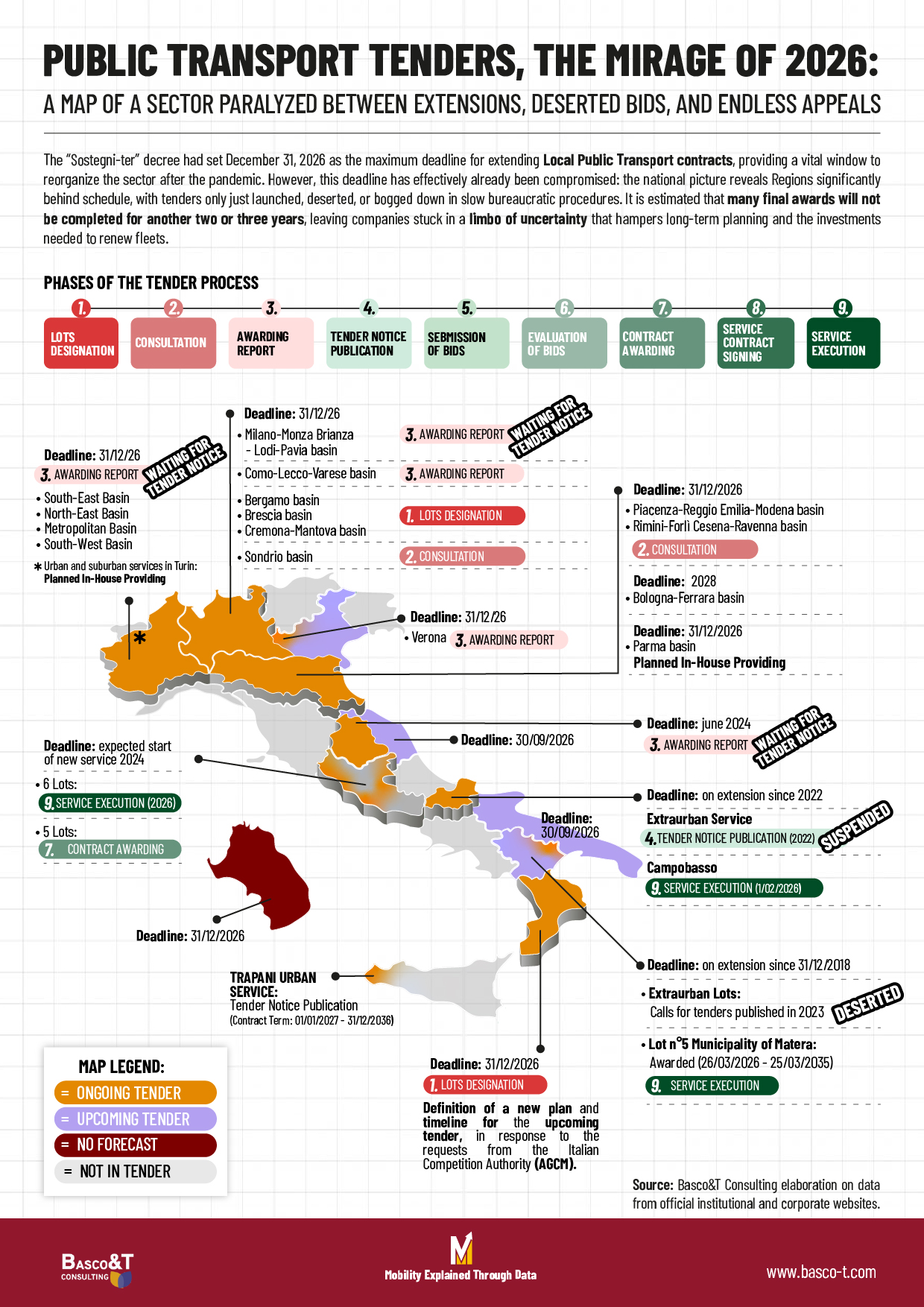
The “Sostegni-ter” decree had set December 31, 2026 as the maximum deadline for extending Local Public Transport contracts, providing a vital window to reorganize the sector after the pandemic. However, this deadline has effectively already been compromised: the national picture reveals Regions significantly behind schedule, with tenders only just launched, deserted, or bogged down in slow bureaucratic procedures. It is estimated that many final awards will not be completed for another two or three years, leaving companies stuck in a limbo of uncertainty that hampers long-term planning and the investments needed to renew fleets.
Share on:
The labyrinth of public transport tenders: the 2026 deadline is a mirage — and companies are left stranded.
The Local Public Transport sector in Italy continues to move at two speeds, but with one major common denominator: uncertainty. On the one hand, companies are expected to lead the ecological transition and modernize their fleets; on the other, they are forced to operate within a precarious regulatory and contractual framework, marked by unrealistic deadlines and exhausting bureaucratic procedures.
At the heart of this paralysis lies the notorious deadline of December 31, 2026.
The illusion of the “Covid extension”
To mitigate the devastating effects of the pandemic and give the sector some breathing space, the legislator intervened with the Sostegni-ter Decree (Article 24, paragraph 5-bis of Decree-Law 4/2022, converted into Law 25/2022). This provision allowed Regions to extend the duration of existing public service contracts no later than December 31, 2026, making use of the provisions of EU Regulation 1370/2007. The objective was a worthy one: to support investment in local public transport and offset losses linked to Covid-19 containment measures.
However, what was meant to be a temporary window to reorganize the system and prepare new tenders in time is turning into yet another Italian mirage. Looking at the current map of contract awards, it is clear that the 2026 deadline will not be met.
A fragmented and delayed national landscape
An analysis of the current situation at regional level reveals a patchy scenario, where delays dominate:
- Stalled or deserted tenders: In some regions, procedures have been launched but are colliding with the harsh realities of the market. A striking example is Basilicata, where the lots for regional services and for the provinces of Potenza and Matera, launched in 2024, received no bids, with the sole exception of the lot for the Municipality of Matera.
- Still up in the air: In Calabria, the new plan and timetable for the future tender are still “being defined,” under strong pressure and repeated warnings from the Italian Competition Authority (AGCM) over continuous direct extensions. In Sardinia, contracts are nearing expiry, yet there is currently “no clear plan” in place. Veneto is still in the process of outlining its new governance system.
- Slow-moving procedures: Regions such as Lazio, Umbria, and Sicily have tenders currently underway, but the administrative timelines for completion, evaluation, and the inevitable wave of appeals before administrative courts make any swift resolution impossible.
- “In-house” exceptions: Some territories have effectively locked in services through direct in-house awards, such as Abruzzo (until 2027), Liguria, and Trentino-Alto Adige (with deadlines extending as far as 2031).
Considering that some regions have yet to even begin the process or are only at the stage of preliminary consultation (such as local public transport in Verona), and given the extremely long timelines of administrative justice and evaluation committees, it is entirely reasonable to assume that final contract awards will not be seen for another two or three years. In effect, 2026 has already slipped.
The consequences: a “limbo” that stalls development
All of this translates into significant damage for the real economy. This situation places transport companies in a limbo of uncertainty that undermines planning and the programming of investments.
How can a company purchase dozens of new electric buses, build charging infrastructure, or hire and train new drivers if it does not know whether it will still hold the operating concession in that area in two years’ time? Investments in local public transport require long-term amortization plans and solid bank guarantees—conditions that no series of short-term extensions, renewed every few months, can ever support.
Local public transport is not an emergency—it is an industry
Once again, Local Public Transport in Italy is not being treated as a true industrial sector. It is managed with a logic of permanent emergency, continuous postponements, and patchwork regulations, overlooking the fact that the companies that keep the country moving need certainty, a stable regulatory framework, and reliable administrative timelines in order to plan their business over the long term.
Until institutions guarantee this basic ecosystem, the risk is not only that tenders will go deserted, but that citizens will be left with a stagnant service, unable to evolve or respond to the challenges of future mobility.