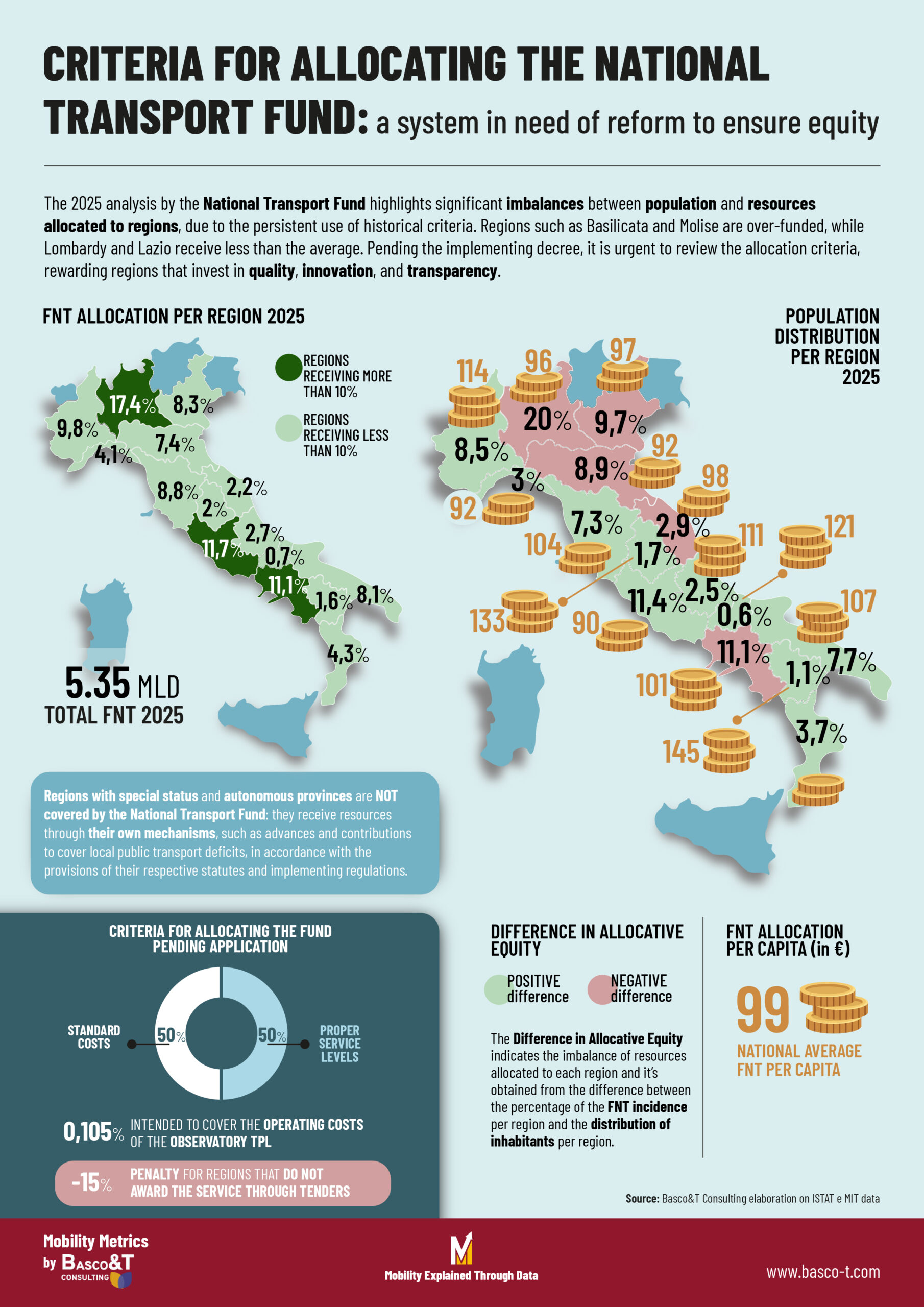
The 2025 analysis of the National Transport Fund highlights significant imbalances between population and resources allocated to regions, due to the persistent use of historical criteria. Regions such as Basilicata and Molise are over-funded, while Lombardy and Lazio receive less than the average. Pending the implementing decree, it is urgent to review the allocation criteria, rewarding regions that invest in quality, innovation, and transparency.
Share on:
The National Transport Fund (FNT)is a financing mechanism established in 2011 by the Italian government as part of the fiscal federalism process, which aims to support local public transport by road and rail, representing a strategic resource for local public transport.
The analysis examines the distribution of the National Transport Fund (FNT) among Italian regions in 2025, comparing the allocated share with the demographic weight. The aim is to identify systemic imbalances in the current system, based almost entirely on historical parameters that are no longer consistent with territorial dynamics.
Data and methodology
The analysis is based on ISTAT demographic data updated as of January 1, 2025, and on the official allocations of the National Transport Fund published by the Ministry of Infrastructure and Transport.
The comparison between the FNT share received and the regional demographic weight has highlighted imbalances in distribution.
2025 allocation: postponed applications and defined historical criteria
(Historical percentages of FNT allocation)
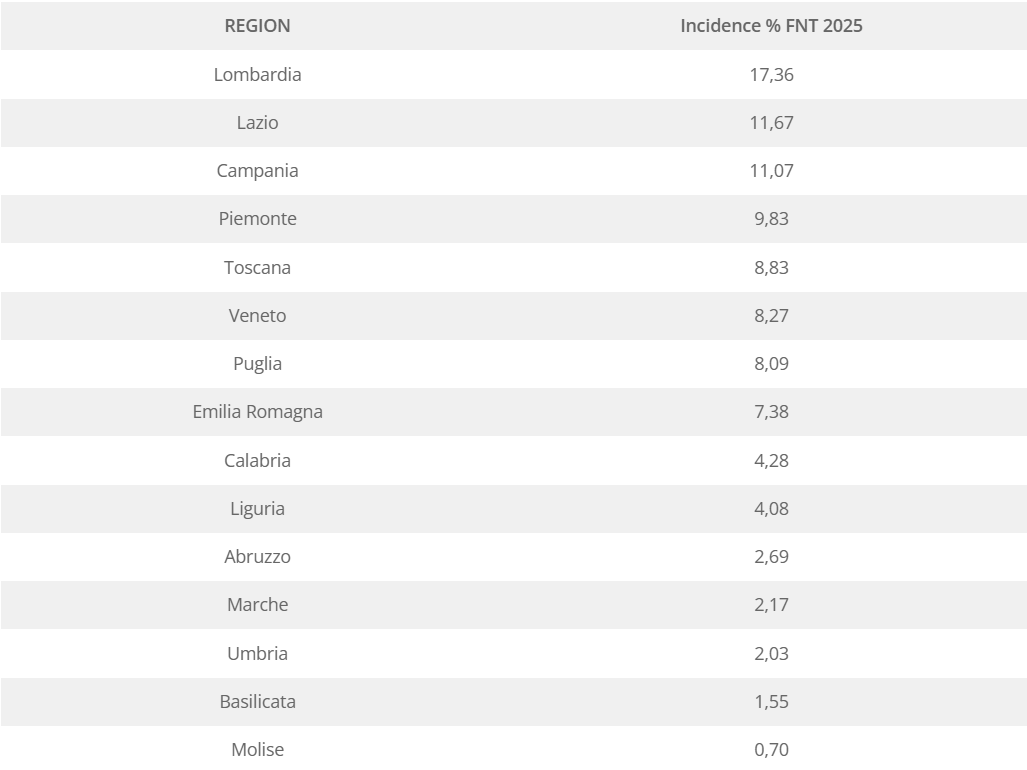
Dati estratti dal Ministero delle Infrastrutture e dei trasporti (MIT)
The National Transport Fund allocation system has undergone several regulatory revisions, but continues to be based on a predominantly historical structure.
The 2022 decree-law introduced a new structure for the allocation criteria. This regulation establishes that the allocation must take place by October 31 of each year, by decree of the Minister of Infrastructure and Transport, in agreement with the Minister of Economy and Finance, subject to agreement at the Unified Conference.
The fund is divided into two main components: 50% is allocated on the basis of the standard costs of regional public transport services, as recorded in the Public Transport Observatory database, and from 2024 also on the basis of the costs of managing the regional railway infrastructure; the other 50% is allocated according to adequate service levels, a concept that should reflect the quality and efficiency of public transport, but which still awaits an operational definition.
In addition to these criteria, there is a 15% penalty for regions that do not award services through public tender by December 31 of the previous year, or that do so in a manner that does not comply with the resolutions of the Transport Regulatory Authority. The reduced resources are redistributed among the regions that comply with the rules.
Finally, 0.105% of the fund, up to a maximum of €5.2 million per year, is allocated to cover the operating costs of the Local Public Transport Observatory.
Despite this, the implementation of the new allocation criteria has been postponed, pending the ministerial decree scheduled for June 2025, which has not yet been issued.
Consequently, the allocation for 2025 was made according to historical criteria: 90% of the fund is allocated according to the percentages set out in the decree, while the remaining 10% is allocated only if the regions demonstrate that they have achieved certain efficiency targets, while maintaining the same reference percentages.
Allocative Equity Difference
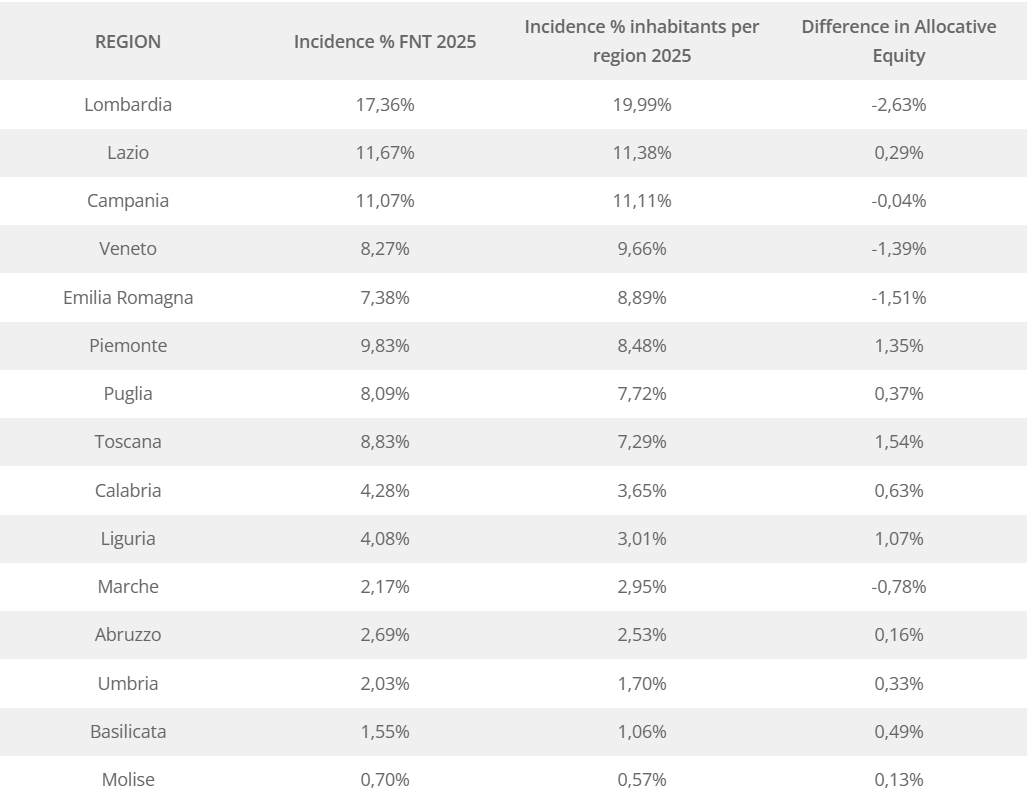
Basco&T Consulting analysis based on ISTAT data and data from the Ministry of Infrastructure and Transport
The analysis of the distribution of the National Transport Fund for 2025 highlights clear imbalances between the resources allocated to the regions and their demographic weight. To represent these imbalances, the Allocative Equity Difference was calculated by subtracting the percentage incidence of the FNT from the percentage incidence of inhabitants per region. Some regions are significantly advantaged (positive values) compared to their population, while others show imbalances (negative values).
This is the case of Basilicata, which receives 1.55% of the fund despite representing only 1.06% of the population, with a positive difference of 0.49%. Molise and Liguria also benefit from an over-allocation: the former receives 0.69% compared to 0.57% of the population, while the latter receives 4.08% compared to a demographic weight of 3.01%.
Conversely, some more populous regions are penalized. Lombardy, which accounts for almost 20% of the Italian population, receives only 17.36% of the fund, with a negative difference of over 2.6 percentage points. Emilia-Romagna and Campania also show discrepancies, albeit less pronounced.
Conclusion
2026 represents a crucial crossroads for the local public transport sector, with the expiry of numerous contracts and the launch of new tenders, as in Emilia-Romagna, while in other regions, such as Lazio, further delays are looming.
In this context, the mechanism for allocating the Local Public Transport Fund continues to be based on historical criteria, with a still marginal bonus quota. The failure to implement the ministerial decree on service indicators is hindering the launch of a long-awaited reform.
To ensure fairness, efficiency, and sustainability, it is urgent to review the allocation criteria, rewarding regions that stand out for their investments in quality, innovation, and ability to activate competitive and transparent procedures within the established time frame.