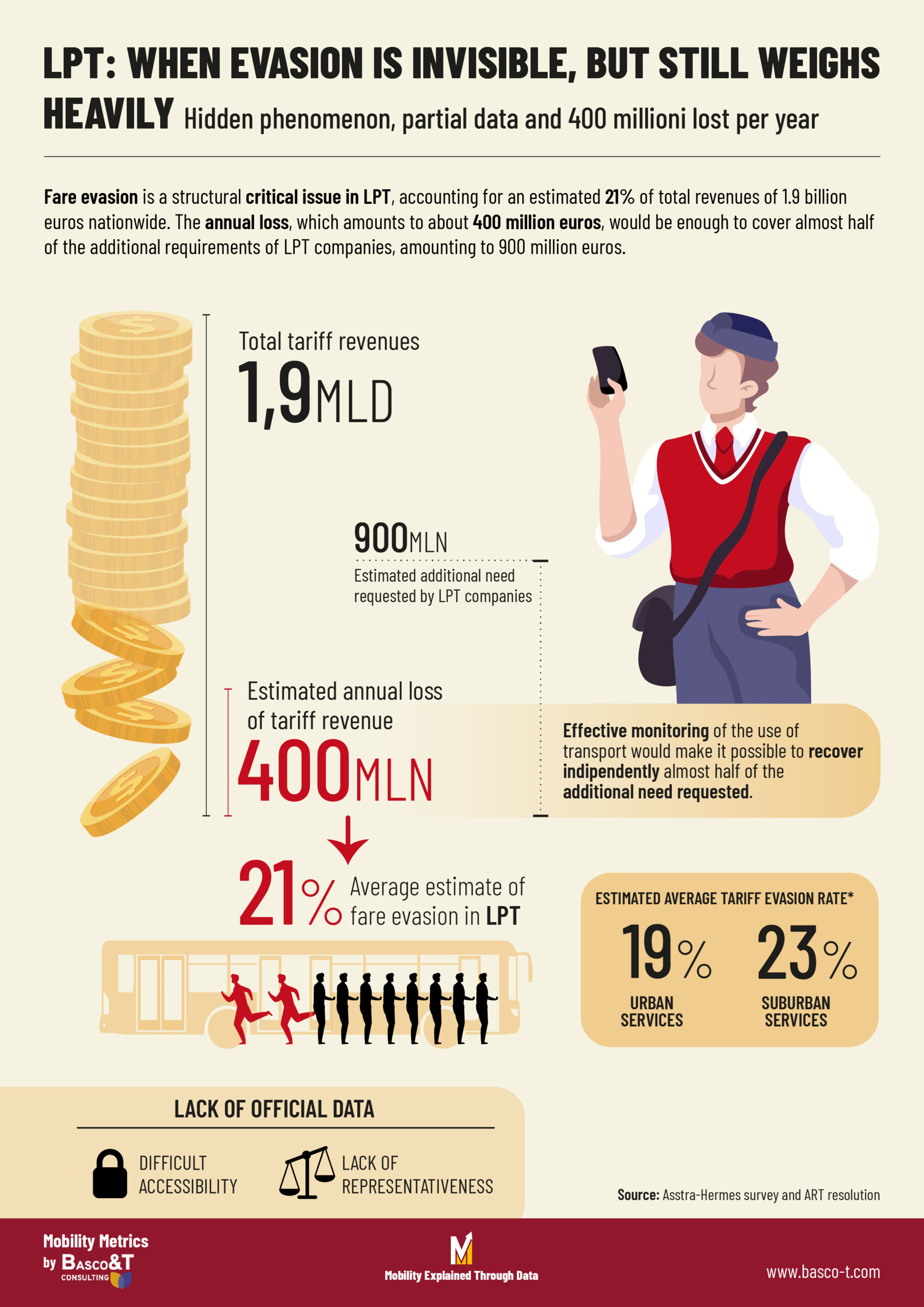
Fare evasion is a structural critical issue in LPT, accounting for an estimated 21% of total revenues of 1.9 billion euros nationwide. The annual loss, which amounts to about 400 million euros, would be enough to cover almost half of the additional requirements of LPT companies, amounting to 900 million euros.
Share on:
One of the most significant critical issues in Local Public Transport (LPT) is fare evasion. In Italy, available data on this phenomenon are often partial, difficult to access and, in many cases, unrepresentative of reality. A significant limitation is related to the typical behavior of evasive users, who tend to abandon the vehicle at the sight of control personnel, thus escaping detection.
This aspect generates a systematic underestimation of the phenomenon, particularly in the calculation of the evasion rate, commonly expressed by the formula:
Evasion rate = (Number of tickets issued/Number of passengers checked) × 100
This method, lacking proper weighting, returns unreliable estimates and makes comparisons between different territorial and management areas difficult.
A loss of 400 million euros a year
According to studies conducted by ASSTRA, the average real rate of fare evasion is 19 percent in urban services and 23 percent in suburban services, with an overall average value of 21 percent. The economic impact is significant: about 400 million euros a year evaded, out of a total revenue of 1.9 billion.
However, with public transport companies requesting an additional requirement of about 900 million euros, effective control activities on the use of vehicles would make it possible to recover almost half of this on their own, significantly reducing the size of the declared requirement.