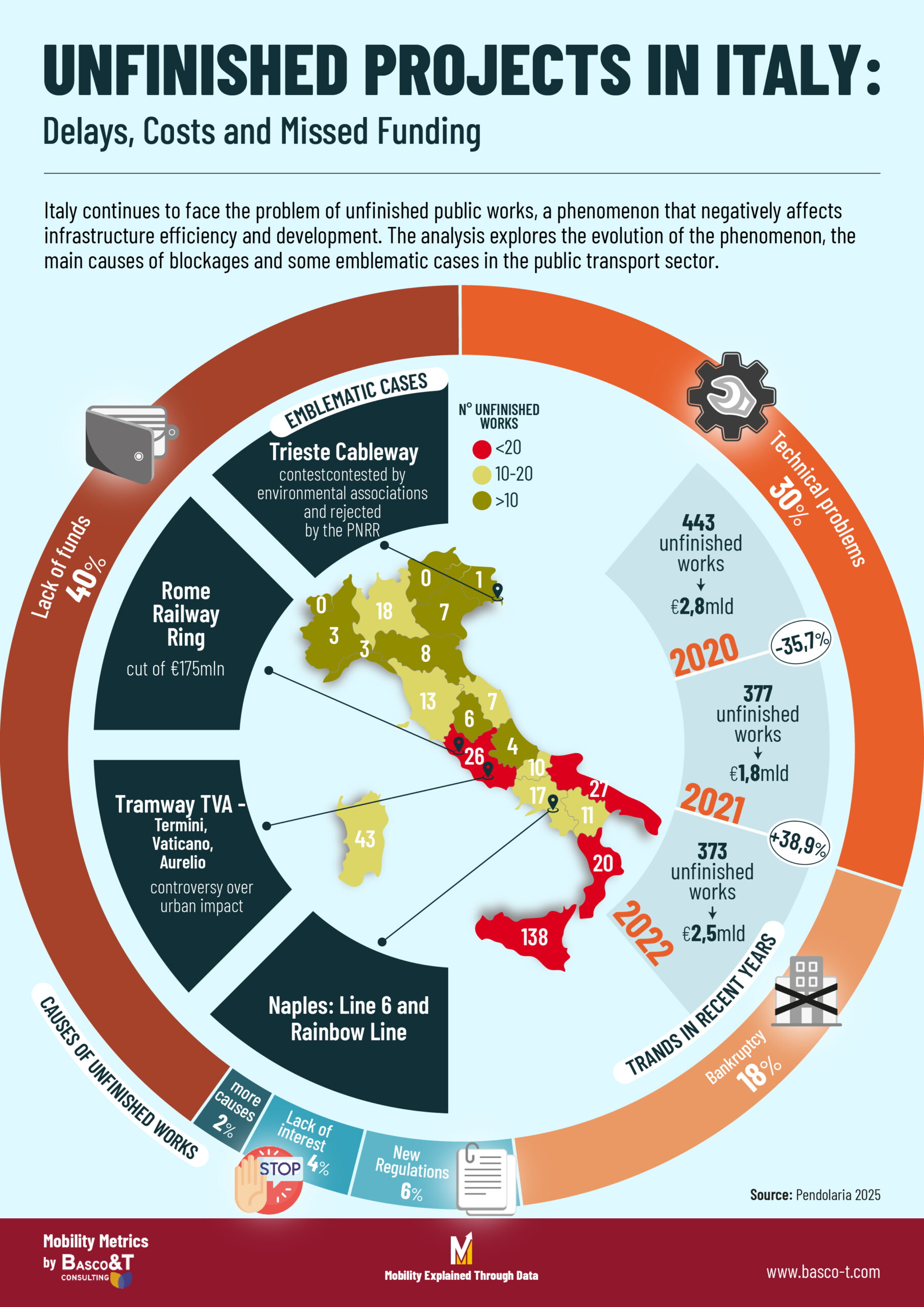
Italy continues to face the problem of unfinished public works, a phenomenon that negatively affects infrastructure efficiency and development. The analysis explores the evolution of the phenomenon, the main causes of blockages and some emblematic cases in the public transport sector.
Despite periodic monitoring and strategies put in place to reduce the phenomenon, new critical issues and blocked construction sites are recorded every year. The update of the Registry of Unfinished Works, a MIMS monitoring system, reveals worrying data: there are still numerous unfinished works and the costs for their completion continue to rise.
Non-downloadable image, to receive it please contact us at metrics@basco-t.com
Share on:
The numbers of unfinished works
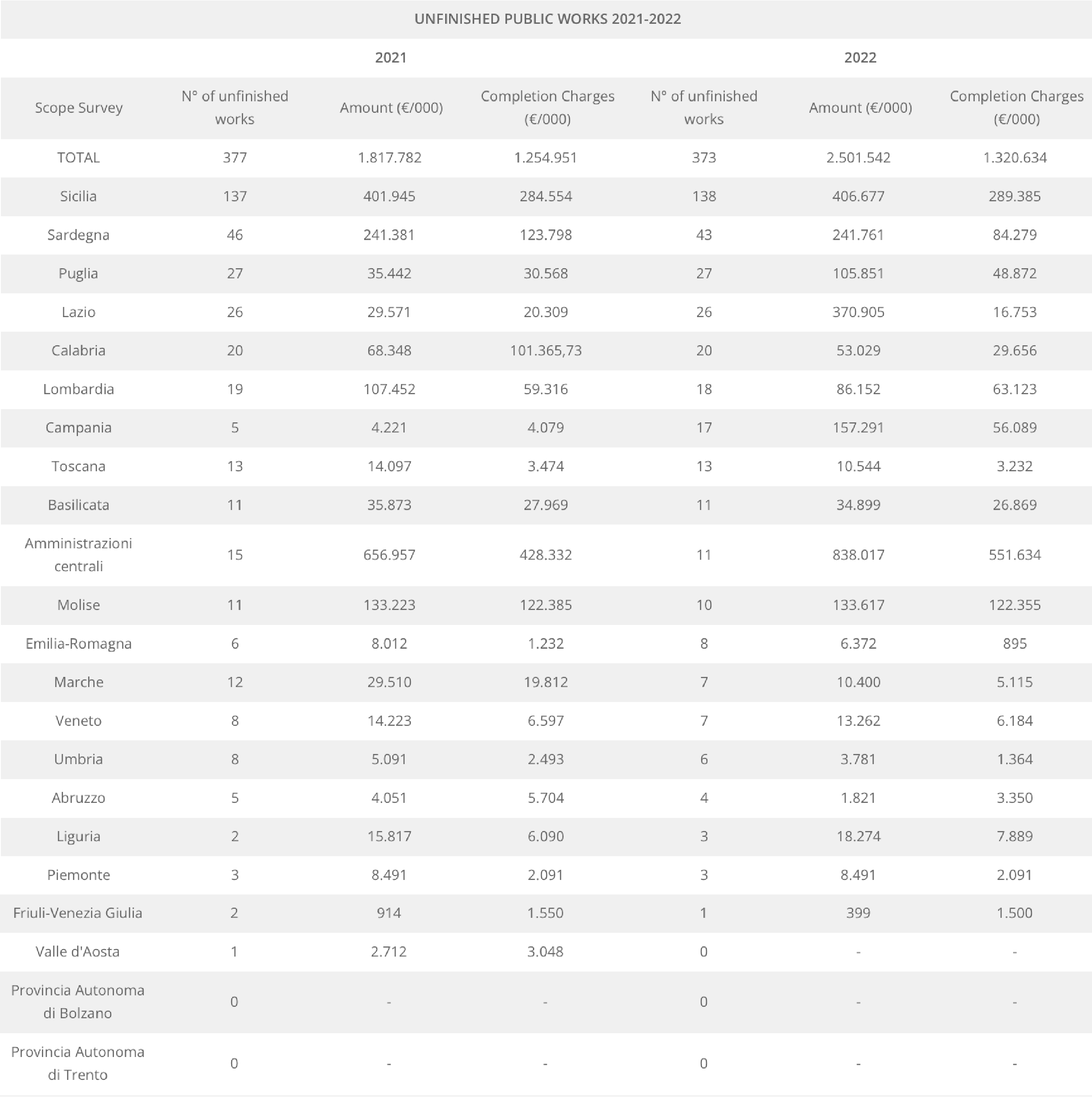
Analysing the trend in recent years, it can be seen that in 2021 there were 377 unfinished works, a slight decrease compared to 2020, when the number stood at 443. According to the latest report, updated to 31 December 2022, the total number of unfinished works is 373, only 4 fewer than the previous year.
The total amount of the interventions, updated to the latest economic framework, decreased drastically between 2020 and 2021, from EUR 2.8 billion to EUR 1.8 billion (-35.7%), reaching EUR 2.5 billion in 2022.
Most affected regions and causes of work stoppages
The territorial analysis shows significant differences between regions. Sicily holds the negative record with 138 unfinished works in 2022.
Among the most problematic regions we find:
- Sardinia43 works worth over 241 million euros.
- Lazio26 unfinished works, with a total amount needed of more than 370 million euro and 17 million for the completion of works.
- Calabria20 unfinished works with a total amount needed of more than 50 million euro and approximately 30 million in charges for completion of works.
- Campania: 17 unfinished works with over 50 million euro required for completion.
Since 2021, the Anagrafe monitoring has introduced a classification of the causes that lead to the blockage of public works. The data reveal that:
- 40% of works are blocked due to lack of funds
- 30% are blocked due to technical problems, often resulting from design errors or regulations that have arisen
- 18% are stopped due to the bankruptcy, withdrawal or contract termination of the contractor
- 6% were stopped due to the introduction of new regulations or legal provisions
- 4% remained unfinished due to lack of interest in completion, especially in the case of obsolete or outdated works
- 2% were stopped by several concomitant causes, making it even more difficult to resume work
Unfinished projects and public transport: emblematic cases
The Pendolaria 2025 report highlights numerous unfinished or stalled public transport infrastructures. Some examples:
- Rome and the railway ring: the closure of the capital's railway ring was cut €175 million from the PNRR funds in 2023. Without the completion of the entire project, the ongoing work between Valle Aurelia and Vigna Clara, scheduled for 2026, risks proving of little use for improving urban rail services.
- The Termini-Vaticano-Aurelio tramway (TVA,Rome): project postponed to 2026 due to controversy over urban impact.
- The case of the Trieste cableway: a 48.7 million euro project for a 4.2 km long cableway, strongly contested by environmental associations and rejected by the PNRR for failing to meet environmental criteria.
- Naples: despite investment in a new metro between Afragola and the city centre, many existing lines remain unfinished, such as Line 6 and the Rainbow Line.
Prospects for the future
Despite the worrying picture, there are regulatory tools to address the problem. Article 21 of Legislative Decree 50/2016 stipulates that unfinished works are included in the three-year public works programmes to ensure completion or to evaluate alternatives such as reuse, sale or demolition of abandoned structures. However, the effectiveness of these measures depends on the ability of administrations to manage resources efficiently.
Data used: