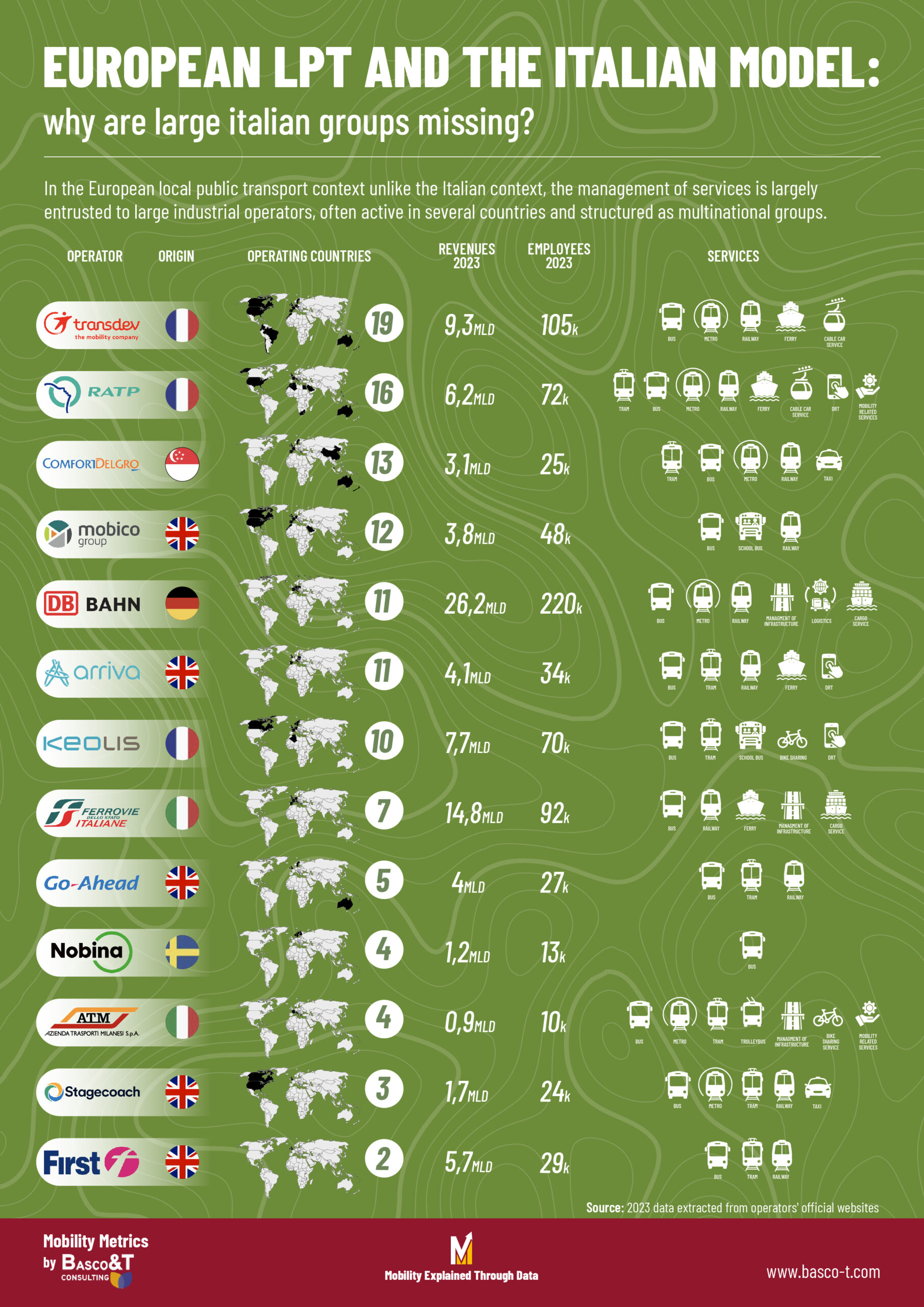
In the context of the TPL european unlike the Italian, the management of the services is largely entrusted to operators of large industrialoften active at more Countries structured as multinational groups. The dominant presence of these players – including Transdev, Keolis, Arriva, DB Group, RATP Group, Mobico– is the result of an evolution of regulatory and industry that has encouraged the internationalization of the sector.
The analysis examines the main local public transport operators active in the European market, comparing their economic and operational dimensions, including turnover, number of employees, type of services operated and, in particular, their presence in foreign markets.
Share on:
The lack of the formation of large national groups in the local public transport (LPT) market in Italy, unlike in other European countries, is the result of a combination of historical, regulatory and industrial factors. The main reasons behind this phenomenon can be traced to:
- Absence of a real competitive market:Absence of a real competitive market: in many European countries, LPT has been progressively opened up to competition through periodic public tenders, with clear and time-bound tenders. This has created the conditions for the development of competitive industrial operators, driven to grow in order to acquire new contracts, also abroad. In Italy, on the contrary, the use of tenders has historically been very limited: most services have been managed by direct award or extended without competition, often through public companies controlled by local authorities.
- Highly fragmented market structure: The Italian system has historically been characterised by hundreds of small or medium-sized operators, often locally rooted and with public governance. This fragmentation has made it difficult to form national players capable of competing with large European groups.
- Strong roots in public-localIn Italy, most of the companies TPL has a public property local (Municipalities, Provinces or Regions), often in a logic of control and more oriented to the management of the consensus that the industrial growth.
- Limited access to capital and delayed capitalisation: Italian LPT companies often have limited assets and reduced investment capacity. In contrast, European groups have benefited from state participations, infrastructure funds (as in the case of the Arriva group, which recently passed into the hands of the I Squared Capital fund), stock exchange listings (45% of the non-Italian operators analysed are listed on the stock exchange) or joint ventures that have allowed them to acquire companies and participate in international tenders. Without critical mass, adequate financial resources and market-oriented governance, it is difficult for an operator to develop in a multinational manner.
- Lack of national industrial direction: Italy has lacked a systemic industrial strategy in the LPT sector, capable of stimulating integration between operators and the emergence of national champions.
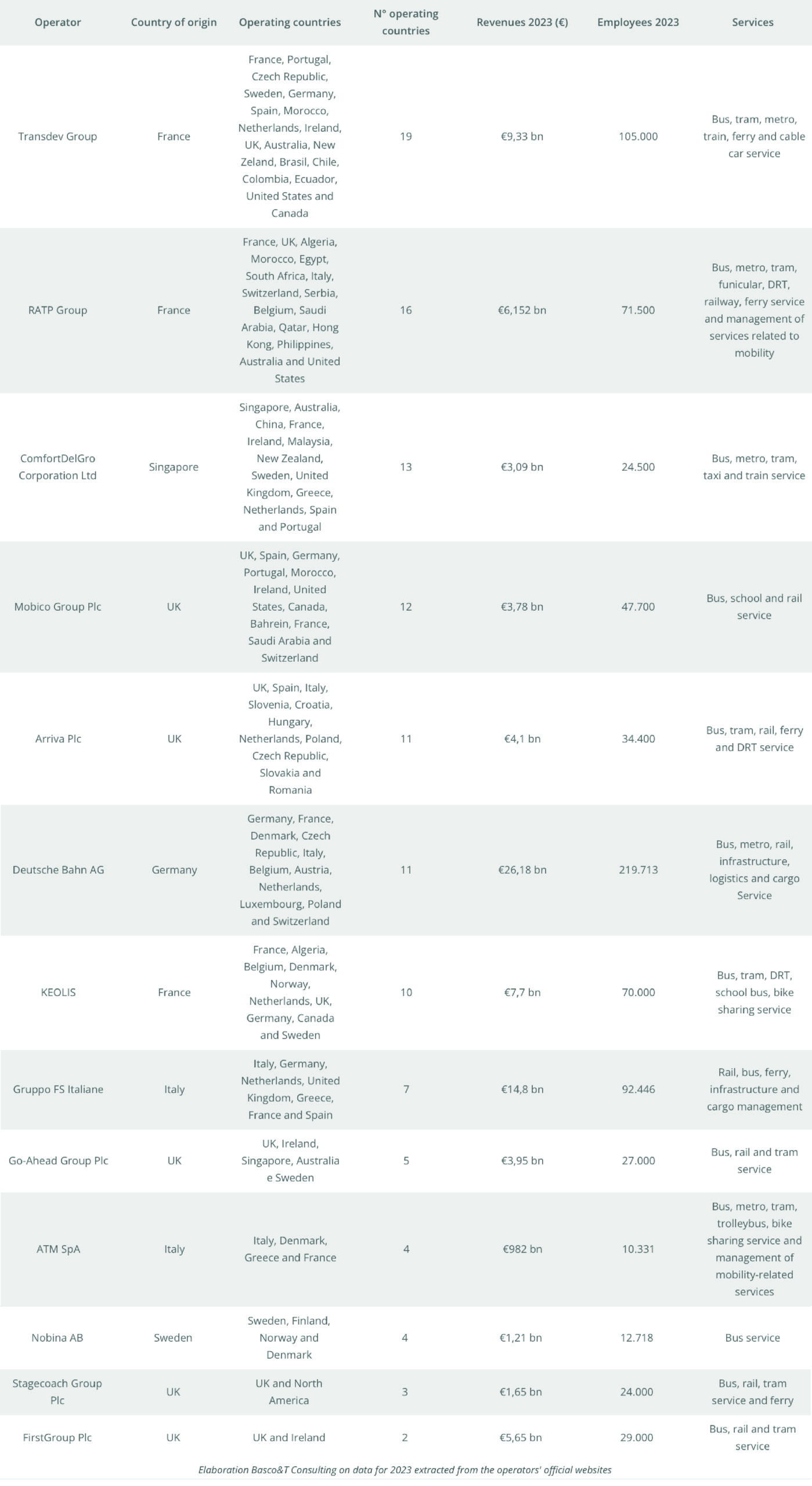
Notes:
*Data of Go-Ahead Group Plc and Nobina AB are relative to 2022
**Data of First Group Plc and ComfortDelGro Corporation Ltd are relative to 2024
***Deutsche Bahn AG Group figures relate to the integrated railway system only
Italian examples of internationalization in the TPL
In the Italian panorama of public transport, FS Italiane and ATM Milano are unique examples of operators that have successfully implemented the strategies of internationalization, managing services of the TPL also outside of the national borders. The FS groupthrough its foreign subsidiaries, is present in several european Countries in particular, in Germany via Netinera, one of the leading transport operators in the local rail and road, and in the Netherlands via Qbuzzactive in many regional areas, with bus and tram.
Similarly, ATM Milano it has extended its activities in the international context, consolidating its presence in the automatic underground of Copenhagen, and the gain of the management of the metro of Thessaloniki and creating ATM Francethat was among the best in the bidders in the tender in three lots-de-l'île-de-France.
These examples demonstrate that, even in a sector that is highly localized and regulated as a TPL, Italian operators can express the skills that can be exportedseizing opportunities in foreign markets, and contributing to the construction of models of integrated mobility even outside of the national territory.
The future of the TPL in italy between races and consolidation in the industry
Even analysing the Italian cases often considered among the most efficient, it is clear how wide the distance is still compared to European best practices. The prospect of the launch of post-2026 tenders could accelerate industrial consolidation processes, favouring the entry of structured operators and encouraging dimensional growth through mergers, acquisitions or strategic partnerships. In this scenario, observing the evolution of European models may offer useful insights to anticipate competitive dynamics and define positioning strategies.
For more insights, also read our analysis of salaries in Local Public transport in Europe.