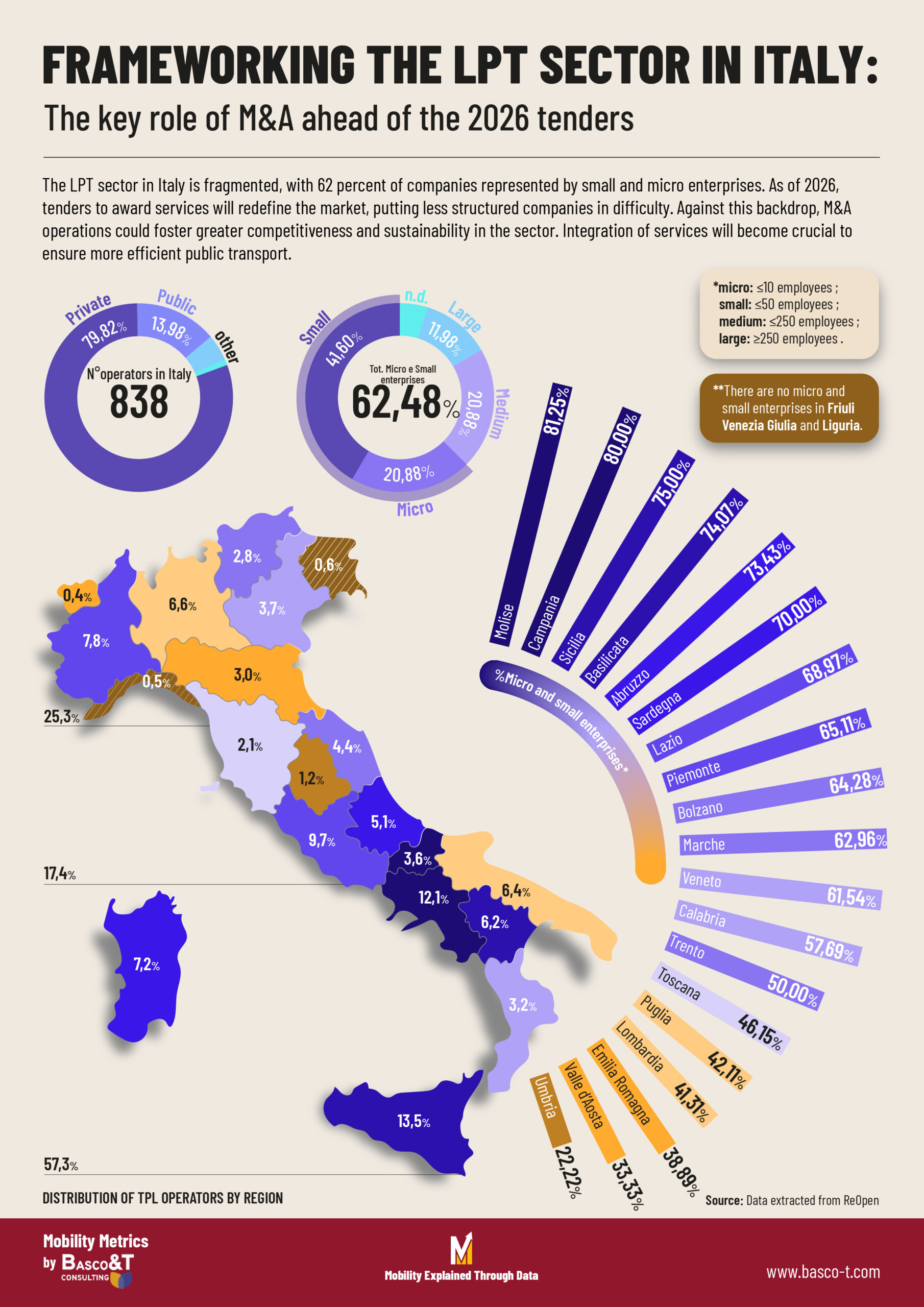
The LPT in Italy is fragmented, with 62 percent of companies represented by small and micro enterprises. As of 2026, tenders to award services will redefine the market, putting less structured companies in difficulty. Against this backdrop, M&A operations could foster greater competitiveness and sustainability in the sector. Integration of services will become crucial to ensure more efficient public transport.
Share on:
The local public transport sector in Italy is a vast and complex industry, characterized by a high number of companies, although this figure has been gradually decreasing. Between 2019 and 2021, the number of operators declined from 931 to 838 (-9.9%), partly due to recent public tenders that have encouraged aggregation processes. During the same period, the number of employees decreased from 124,000 (Asstra and Intesa San Paolo Report, 2022) to 123,000 (Reopen, Invitalia, 2021).
Despite this decline, the sector has maintained operational capacity constantwith over 49.000 means in service, mileage during the year equal to 1.8 billion vehicle-km and more than 225 million train-km. The the number of passengers transported he has recorded a bending, going from 5.5 billion to 5 billion, while the revenue remained stable at around € 12 billion.
The fragmentation of the Italian LPT
The local public transport (LPT) sector in Italy is characterized by significant fragmentation, with an uneven distribution of operators across the country and a clear predominance of private companies. Data analysis highlights that the sector comprises a multitude of operators with different corporate structures, varying sizes, and heterogeneous service coverage between urban and suburban area
Regional differences in the Italian LPT
Notes:
*The data related to mixed transport services also include navigation service operators, while the "Other" category comprises cableways and operators of services that are not clearly defined.
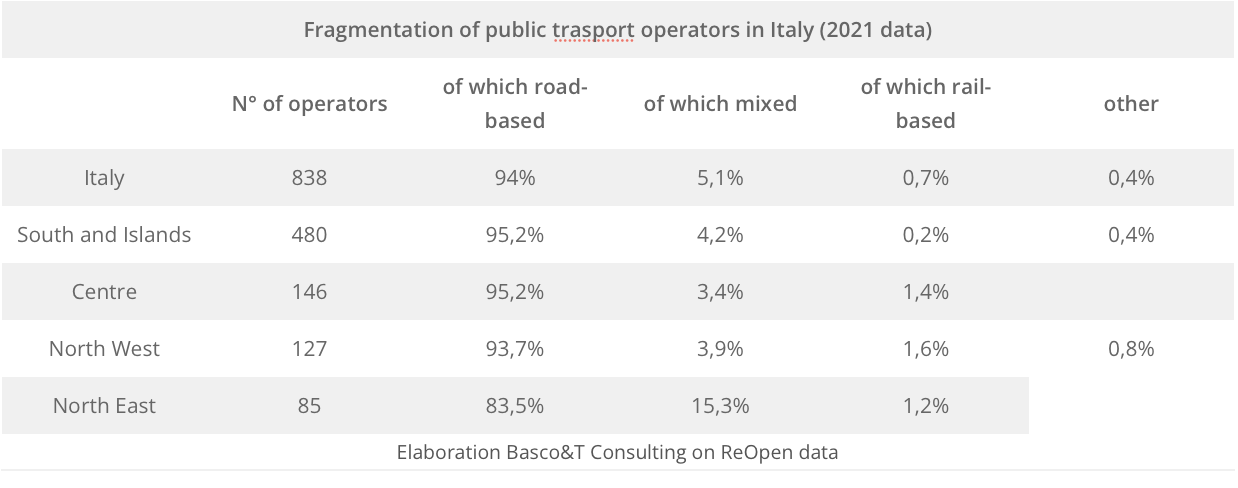
2021 Italy were active 838 operators of public transportwith a strong predominance of transport rubber (94%). Transport mixed represented 5,1%while transporting on iron it was at the 0,7%. Finally, a marginal share of 0,4% it was formed from other types of transport, such as railways.
From the territorial point of view, the South and the Islands host the largest number of operators (57,3%), followed by the Centre (17,4%)from North-West (25,3%) and from the The North East (10.1 Percent). Road transport is dominant everywhere, while the services multimodal and rail are distributed unevenly.
At the regional level, significant differences emerge:
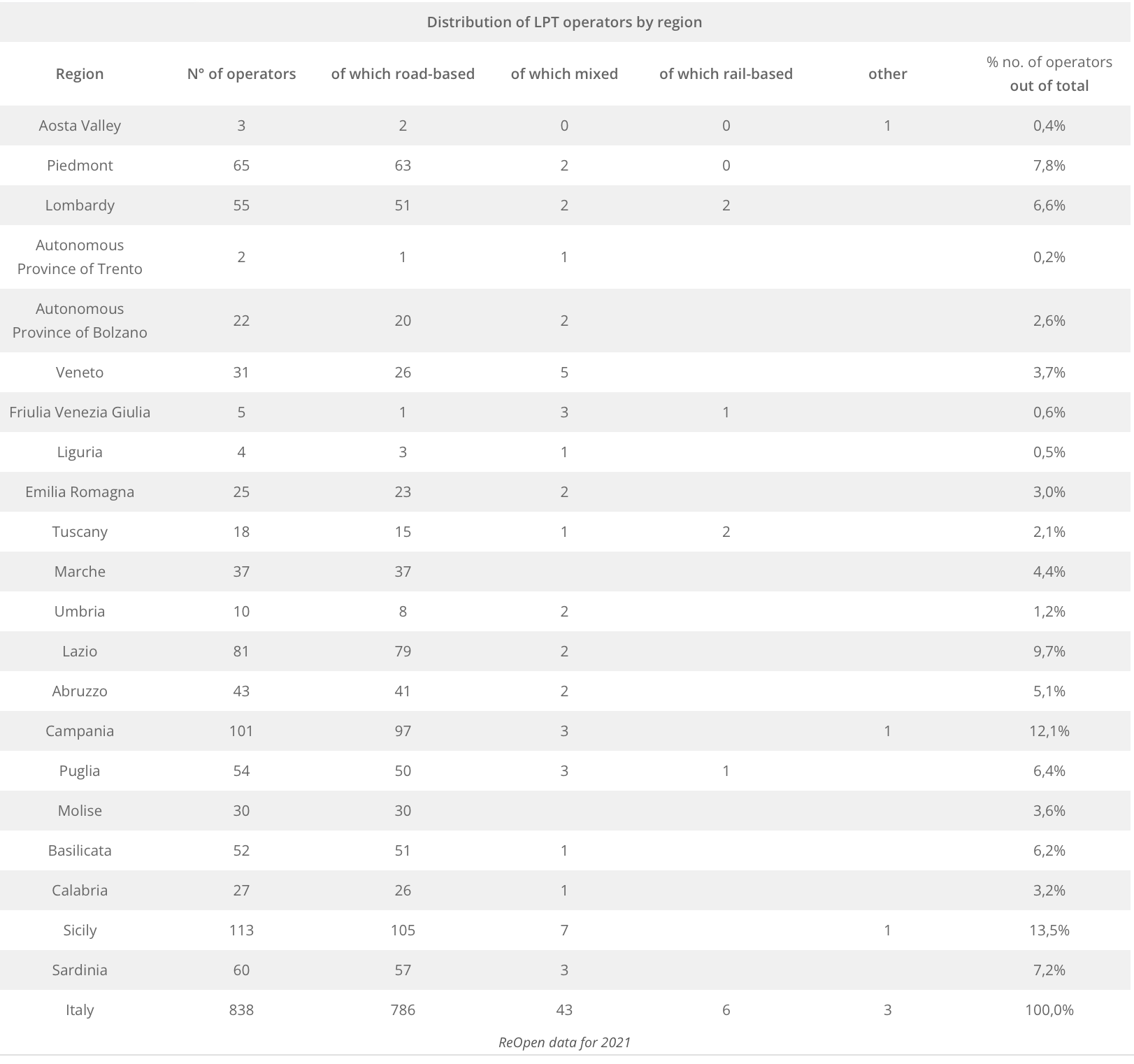
- Sicily and Campania have the highest number of operators (113 and 101, respectively), followed by Lazio (81) and Sardinia (60).
- Valle d'aosta, and the Autonomous Province of Trento they have the lowest number, with 3 and 2 companies.
- Rail transport is more prevalent in Lombardy and Tuscany, both hosting two rail operators.
- Mixed transport services are most common in Veneto (5 operators), Friuli Venezia Giulia (3), Puglia (3), and Sicily (7).
Corporate structure and type of ownership
Of the 838 registered public transport operators, 584 are listed in the AIDA database (Bureau Van Dijk). Ownership is predominantly private, with the following national distribution:
- 79,82% Private
- 13,98% Public
- 4,60% Majority public-owned
- 1,59% Majority private-owned
On a regional level:
- Regions with a clear predominance of private operators (over 90 percent) include Lazio, Campania, Sicily, Basilicata, and Molise
- Liguria is the only region with 100 percent of public tpl operators
- Regions with a higher incidence of public companies include Valle d’Aosta (33.3%), the Autonomous Province of Trento (50%), and Calabria (23%). are Valle d'aosta (33,3%), the Autonomous Province of Trento (50%) and Calabria (23%)
- Friuli Venezia Giulia has the highest proportion of majority public-owned companies (60%), followed by Umbria (33%) and Veneto (11.5%).
Company size: an industry dominated by small companies
The European Commission Recommendation 2003/361/EC classifies companies based on the number of employees and annual revenue as follows:
- Micro-enterprise: Up to 10 employees and an annual turnover of up to €2 million.
- Small enterprise: Up to 50 employees and an annual turnover of up to €10 million.
- Medium enterprise: Up to 250 employees and an annual turnover of up to €50 million.
- Large enterprise: 250 or more employees.
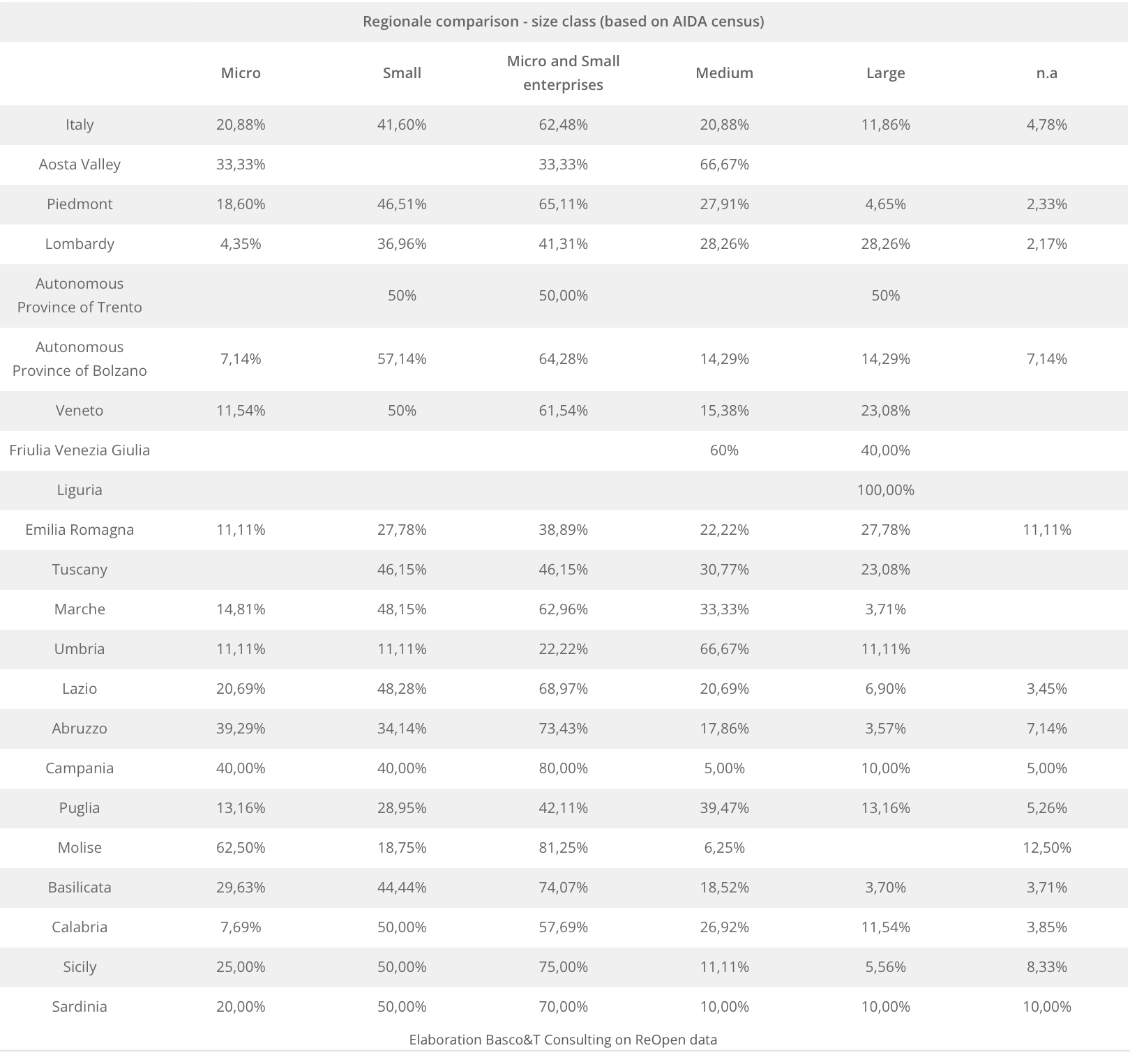
The Italian local public transport sector is primarily composed of micro and small enterprises (62.4%):
- 41,59% small
- 20,88% medium
- 20,88% micro
- 11,86% large
On a regional level:
- Small enterprises are most prevalent in Piedmont, Tuscany, Marche, Lazio, Basilicata, Calabria, Sicily, and Sardinia, where they represent over 45% of the total.
- Micro-enterprises are more common in Abruzzo, Campania, and Molise.
- Medium-sized enterprises have a strong presence in Umbria (66.67%) and Friuli Venezia Giulia (60%).
- Large enterprises are mainly concentrated in Lombardy, Veneto, and Friuli Venezia Giulia.
Toward the 2026 tenders: the role of M&A transactions
Italy’s local public transport (LPT) sector is highly fragmented, with 62% of companies classified as small or micro enterprises. This structure presents several challenges for the future, including:
- Investment needs for the renewal of bus fleets.
- Increasing management complexitywith requirements becoming more stringent for the operators.
- The necessity of economies of scale to enhance efficiency and financial sustainability.
- The races for the custody of the servicestarting from 2026 will affect progressively, all the Italian regions, redefining the market and the competitive dynamics.
In this scenario, Mergers & Acquisitions (M&A) strategies could play a key role in reducing market fragmentation and strengthening companies' competitive capacity. Less structured enterprises, in particular, may struggle to adapt to the new competitive framework imposed by public tenders.
2026 is set to be a pivotal year for LPT in Italy, where service integration and operational streamlining will become increasingly necessary to ensure an efficient and sustainable public transport system.
Explore our projects in the field of M&A
Fragmentation of the TPL