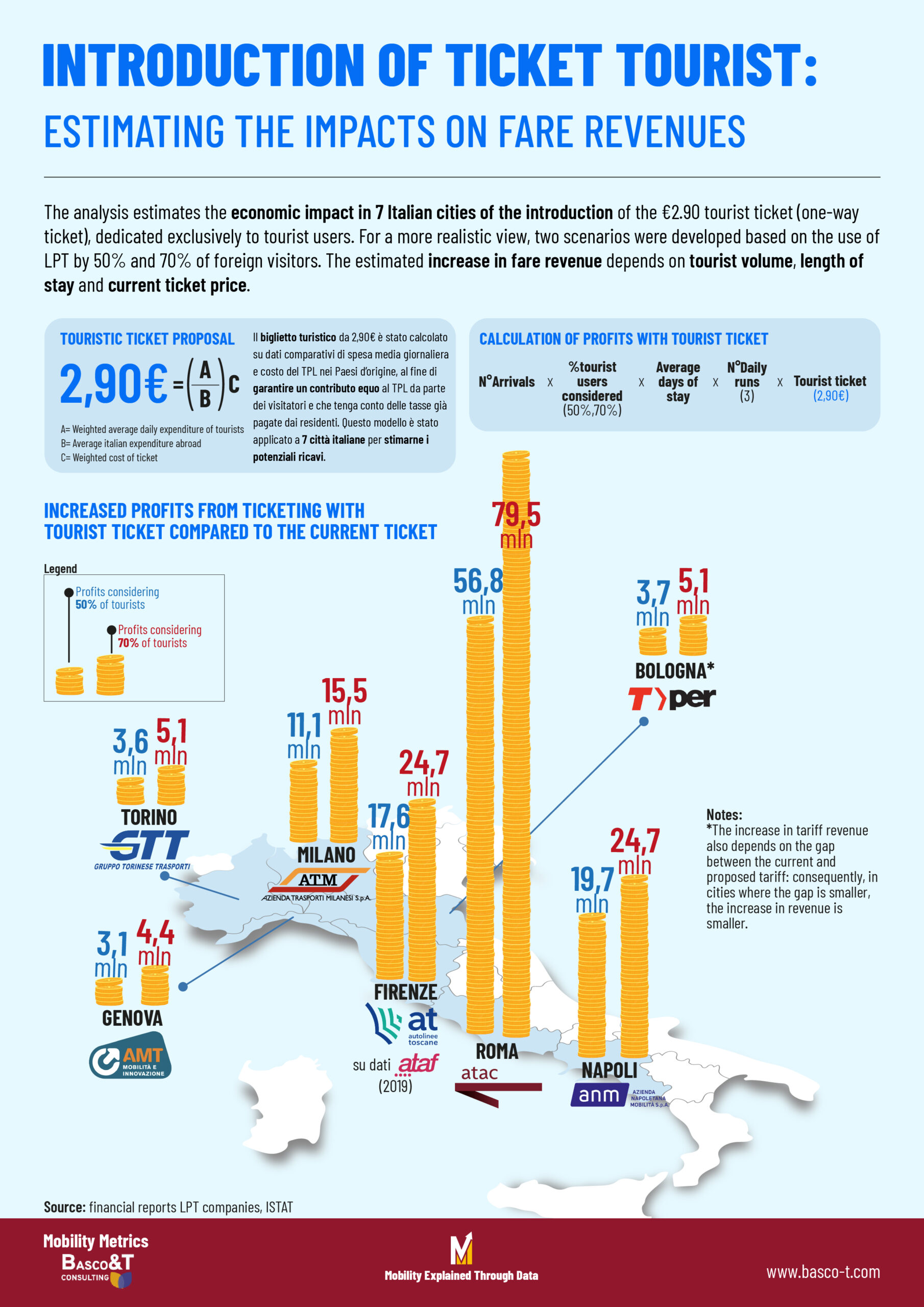
The analysis estimates the economic impact in 7 Italian cities of the introduction of the €2.90 tourist ticket (one-way ticket), dedicated exclusively to tourist users. For a more realistic view, two scenarios were developed based on the use of LPT by 50% and 70% of foreign visitors. The estimated increase in fare revenue depends on tourist volume, length of stay and current ticket price.
Share on:
Effects of inflation
With the aim of measuring the impact of a moderate increase in the ticket reserved for tourists - conventionally set at €2.90 per single ride - we conducted a comparative analysis of the main local public transport operators in Rome, Naples, Milan, Turin, Genoa, Florence and Bologna. The proposed single price was calculated by dividing the weighted tourist expenditure based on foreign citizen attendance rates (135.33€) by the average Italian expenditure abroad (133.6€); ratio multiplied by the weighted ticket price of foreign countries. For more information on the proposed price calculation, you can refer to the previous article available on our website and social profiles.
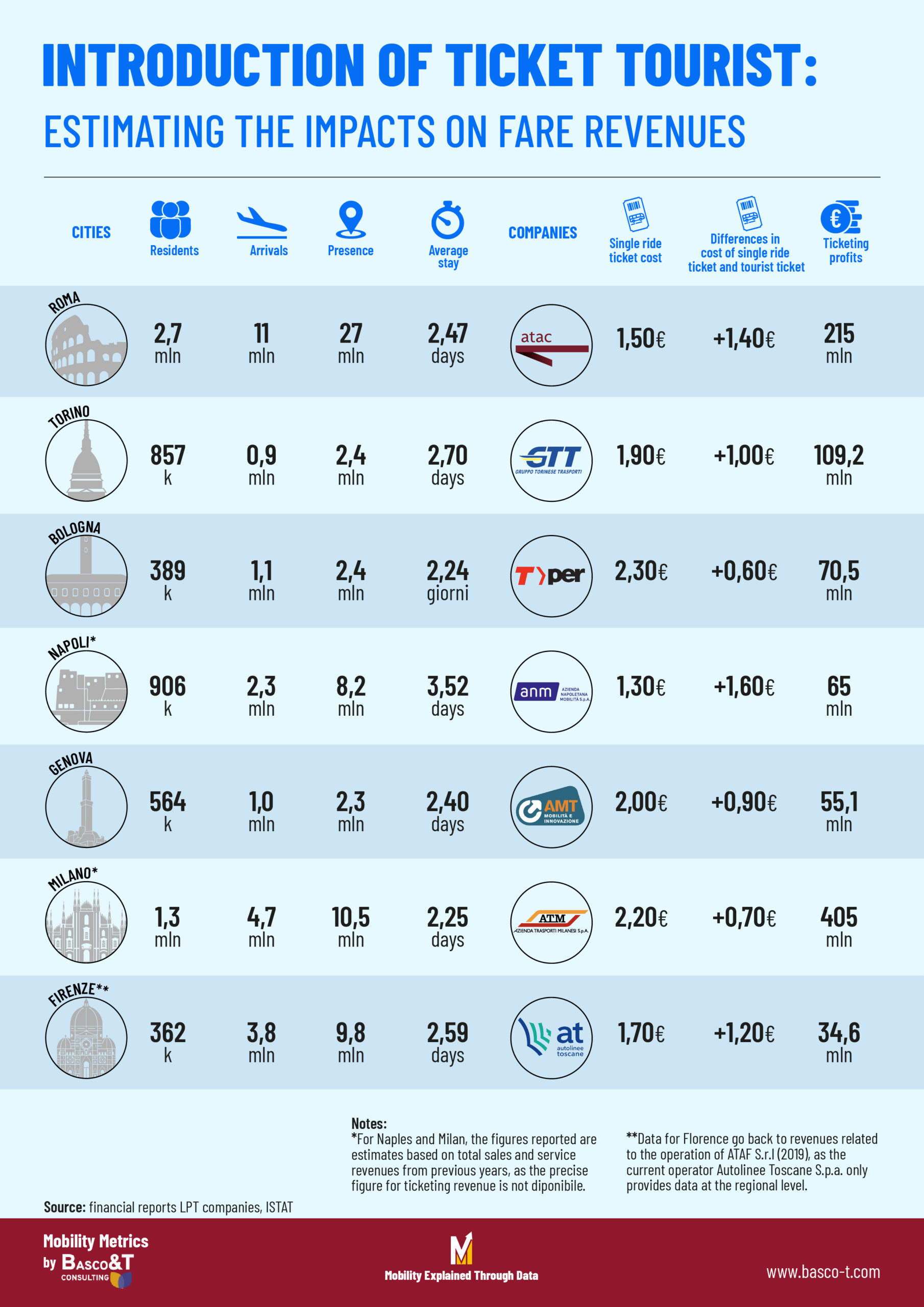
The initial phase of the analysis involved estimating the tourist flow and relative average stay. To this end, we processed ISTAT 2023 data on foreign arrivals and presences in each city, supplementing them with surveys from the respective Urban Tourist Observatories. It emerged, for example, that Rome records 10.96 million arrivals with an average stay of 2.47 days, Naples 2.33 million with 3.52 days and Florence 3.79 million with 2.59 days of stay.
Next, we collected local single fare lists: from 1.30 € in Naples to 2.20 € in Milan, via 1.50 € in Rome and 1.70 € in Florence. Comparing each price with the assumed tourist fare, we calculated a “delta” of unit increase, varying between 0.70 € (Milan) and 1.60 € (Naples).
To convert these differentials into overall economic values, the methodology involved multiplying the fare delta by the number of foreign arrivals, by the average stay in days, and by an average (assumed) usage of 3 rides per day. Since assuming that 100 % of the tourists use local public transportation would have made the estimate unrealistic, we therefore came up with two separate scenarios: one in which 50 % of the tourists take the vehicles and one in which this percentage is 70 %. The result of this shows that the annual increase in revenue from the inflation could reach 57 to 79 million euros in Rome, 19 to 27 million in Naples, and 17 to 24 million in Florence, respectively. Milan, Genoa, Turin and Bologna would see less significant benefits of 11 - 15 million, 3.1 - 4.3 million, 3.6 - 5 million and 2.4 - 5.1 million respectively.
To understand the weight of these increases, we finally related the estimated new revenues to the current ticketing revenues shown in the consolidated financial statements of the LPT companies: 215 million in Rome, *65 million in Naples, *405 million in Milan, **35 million in Florence, 55 million in Genoa, 109 million in Turin, and 70 million in Bologna. In percentage terms, it appears that Florence would benefit from a relative increase in revenues of 51 - 71%, Rome 26 - 37%, Naples 30 - 42%, Genoa 6 - 8%, Bologna 5 - 7%, Turin 3 - 5% and Milan 3 - 4%.
*For Naples and Milan, the data reported are estimates based on total revenues from sales and services from previous years, as the precise figure for ticketing revenues is not diponibile.
**Data for Florence go back to revenues related to the operation of ATAF S.r.l (2019), as the current operator Autolinee Toscane S.p.a. only provides data at the regional level.
The comparison of absolute and percentage impact highlights two different dynamics: on the one hand, cities such as Rome, Florence and Naples can rely on both a high delta and a substantial tourist base, generating significant monetary increases; on the other hand, metropolises with already significant ticketing revenue such as Milan need a much more pronounced increase in price to produce appreciable percentage changes.
| Città | Abitanti | Profitti Bigliettazione (Milioni) | Arrivi (Milioni) | Costo del biglietto per corsa singola | Delta | Presenze (MILIONI) | Permanenza (giorni) |
| Rome | 2746929,0 | 215,0 | 11,0 | 1,5 | 1,4 | 27,0 | 2,5 |
| Firenze | 362582,0 | 34,6 | 3,8 | 1,7 | 1,2 | 9,8 | 2,6 |
| Naples | 906833,0 | 65 | 2,3 | 1,3 | 1,6 | 8,2 | 3,5 |
| Milan | 1367580,0 | 405 | 4,7 | 2,2 | 0,7 | 10,5 | 2,3 |
| Genova | 564355,0 | 55,1 | 1,0 | 2,0 | 0,9 | 2,3 | 2,4 |
| Turin | 857434,0 | 109,2 | 0,9 | 1,9 | 1 | 2,4 | 2,7 |
| Bologna | 389261,0 | 70,5 | 1,1 | 2,3 | 0,6 | 2,4 | 2,2 |
Basco&T Consulting elaboration on ACEA data ISTAT, e Report finanziari delle aziende TPL
| Città | Profitti considerando il 50% dei turisti (Milioni) | Percentuale di guadagno | Profitti considerando il 70% dei turisti (Milioni) | Percentuale di guadagno |
| Rome | 56,8 | 26% | 79,5 | 37% |
| Firenze | 17,6 | 51% | 24,7 | 71% |
| Naples | 19,7 | 3% | 27,6 | 42% |
| Milan | 11,1 | 3% | 15,5 | 4% |
| Genova | 3,1 | 6% | 4,4 | 8% |
| Turin | 3,6 | 3% | 5,1 | 5% |
| Bologna | 2,2 | 3% | 3,1 | 4% |
This analysis shows that the effectiveness of a fare hike aimed at tourists depends critically on the combination of arrival volumes, length of stay, departure price, and size of pre-existing business. Any fare policy decision will therefore need to be carefully calibrated to the specific context of each urban basin, balancing the need to increase revenue with the goal of keeping mobility services accessible.