
In 2020 the electric buses in Europe accounted for about 6% of new car registrationswith the sale of approximately 1.770 units and an increase on the previous year in excess of 18%, in the context of a more general growth of engine alternatives.
In just one year the incidence of diesel on the new car has seen a decline of almost 10 points.
In 2021, the number of registrations of electric buses has been a sharp increase of 48% compared to the year 2020.
The future of the TPL european is definitely electric.

In Italy, 85% of the buses, new, registered in 2020 is diesel. Does mark an encouraging increase in the electric/hydrogen, over 100 new units. Overall the bus alternative power supply sold were 475, representing 15.1% of the total.
The data relating to the market share of the main players in the field of electric buses in Europe denote a gradual increase of the opening of the market. The market e-bus of 2020 was in the hands of top 3 manufacturers: Solaris, BYD and Volvo Buses. In 2021, new operators such as Mercedes, Iveco and Yutong are gaining new market shares.

However, it is to be noted as in 2021, we need 5 builders to get to 50% of the market share, compared to only 3 2020.

Solaris maintains its leadership positioneven if with a lower market share, counting roughly the same number of registrations. ADL – BYD increases from 190 to 375. Also Mercedes registers a leap forward by tapping altitude 333 deliveries of the e-bus in 2021 (+ 240%), compared to 98 in 2020.
Another driver who will guide you through the ecological transition of public transport is that the production capacity of the batteries is increased faster than the demandtherefore prices per kWh are reduced significantly.
The the rapid decrease of the prices of batteries with higher performance, will have a major impact on the TCO of electric buses.

The forecast of the price of the batteries for the next few years points to a decrease in 2030, about 75% of the price per kWh in 2020.
This decrease is important in prices will impact significantly on the total cost of electric buses in the near future.
The forecast Basque&T Consulting on the number of electric buses in Italy underline an exponential increase in the coming years. In 2031 is expected to total replacement of vehicles and diesel fuel with electric vehicles, and green (hydrogen, hybrid, natural gas). The push towards this future comes from the gradual decrease of the prices of electric buses to the presence of important dedicated funds (the correlation between funds and new car registrations has been demonstrated by a study of the Basque&T Consulting click here).

Among the drivers to the most interesting parts of this transition ecology of the TPL are the new business models born recently in this sector aim to reduce the gap of the cost of purchasing electric vehicles and diesel engines.
Among these, stands out the Battery-as-a-Service (BaaS) that uses the the model of the circular economy to maximize the use of the assets, connecting the transport sector with the energy.
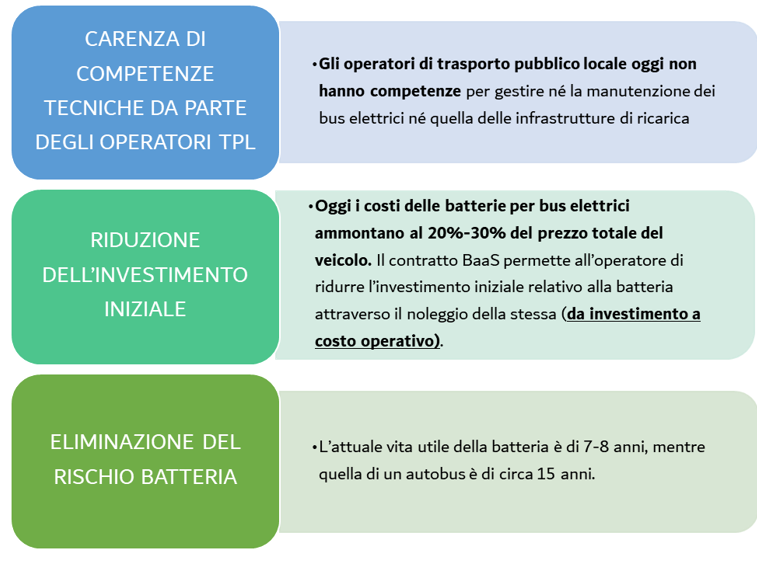
This business model, based on an integrated value chain between the two sectors, the end user has the possibility to rent the battery as a separate component from the vehicle. Rent the batteries in the leasing allows you to decrease the value of the initial investment of an electric vehicle. This means that the BaaS allows operators of public transport to convert a cost that would be capitalized in an operating cost.

Against payment of a fee, the BaaS offers routine maintenance (monitoring and optimization of energy) the battery and its replacement to end-of-life (found after approximately 7 years). In some cases, the contract BaaS may also include the disposal or recycling/reuse of the battery that no longer can be used on buses (second-life).
The Battery-As-A-Service is a business model that is spreading in the rest of the world, and in particular in the field of public transport, thanks to the company a leader in the industry and bus. In detail, we find Proterra in the USA, a manufacturer of e-bus, or Neot in Europe, consulting company in the field of energy. The model BaaS is, therefore, widely adopted by different companies with core business in completely different between them. In some cases, the BaaS is, even when combined with consulting activities pre-purchase related to the planning of the necessary investments, including the fleet of e-buses, the energy infrastructure and energy optimization.
The Battery-As-A-Service might be, in the near future, an important driver for the electrification of public transport in the Beautiful Country.
The elements that will support its future development will include:
The data in insight have been developed on the basis of banks ' proprietary data Basque&T Consulting.
For more information and details please contact us at the address info@basco-t.com
Authors:
Managing Partner