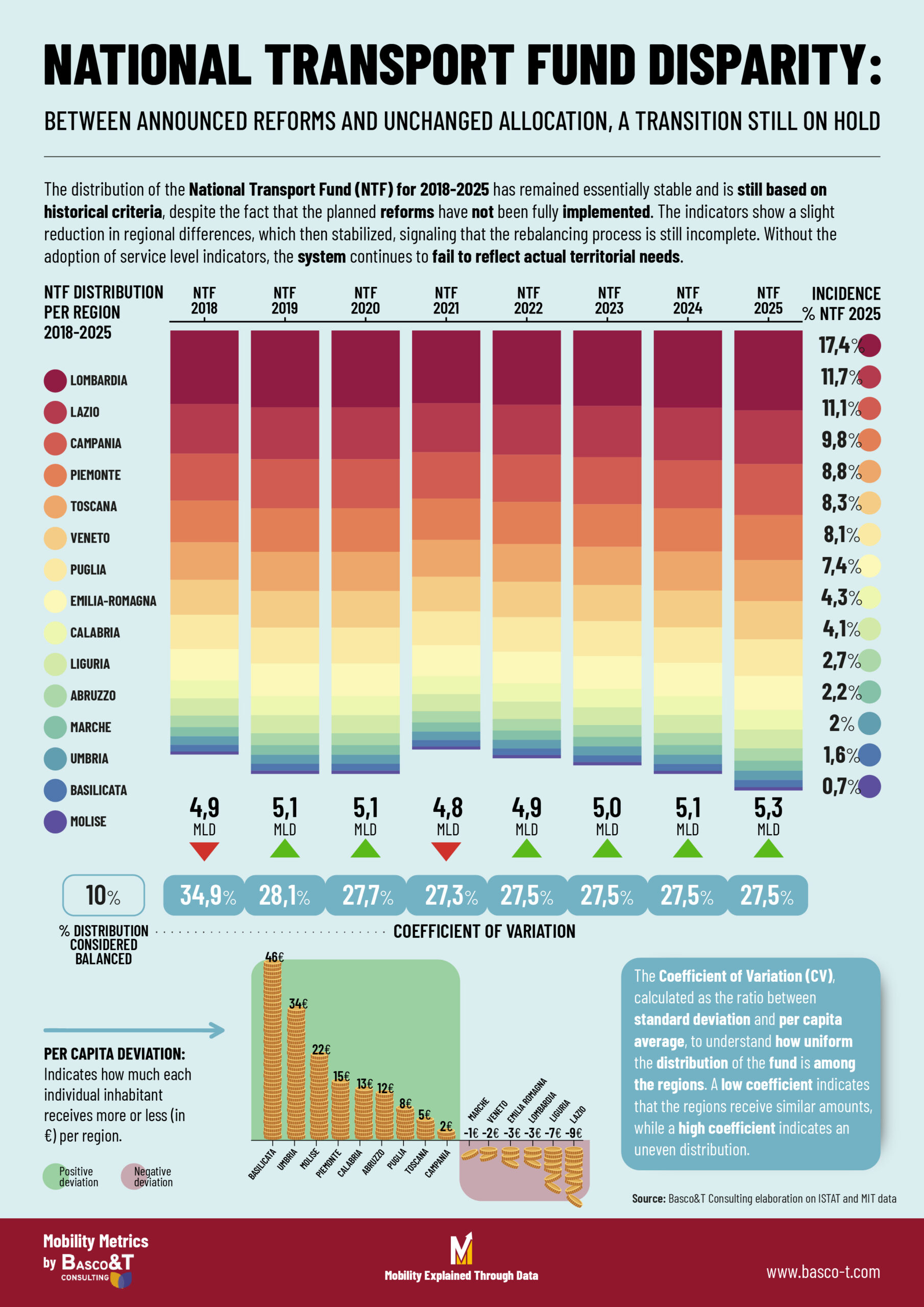
The distribution of the National Transport Fund (FNT) for 2018-2025 has remained essentially stable and is still based on historical criteria, despite the fact that the planned reforms have not been fully implemented. The indicators show a slight reduction in regional differences, which then stabilized, signaling that the rebalancing process is still incomplete. Without the adoption of service level indicators, the system continues to fail to reflect actual territorial needs.
Share on:
The analysis examines the distribution of the National Transport Fund (FNT) among ordinary Italian regions for the period 2018-2025, analyzing the distribution of the Fund over the years and comparing per capita values with the national average. The objective is to assess whether the system is correcting historical anomalies due to outdated allocation criteria.
Sources and methodology
The sources used include ISTAT demographic data and FNT allocations published by the Ministry of Infrastructure and Transport. The methodology is based on quantitative indicators: FNT allocation, standard deviation, coefficient of variation (CV). These indicators make it possible to measure dispersion and relative equity between regions over time.
Criteria for FNT allocation: between historicity and pending reforms
Despite various regulatory revisions, the National Transport Fund allocation mechanism remains based primarily on historical criteria.
In 2023, the reforms introduced outlined a new allocation model: 50% based on standard costs, 50% on adequate service levels, with a 15% penalty for regions that do not award the service through a tender process.
Despite this, the effective application of these provisions has been postponed, pending the implementing ministerial decree expected by June 2025, which has not yet been issued.
As a result, even in 2025, the allocation was made according to historical criteria, i.e., parameters consolidated over time that allocate 90% of the fund on the basis of fixed allocation percentages; and allocating the remaining 10% again on the basis of the same percentages, but subject to verification of the achievement of specific efficiency targets.
At the same time, regions with special status and autonomous provinces are not direct beneficiaries of the National Transport Fund. They receive funding through specific mechanisms, such as extraordinary advances and contributions aimed at covering the operating deficits of local public transport. The special statutes require these entities to adapt their transport legislation in accordance with the provisions contained in the statutes themselves and in the relevant implementing regulations.
The ministerial decree that was supposed to define the indicators for adequate service levels had been postponed until June 30, 2025. As of today, November 2025, the decree has not yet been published in the Official Gazette or on the Ministry's website. The Ministry of Infrastructure and Transport confirms that the indicators are being developed but have not yet been finalized.
Consequently, the old regulatory framework will continue to apply in 2026, with the only change being the effective activation of penalties (-15%) for failure to award contracts through competitive bidding.
In summary, the allocation of the 2025 Fund followed the same procedures as in previous years, and 2026 is shaping up to be another year of transition. Regions that have not awarded services by December 31, 2025, will suffer a 15% reduction, while those that comply will benefit from redistribution.
Distribution of the FNT by region
(Figures in thousands of euros)
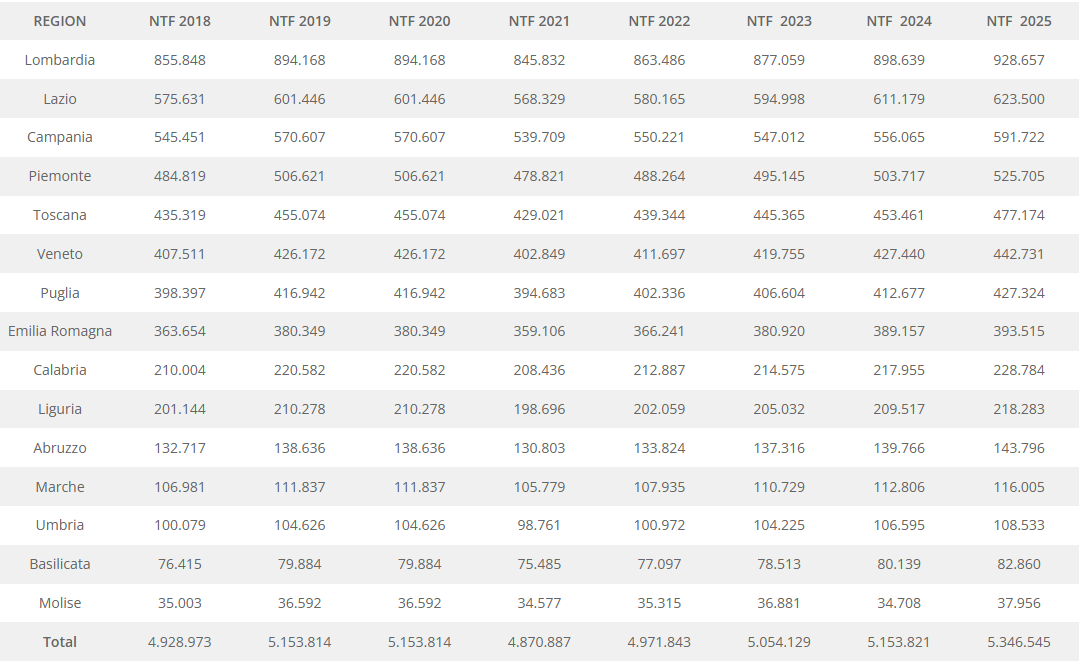
Basco&T Consulting elaboration on ACEA data Istat e dati del Ministero delle Infrastrutture e dei trasporti
Analysis of FNT data from 2018 to 2025 shows a pattern of continuity, with the allocation mechanism remaining largely unchanged despite regulatory provisions that were supposed to modify it.
The data show that, despite annual variations in the total amounts allocated (from €4.93 billion in 2018 to €5.15 billion in 2024, with a decline to €5.34 billion in 2025), regional allocations have remained largely stable, with marginal increases for some regions and reductions for others.
Measurement of inequality in the distribution of the Fund
(Figures in thousands of euros)
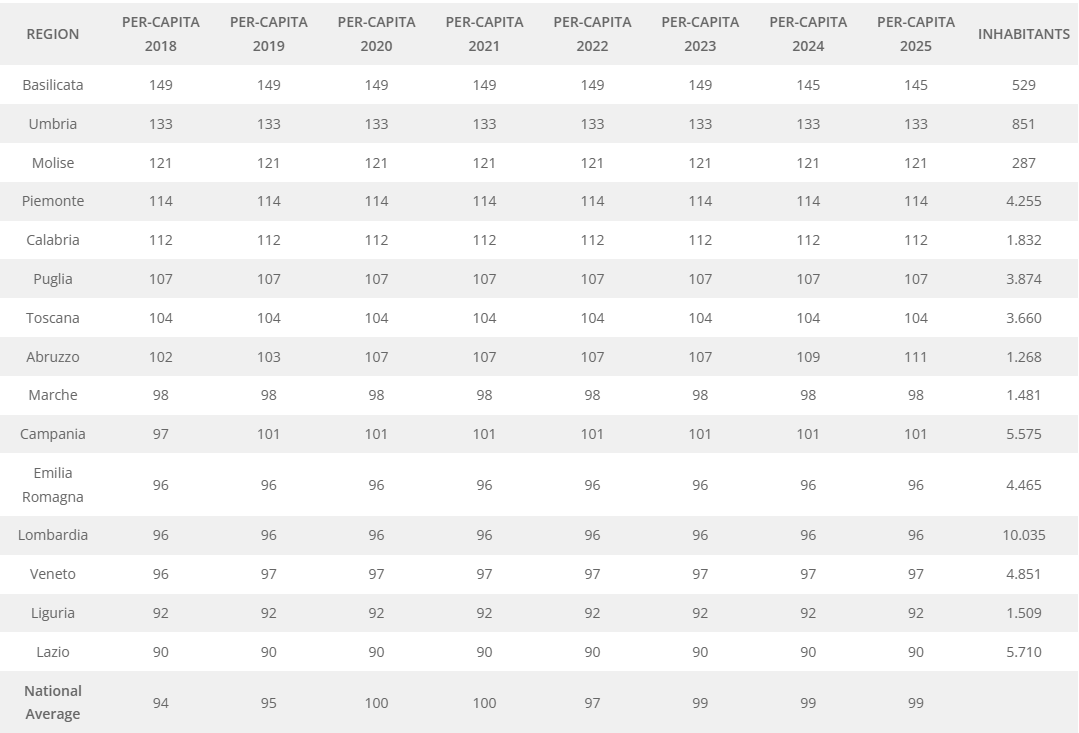

Basco&T Consulting analysis based on ISTAT data and data from the Ministry of Infrastructure and Transport
Statistical analysis of the per capita values of the National Transport Fund (FNT) between 2018 and 2025 shows a trend of progressive reduction and stabilization of distributional inequality between Italian regions.
In particular, we analyzed the standard deviation, which indicates how much the resources allocated per inhabitant differ from one another. The higher the indicator, the greater the differences between regions in the distribution of the fund.
To calculate the standard deviation, we subtracted the national average (99) from the per capita value of each region and squared the result. Finally, we took the average of these results and calculated their square root.
The result shows that, going from €147 in 2018 to around €121 in subsequent years, the system has begun to correct some of the most obvious historical distortions but at the same time has stabilized.
We then analyzed the coefficient of variation (CV), calculated as the ratio between standard deviation and per capita average, to understand how uniform the distribution of the fund is among the regions. A low coefficient indicates that the regions receive similar values, while a high coefficient indicates an unbalanced distribution.
Also in this case, we can see a stabilization of values from 2022 onwards, although they remain above the 10% threshold considered indicative of fair distribution, indicating that the rebalancing process is still incomplete.
The stabilization of values reflects a phase of consolidation, but also a certain inertia in the system, which continues to be based on historical criteria pending the full implementation of the planned reforms.
In summary, the data show a measurable improvement in distributive equity, but confirm the need to definitively move beyond the model based on historical expenditure and adopt an approach based on real needs and service levels.
Resource allocation: comparison between regions and per capita averages
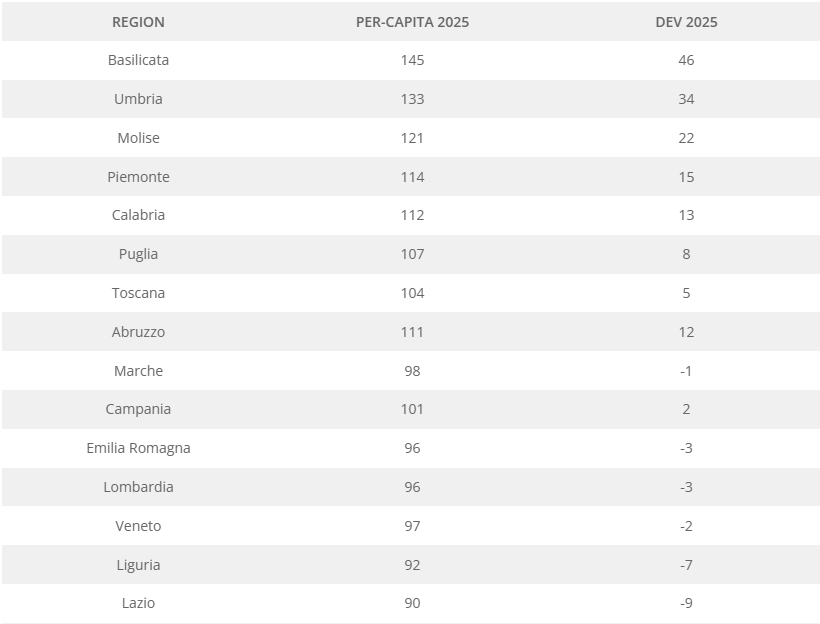
(Figures expressed in euros per inhabitant)
Basco&T Consulting analysis based on ISTAT data and data from the Ministry of Infrastructure and Transport
A further level of analysis, based on deviation from the per capita average, confirms and deepens the picture of inequality.
The deviation, calculated as the difference between the per capita value of each region and the national average, indicates whether a region receives more or less resources than the national average (equal to 99).
A positive deviation indicates that the region is receiving more resources than the national average, while a negative deviation shows below-average funding.
Some regions continue to receive resources above the national average per capita: Basilicata, for example, has a positive deviation of €46 per capita, followed by Umbria with €34 and Molise with €22.
These figures indicate greater spending capacity for local public transport, which could potentially translate into more frequent or more accessible services.
Conversely, regions such as Lazio and Liguria receive less than the per capita average, with negative deviations of €9 and €7 per capita, respectively. These differences may be reflected in a lower capacity to invest in local public transport, with possible repercussions on service quality, territorial coverage, and the economic sustainability of local networks.
Conclusion
The analysis shows that, between 2018 and 2025, the distribution of the National Transport Fund followed historical criteria, with limited effects on reducing regional inequalities.
The planned reforms have not been fully implemented, and penalties for failure to allocate funds have not been applied. Without the adoption of service indicators, the distribution remains unchanged.
The picture confirms the need for structural change to ensure distribution that is more in line with actual needs.