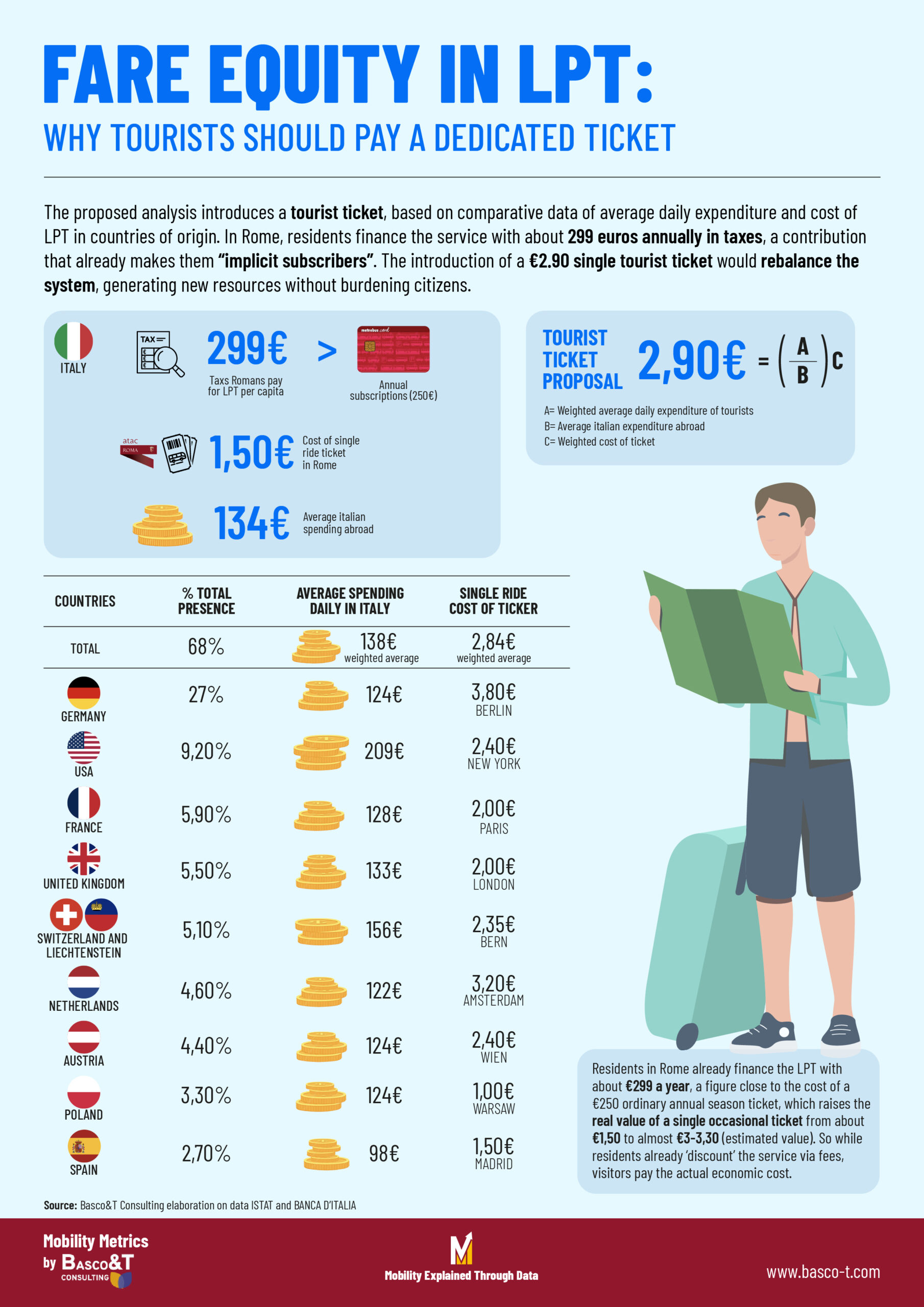
The proposed analysis introduces a tourist ticket, based on comparative data of average daily expenditure and cost of LPT in countries of origin. In Rome, residents finance the service with about 299 euros annually in taxes, a contribution that already makes them “implicit subscribers.” The introduction of a €2.90 single tourist ticket would rebalance the system, generating new resources without burdening citizens.
Share on:
TOURISTIC FARES
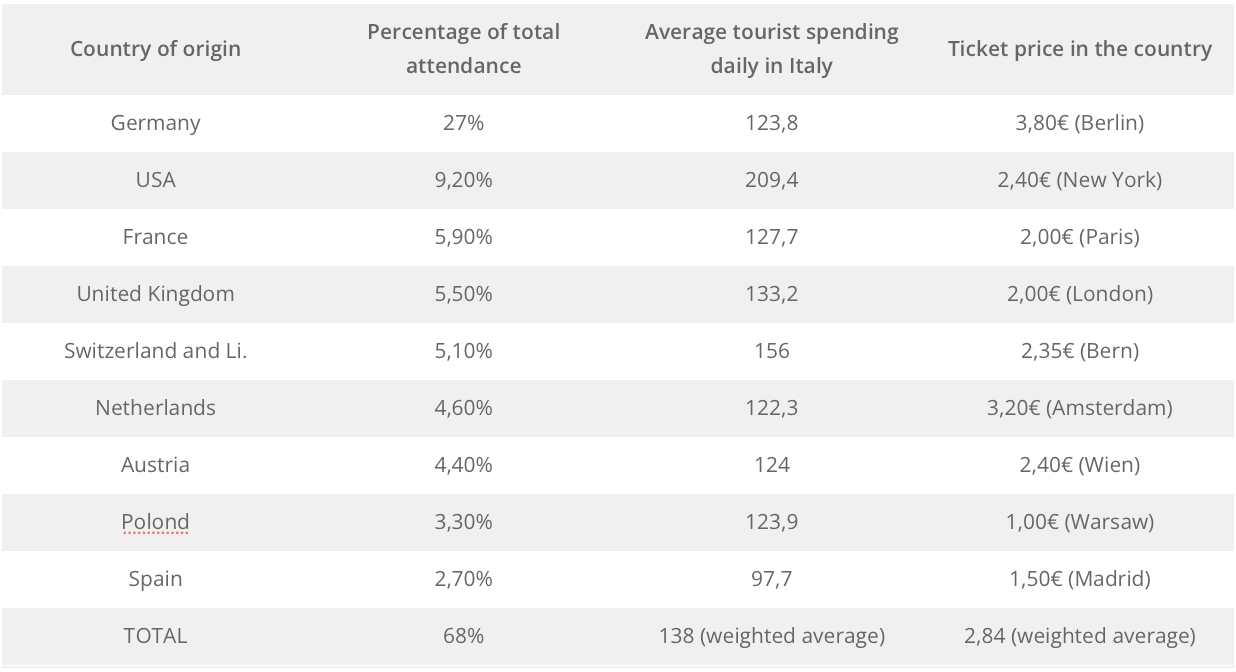
Basco&T Consulting elaboration on ACEA data ISTAT e BANCA D’ITALIA

In a scenario in which urban transportation is increasingly struggling to find adequate coverage from regional budgets, the role of ticketing revenues assumes strategic and indispensable importance. As regions, grappling with often insufficient national allocations, are forced to divert resources to emergency health and infrastructure priorities, the traditional public financing of LPT-which more than 70 percent relies on transfers-is in danger of shrinking dramatically, with obvious repercussions on frequency, maintenance and fleet renewal.
In this context, enhancing the revenue from ticket sales is no longer just a matter of accounting efficiency, but a real lever of service sustainability: every euro collected at the turnstile is fuel to ensure punctual rides, capillary lines and investment in new technologies and environmentally friendly vehicles. At the same time, greater fare autonomy reduces budget vulnerability and allows for long-term planning, without having to continually hope for extraordinary “bailouts” from the state or region. For this reason, we decided to conduct an in-depth study aimed at defining the introduction of a premium-priced ticket dedicated specifically to tourists, which we called the “Tourist Ticket.” This choice is based on the awareness of the superior spending capacity of this category of users, who often use LPT occasionally and for recreational purposes. The application of a differentiated visitor fare is further justified when considering that residents already contribute to LPT funding through taxes; for example, in Rome, according to the most recent 2019 data, LPT taxes amount to 299.1 euros per year per resident. This value is very similar to the price of an annual season ticket, which raises the real cost of a single ticket, for occasional users, from the nominal 1.5 euros to an estimated value of about 3 to 3.30 euros. The goal of the analysis is to outline a fair and sustainable fare model capable of generating new resources without placing an additional burden on residents, while at the same time ensuring an efficient and affordable public transportation service for all.
The method we adopted is based on a selective and weighted collection of data from official sources-particularly ISTAT for data on tourist presences and the Italian Federation of Public and Tourist Shops, which compiled data on the average daily expenditure of tourists in Italy on the basis of Bank of Italy surveys, broken down by country of origin. In our study, we decided to consider only those countries that recorded an attendance rate of more than 2%, for an overall total of 68%.
The analysis was developed in several stages:
- For each country of origin, the percentage of total tourist presences in Italy was surveyed.
- Data were collected on the average daily expenditure incurred in Italy by each group of tourists.
- The cost of the LPT single-ride ticket in the capitals of the countries considered (excluding New York) was collected.
- From this data, the “fair” ticket price in Italy for each group, proportionate to their average expenditure, was estimated.
- The variance from the current Rome price (€1.50) was then calculated to assess the degree of perceived consistency.
Finally, through weighting based on attendance percentages, two synthetic values were derived: the average estimated ticket (2,30€) and the weighted ticket (2,84€), which better reflects the actual distribution of tourists. The proposed single price of 2,90€ was calculated by dividing the weighted tourist expenditure (135,33€) by the average Italian expenditure (133,60€), a ratio multiplied by the weighted ticket price. This value thus takes into account not only the percentage of tourist attendance in Italy, but also the difference in average expenditures between Italian and European tourists.
Results
Data processing shows that the current €1.50 ticket is, for most foreign tourists, lower than both the fares they are used to paying in their countries and the proportional expenditure they incur in Italy. In particular, tourists from the United States, Switzerland, the United Kingdom and Germany show a significantly higher spending capacity, which would justify a ticket price well above the current one. On the other hand, tourists from countries such as Spain, Poland and Austria turn out to be more price-sensitive: for these groups, the estimated fair ticket value turns out to be less than €1.50, suggesting a potential implicit surcharge.
Conclusion
The analysis suggests that a single ticket for international tourists in the range of 2.90 euros is not only sustainable but also economically appropriate. This figure is in line with visitors' spending habits, reflects an equity criterion among different source markets, and represents an opportunity to economically enhance the public service while still maintaining a high level of accessibility.
A targeted review of the fares reserved for tourists - along the lines of cities such as Tallinn in Estonia - could therefore contribute to a fairer, more sustainable and better-funded transportation system that meets both local needs and the expectations of those visiting the country.