This analysis is based on the evolution of road-based public transport in European Union countries, with particular attention to the size of the bus fleet, its distribution relative to population and territory, and the overall effectiveness of the service in terms of accessibility and coverage, through the definition of a "Coverage Index."
Share on:
Local public transport represents a key component of sustainable mobility policies, social inclusion, and urban development. Among the various transport modes, road-based public transport—particularly bus services—continues to play a central role in ensuring daily connectivity for millions of European citizens, especially in areas not served by rail or metro networks.
In recent years, the COVID-19 pandemic, ecological and digital transitions, and new investments linked to the National Recovery and Resilience Plans (NRRPs) have reshaped the priorities and structure of public transport systems throughout Europe. However, the actual availability of service, its territorial distribution, and its accessibility to the population remain highly uneven across different EU countries.
Based on these premises, this article presents a comparative analysis of bus networks across EU countries, aiming to assess how widespread and accessible the service is, and to identify any existing disparities.
Evolution of the bus fleet in Europe
Basco&T Consulting elaboration on ACEA data ACEA
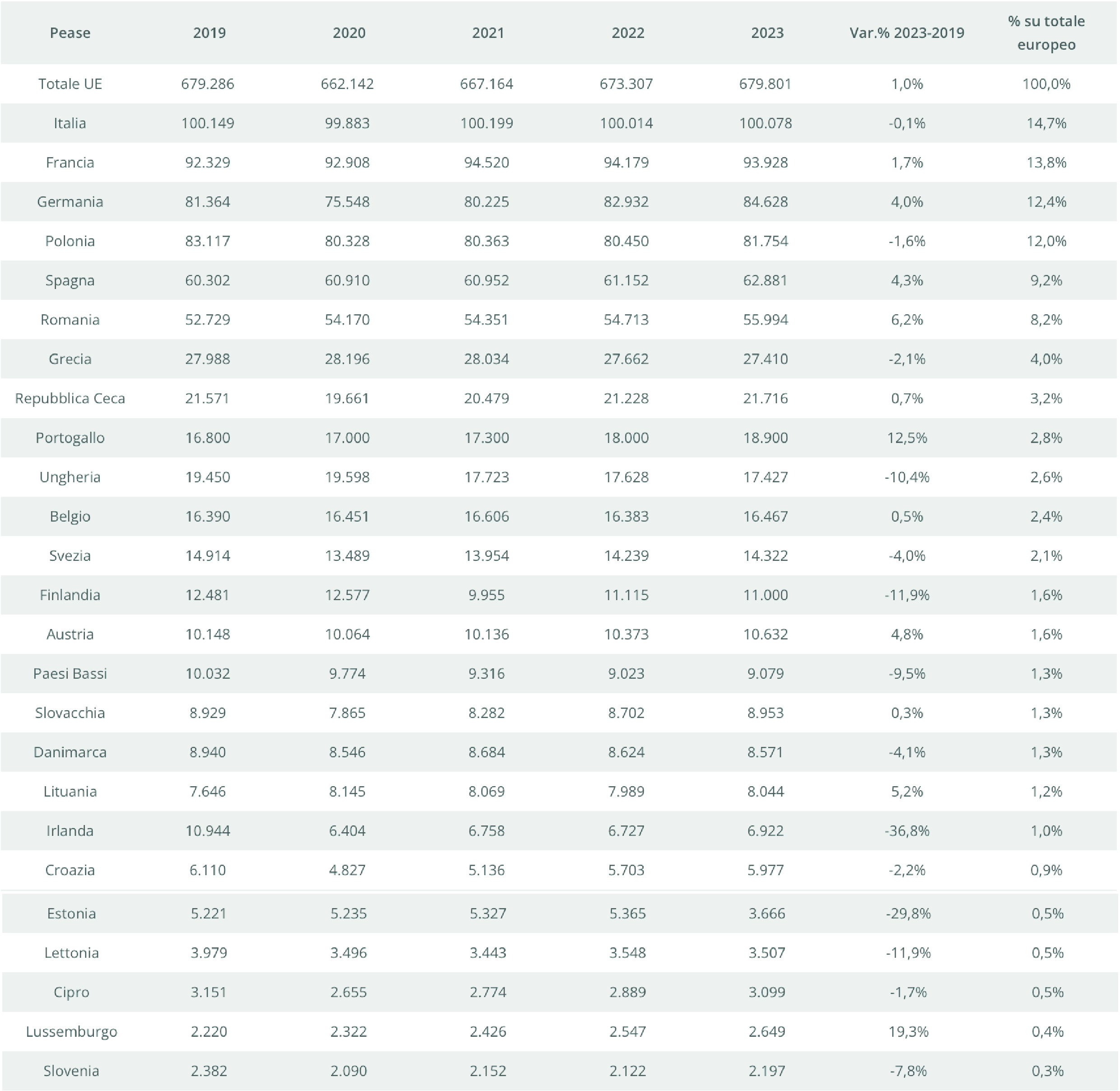
According to the latest ACEA report — Vehicles on European Roads, published in January 2025 — the total number of buses circulating in Europe in 2019 was 679,286, which dropped to 662,142 in 2020 (−2.5%). In 2021, the figure rose to 667,164, followed by another increase in 2022 to 673,307, and finally reaching 679,801 in 2023. The overall variation between 2019 and 2023 is +1.0%.
In 2023, Italy recorded the highest number of circulating buses among European countries, with 100,078 units, representing 14.7% of the European Union total. It was followed by France with 93,928 (13.8%), Germany with 84,628 (12.4%), and Poland with 81,754 (12.0%). Spain had 62,881 buses, equivalent to 9.2% of the EU total.
Among the countries with the lowest values in 2023 are Luxembourg, with 2,649 (0.4%), Slovenia, with 2,197 (0.3%), Cyprus, with 3,099 (0.5%), and Estonia, with 3,666 (0.5%).
Some countries recorded an increase in buses compared to 2019:
- Luxembourg: from 2,220 to 2,649 (+19.3%)
- Portugal: from 16,800 to 18,900 (+12.5%)
- Romania: from 52,729 to 55,994 (+6.2%)
- Lithuania: from 7,646 to 8,044 (+5.2%)
- Spain: from 60,302 to 62,881 (+4.3%)
- the Austria from 10.148 to 10.632 (+4,8%)
Other countries saw a decrease compared to 2019:
- the Irlanda è passata da 10.944 to 6.922 (-36,8%)
- the Estonia from 5.221 to 3.666 (-29,8%)
- Finland: from 12,481 to 11,000 (−11.9%)
- Latvia: from 3,979 to 3,507 (−11.9%)
- the Ungheria from 19.450 to 17.427 (-10,4%)
- Netherlands: from 10,032 to 9,079 (−9.5%)
The Italy è rimasta stabile rispetto al 2019, con una variazione del -0,1%.
Buses per Capita
Elaborazione Basco&T Consulting su dati ACEA ed EUROSTAT
NOTA: dati di Malta e Bulgaria non disponibili
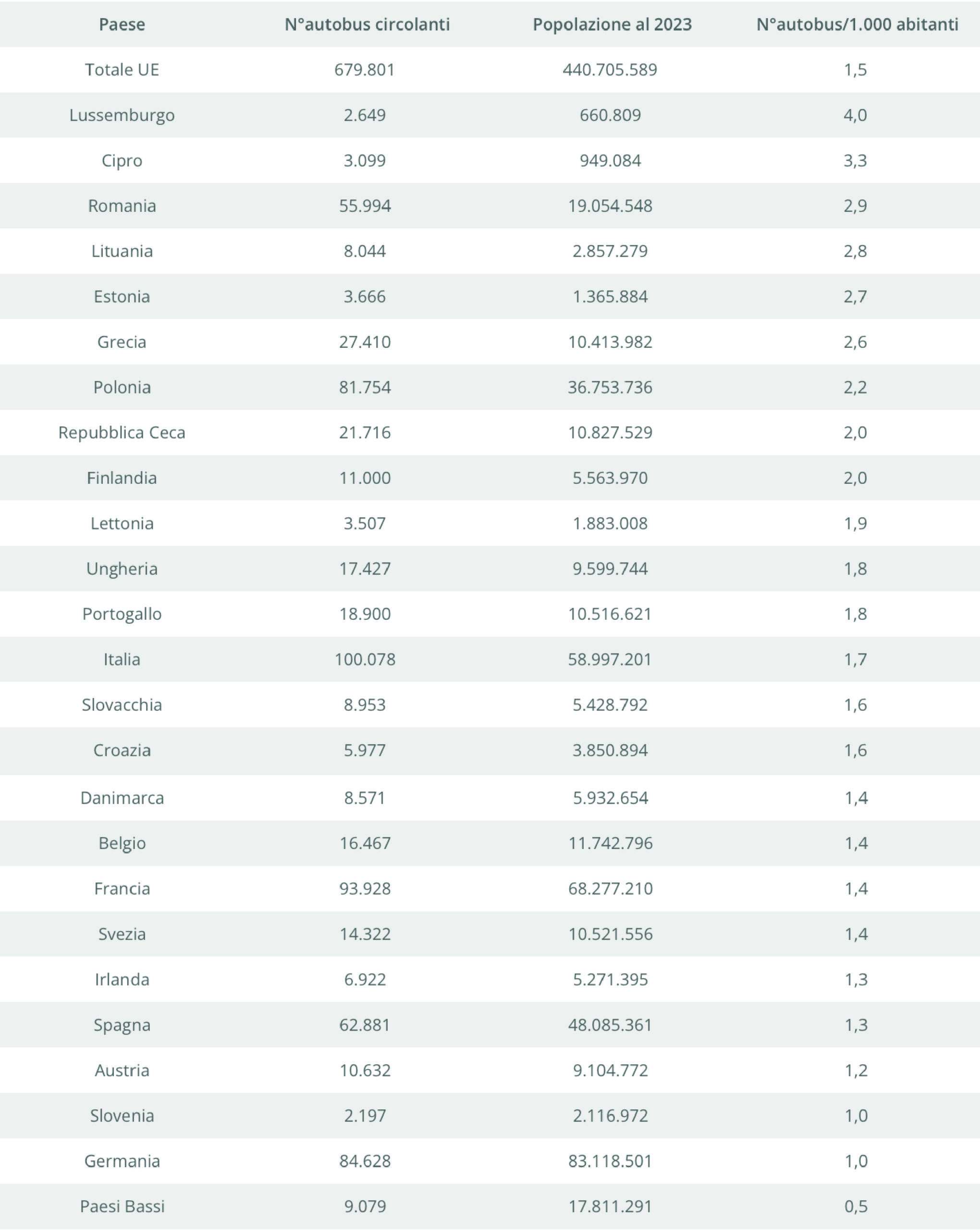
The number of buses in operation per 1,000 inhabitants in each European Union country is an indicator that allows for comparisons of the prevalence of road-based public transport across Member States. It provides an overview of the availability of collective transport vehicles relative to the population.
At the top of the ranking is Luxembourg, with 4 buses per 1,000 inhabitants, standing out clearly from other European countries. Cyprus also records a high value, with 3.3 buses per 1,000 inhabitants, followed by Romania, which reports 2.9 buses per 1,000 inhabitants.
Some Eastern European countries, such as Lithuania (2.8) and Estonia (2.7), also show a strong bus presence relative to population size. Greece (2.6) and Poland (2.2) remain above the European average.
Countries with Medium-Level Bus Availability
Several countries are around the EU average of 1.5 buses per 1,000 inhabitants:
- Czech Republic and Finland both report 2.0 buses per 1,000 inhabitants
- Latvia (1.9), Hungary, and Portugal (1.8) show slightly above-average values
- The Italy, with 1,7, si trova in una posizione intermedia, mostrando una diffusione superiore rispetto alla media ponderata europea ma comunque inferiore ad alcuni paesi occidentali.
Below Italy, we find several Central and Northern European countries:
- Slovakia and Croatia: 1.6 buses per 1,000 inhabitants
- Denmark, Belgium, France, and Sweden: 1.4
Even lower are Ireland and Spain (1.3), followed by Austria (1.2) and Slovenia (1.0). Germany, with 1.0 bus per 1,000 inhabitants, ranks among the countries with the lowest bus density relative to population. The lowest value overall is recorded in the Netherlands, where only 0.5 buses operate per 1,000 inhabitants.
Number of buses per km²
Elaborazione Basco&T Consulting su dati ACEA e EUROSTAT
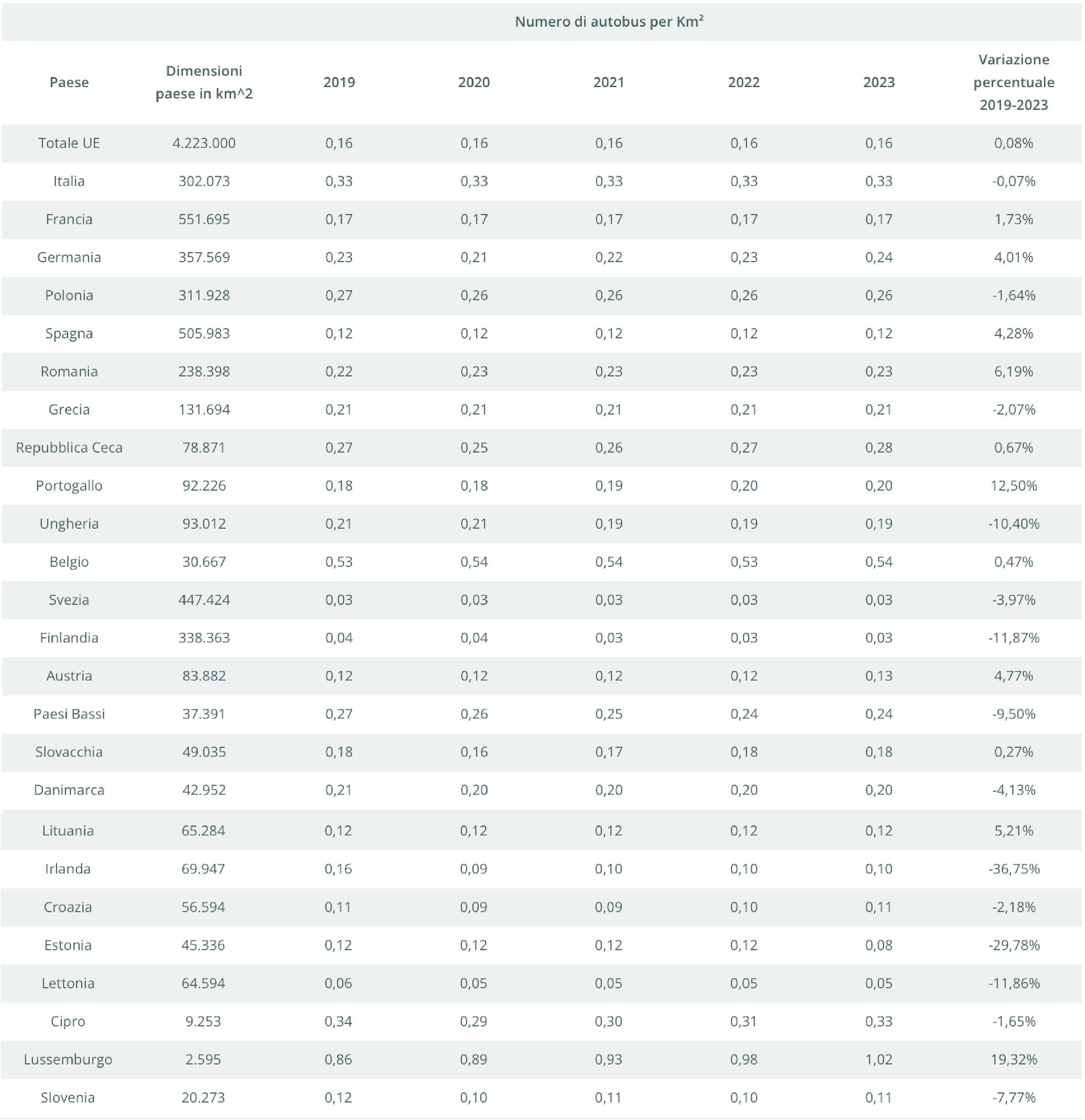
The following analysis provides an overview of the density of road-based public transport services, measured as the number of buses per square kilometre (km²), across various European Union countries and for the EU as a whole, covering the five-year period from 2019 to 2023. This indicator allows for comparisons of the spread of public bus services among Member States, offering a snapshot of the availability of collective transport vehicles in relation to a country’s size. A higher value indicates broader territorial coverage and, potentially, greater service accessibility.
National Variations and Overall Trends
The data analysis reveals a heterogeneous and dynamic picture of bus density within the European Union.
General EU Trend
Overall, the European Union demonstrated notable resilience in maintaining the density of its bus services. Starting from 0.16 buses per km² in 2019, there was a slight decrease of −1.45% in 2020, a year heavily affected by the COVID-19 pandemic and mobility restrictions. However, recovery was steady, and pre-pandemic levels were regained by 2023.
Italy’s Trend
Italy consistently ranks among the countries with a significantly higher bus density than the European average, surpassed only by Belgium (0.54) and Luxembourg (1.02) in 2023. It is important to note that both of these countries are characterized by very small land areas (Luxembourg with 2,586 km² and Belgium with 30,667 km²), which naturally contributes to a higher density of transport networks. In 2019, Italy registered 0.33 buses per km², a figure that remained very stable throughout the period, with only minor fluctuations. In 2020, there was a very slight decrease, but values remained virtually unchanged in the two following years, resulting in a minimal overall decrease of −0.06% over the five-year period.
Countries with the Largest Variations (2019–2023)
To identify the most significant changes, we examined the differences between the highest and lowest values recorded in each country between 2019 and 2023.
Increases (Most Significant Growth)
The country that showed the largest upward change was Luxembourg. Its bus density per km2 increased from 0.86 in 2019 to 1.02 in 2023, registering a remarkable growth of about +0.16 (+19.3%). It is followed by Portugal, which experienced steady growth with a marked acceleration after the pandemic, growing from 0.18 in 2019 to 0.20 (+12.5%) in 2023.
Decreases (Most Significant Declines)
On the opposite side, the country with the largest and most significant negative change is Estonia. Its density decreased dramatically from 0.12 in 2019 to 0.08 in 2023, with a sharp decline of -0.04 (- 42.39%) in the last year. Ireland also experienced a noticeable decline, from 0.16 in 2019 to 0.09 in 2020 (- 41.47%), and then recovered to 0.10 in 2023 (+ 8%) with an overall decrease of about -0.06 (- 36.8%).
Minor Variations
Countries showing stable or minor variations between 2019 and 2023 include: Countries such as France (+ 1.73 %), Poland (-1.64 %), the Czech Republic (+ 0.67 %), Belgium (+ 0.47 %) and Slovakia (+ 0.27 %) remain constant, or affected by small changes between 2019 and 2023.
National Recovery and Resilience Plans (PNRR)
The analysis of bus network density can be further enriched by considering the role of public policy, in particular the investments planned under the National Recovery and Resilience Plans (PNRR), financed by the Next Generation EU program.
The European Union allocated over €723 billion in grants and loans to support post-pandemic recovery and promote the green and digital transitions. A significant portion of these funds was directed toward the transport sector, including efforts to modernize local public transport systems.
In the case of Italy, the PNRR allocated substantial resources to the sector:
- €3.6 billion for the development of rapid mass transit systems (metro, tram, trolleybus)
- €1.3 billion for the purchase of low- or zero-emission buses in metropolitan areas and major cities
- €836 million for improvements to regional railways
- €175 million through REACT-EU for the renewal of around 437 buses in Southern Italian regions
These investments aim not only to reduce emissions but also to increase the efficiency and accessibility of public transport services. However, as observed in Italy’s case, bus density remained largely stable during the five-year period, suggesting that at least initially, the funds were mainly allocated to replacing outdated vehicles rather than expanding the number of buses. It is therefore likely that the most visible effects in terms of network density will emerge in the coming years as project implementation reaches full scale. Nonetheless, Italy remains one of the countries with the most densely developed and stable bus networks, an indicator of a well-established and territorially extensive service. In other countries with positive trends, such as Luxembourg and Portugal, it is also plausible that targeted public policies and access to EU funds have supported the expansion of services, even though detailed data on the individual national plans is not always available.
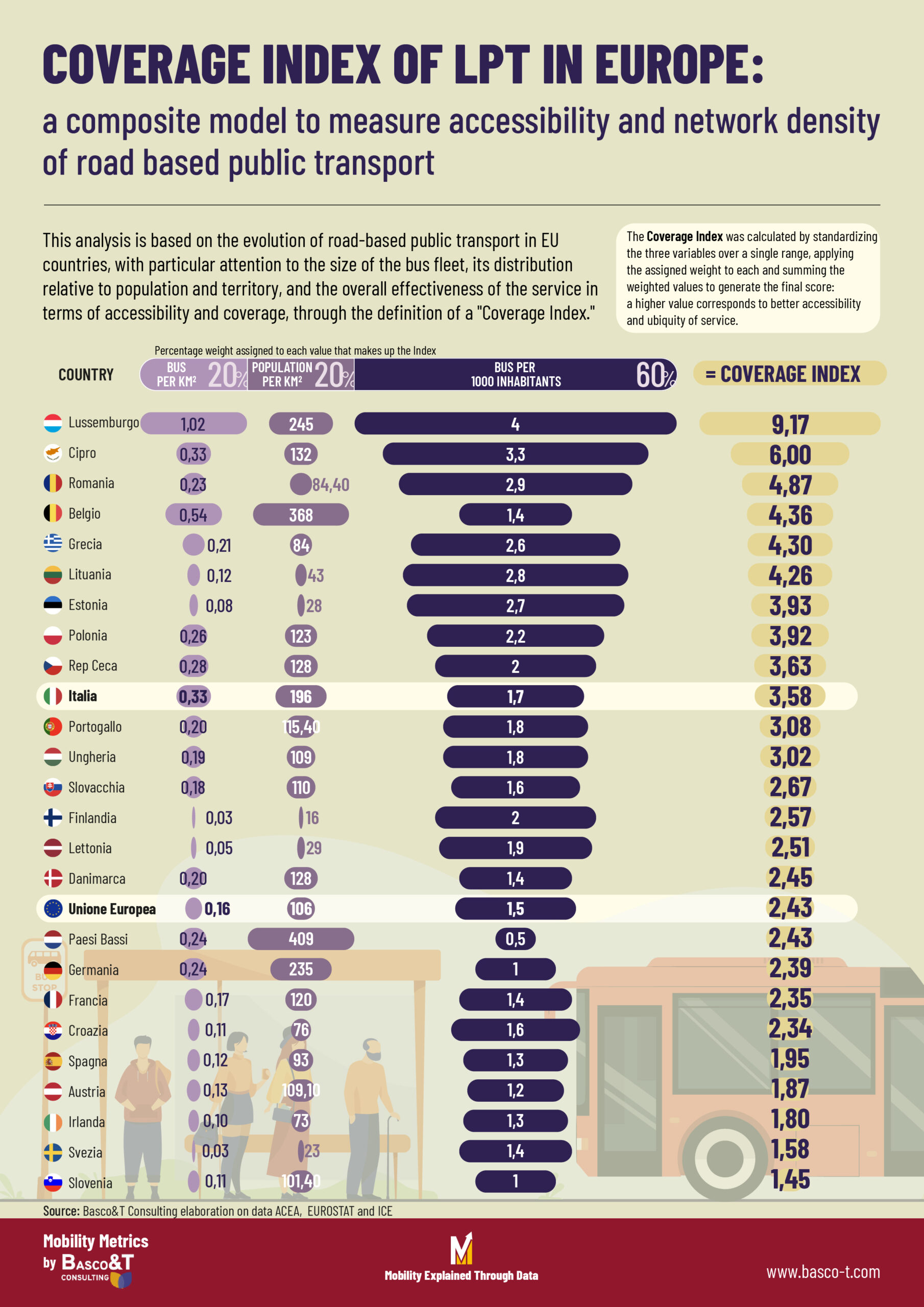
Covering index
Elaborazione Basco&T Consulting su dati ACEA, EUROSTAT e ICE
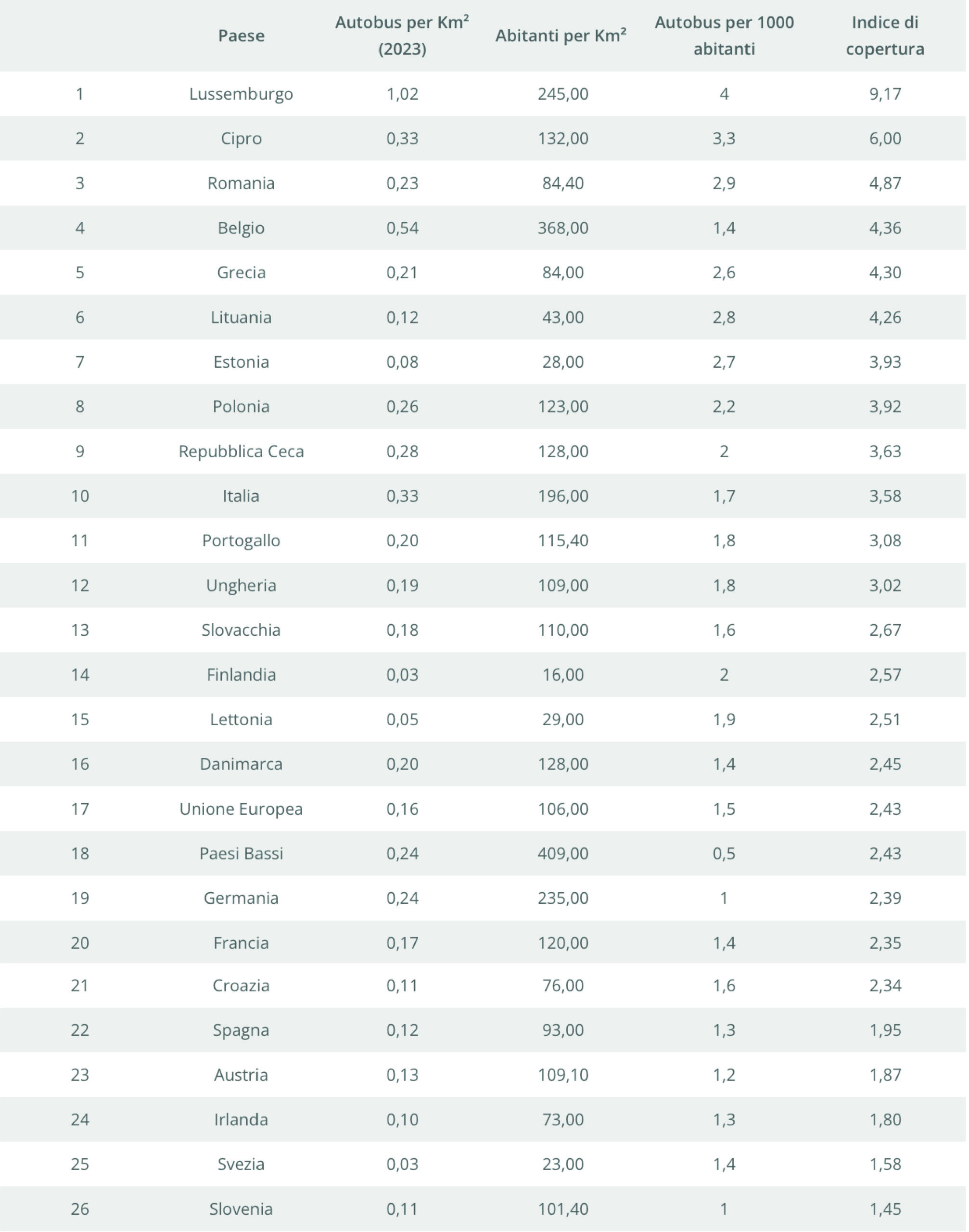
This analysis constitutes a statistical investigation aimed at creating a "Coverage Index", developed on the basis of the previously examined data.
This composite index was constructed by combining three key variables: population density, number of buses per km², number of buses per 1,000 inhabitants. These variables were standardized to a common scale, and each was assigned a specific weight — 20%, 20%, and 60%, respectively — reflecting the importance attributed to each factor. A higher index score corresponds to better accessibility, both in terms of geographic coverage and per capita availability of local public transport (LPT) in a given country. The data analysis revealed significant heterogeneity in the performance of bus services across EU Member States. At the top of the ranking are Luxembourg (9.17), Cyprus (6.00), and Romania (4.87), indicating that these countries offer particularly effective and well-integrated road-based public transport systems. This likely results from a combination of factors such as small territorial size and/or a high number of buses per inhabitant, which allow for greater concentration and network density. At the lower end of the scale are Ireland (1.80), Sweden (1.58), and Slovenia (1.45), whose scores suggest limited territorial and per capita coverage. This disparity is further highlighted by the comparison between the average index value (3.26) and the median value (2.67), represented by Slovakia. Italy, for its part, ranks 10th with a score of 3.58. This places it significantly above both the average and median values across EU countries, as well as well above the EU weighted average of 2.43. This suggests that Italy performs better than the European average in terms of bus service coverage. The fact that the mean exceeds the median indicates a skewed distribution, with some countries (such as Luxembourg) achieving exceptionally high scores that raise the overall average. This highlights that the index calculation method — with its assigned weights — tends to reward countries that successfully combine a high availability of buses per inhabitant with strong geographic coverage and/or concentrated population distribution. Discrepancy Between Arithmetic and Weighted Averages The apparent difference between the average score of European countries (3.26) and that of the European Union as an entity (2.43) — which ranks 17th overall — can be explained by the methodology used to construct the index. The Coverage Index was developed through the standardization of three variables (buses per km², inhabitants per km², buses per 1,000 inhabitants) and subsequent weighting (20%-20%-60%) to emphasize the importance of bus availability per resident. However, the EU as a whole is not simply the arithmetic mean of the individual countries, but rather an aggregated entity, heavily influenced by high-population, low-coverage countries such as Germany, France, and Spain. This causes its standardized scores to be lower than the average of Member States, resulting in a final score below the simple average. As such, the EU’s position reflects a weighted aggregate reality, rather than a uniform statistical average across countries — providing a more realistic picture of the European situation as a whole. The analysis presented highlights significant disparities in the availability, territorial density, and accessibility of road-based public transport across European Union countries. Through the construction of the Coverage Index—which integrates three key dimensions (buses per km², buses per 1,000 inhabitants, and population density)—it was possible to evaluate the overall performance of national bus systems in a concise and comparative manner.
Countries such as Luxembourg, Cyprus, and Romania stand out for the density and efficiency of their networks, benefiting from a combination of compact territory and a strong per capita bus supply. On the opposite end of the spectrum, Ireland, Sweden, and Slovenia show significantly lower levels of coverage compared to the European average. Italy, with a score of 3.58, ranks well above both the EU average (3.26) and the EU-wide weighted index (2.43), confirming a stable and relatively extensive network.
The stability of Italy’s bus density over the 2019–2023 period, despite the investments outlined in the National Recovery and Resilience Plan (PNRR), suggests that resources have so far been primarily allocated to fleet renewal, rather than to quantitative expansion. However, the structural effects of these investments are likely to emerge in the medium term, potentially leading to further improvements in local public transport accessibility.
Finally, the discrepancy between the arithmetic mean and the weighted average underscores the importance of interpreting EU-wide data in light of national demographic and geographic differences. The effectiveness of public transport systems depends not only on the absolute number of vehicles, but on the ability of the system to provide equitable and widespread service across the population.